Traffic is stopped bumper-to-bumper. Should you ride on the line between lanes to get ahead?
Ontario M1 overview
Ontario M1 Practice Test 8
30 questions on lane position, m1, m2 and m licensing, regulatory signs, mounting, starting and shifting, traffic lights and pedestrian signals and more.
- No sign-up
- Every answer explained
- Independent · not a government site
- Set 8 of 12
- 30 questions
- Instant feedback
0/30
All 30 questions in this test
Every question and its answer choices. The correct answers and explanations appear when you take the test above.
Traffic is stopped bumper-to-bumper. Should you ride on the line between lanes to get ahead?
- Yes, but only on freeways
- Only if your bike is small
- No, lane splitting is extremely dangerous
- Yes, if you go slower than 20 km/h
Sunrise is at 6:00 a.m. As an M1 rider, what is the earliest you may start riding?
- 5:00 a.m.
- 6:00 a.m.
- 6:30 a.m.
- 5:30 a.m.
You ride into an area marked by this sign. Why does it matter?
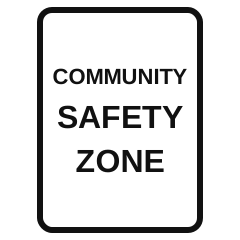
- Using your horn is not allowed
- Fines for traffic offences are higher there
- Motorcycles are banned during school hours
- The speed limit is always 30 km/h
You park on the kickstand. Which way do you lean the motorcycle?
- To the right
- Forward
- To the left
- Straight up
The signal heads at an intersection are completely dark after a storm knocked out power. What rule applies?
- Treat it like a green light
- Nobody has to stop
- Treat it like an all-way stop
- Treat it like a yield sign
You ride with a group of scooters that cannot keep the posted speed. How should you ride?
- Single file, close to the right edge if needed
- Staggered, with the leader in the left tire track
- Spread out across both lanes
- Side by side to stay visible
You must brake on a slippery road. Which brakes should you use?
- Neither; downshift only
- The front brake alone
- Both brakes together
- The rear brake alone
What is the only sure way to see a vehicle behind you in the next lane?
- Check your left mirror twice
- Check over your shoulder
- Watch for its headlight glare
- Listen for its engine
When should you shift up to a higher gear?
- Whenever you start to lean the bike into a sharp turn
- When the engine is turning too fast for your speed
- When the engine is turning too slowly
- Right before you come to a stop
Where is the rear brake control on most motorcycles?
- On the right handlebar
- Near the left footrest
- On the left handlebar
- Near the right footrest
You face a flashing green light. What may you do?
- Only go straight, after yielding to the left
- Turn left, go straight or turn right from the proper lane
- Stop, because the signal is not working
- Only turn left, because oncoming traffic has green
Which insurance covers damage to your own motorcycle and is not required by law?
- Collision insurance
- Uninsured motorist coverage
- Accident benefits coverage
- Third-party liability
Where should you look as you ride through a turn?
- In your mirrors
- Down at your front wheel
- Well ahead, through the turn
- At the centre line beside you
You are holding a steady lean in a curve. What happens if you add throttle?
- Nothing changes in the curve
- The bike leans over further
- The bike turns in more tightly
- The bike runs in a wider curve
When you stop behind another vehicle, about how much space should you leave?
- About a half metre
- Just enough to see its bumper
- About four car lengths
- About one motorcycle length
You are parked at the side of the road and want to rejoin traffic. How should you position your motorcycle?
- Pointed straight across the road
- Behind the nearest parked car
- Angled across the road so you can see both ways
- Parallel to the curb, facing forward in the lane
Where do most collisions between motorcycles and other vehicles happen?
- On freeways
- At intersections
- On rural curves
- In parking lots
A car is tailgating you and does not pass after you change lanes. What should you do?
- Brake sharply to warn the driver
- Speed up to get away from it
- Ride on the paved shoulder until it goes past you
- Increase your space in front, then let it pass
A curve sign carries a small tab with a number on it. What does that number give you?

- The speed limit for the whole road
- The top safe speed for that curve
- The lowest speed allowed in the curve
- The distance to the curve in metres
You see this sign in a work zone. What should you do?
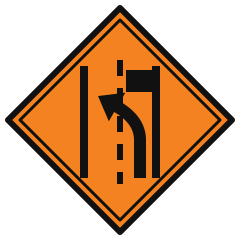
- Use the closed lane if it looks clear
- Merge into the open lane shown by the arrow
- Ride on the shoulder past the closure
- Stop until a worker waves you through
During hard braking a wheel locks. You release that brake briefly, then reapply it just short of locking. What is this called?
- Engine braking
- Threshold braking
- Counter-steering
- Cadence pumping
Must you insure your motorcycle or moped in Ontario?
- Only if the bike is new
- Only if you ride on highways
- Yes, insurance is compulsory
- Only for motorcycles, not mopeds
What must you be ready to do when you see this sign?
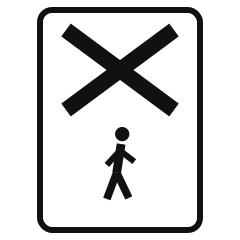
- Stop and yield to pedestrians
- Sound your horn to warn walkers
- Speed up to clear the crossing
- Yield only to children
Which choice of helmet and clothing makes you easiest for other drivers to see?
- Plain white with no reflectors
- Bright colours with reflective items
- Grey that matches the road
- Black or other dark colours
You hold an M2(M) licence. Which vehicle may you not drive?
- A motor tricycle
- A motorcycle with a sidecar
- A car under G1 conditions
- A two-wheeled motorcycle
Who should set the pace for a riding group?
- The rider at the back
- The fastest rider
- Whoever has the biggest bike
- The newest rider
An arrow sign like this is posted at a corner. What does it tell you about that street?

- The street ends just ahead
- You must turn right at the corner
- Traffic on it moves both ways
- All traffic on it moves the arrow's way
Your motorcycle has convex mirrors. What should you keep in mind?
- They show the road in front
- Vehicles look closer than they are
- They remove your blind spots
- Vehicles look farther away than they are
Why should you avoid riding through puddles?
- Puddles always mean black ice
- Riding through water is illegal
- Water cools the engine too quickly and can crack the cylinders
- They can hide potholes and make your brakes less effective
Your rear tire blows out at speed. What should you do?
- Accelerate gently to keep the bike stable until you stop
- Stay off the brake and close the throttle gradually
- Brake hard with both brakes
- Shift your weight far back
All Ontario M1 practice tests
- Ontario M1 Mock Exam 1 – 30 QuestionsUntimed practice · answers explained
- Ontario M1 Mock Exam 2 – 30 QuestionsUntimed practice · answers explained
- Ontario M1 Mock Exam 3 – 30 QuestionsUntimed practice · answers explained
- Ontario M1 Mock Exam 4 – 30 QuestionsUntimed practice · answers explained
- Ontario M1 Mock Exam 5 – 30 QuestionsUntimed practice · answers explained
- Regulatory signsStop, yield, school zone and railway crossbuck shapes, green-ring and red-slash signs, turn and lane controls, stopping, standing and parking zones, community safety zones and HOV lanes.
- Warning, construction and guide signsYellow diamond warning signs for curves, hills, lane endings, crossings and hazards, orange temporary condition signs in work zones, green guide and exit signs, and the slow-moving vehicle sign.
- Traffic lights and pedestrian signalsGreen, yellow and red lights, turns on red, advance green and turn arrows, flashing lights and beacons, blank signals during a power failure, transit priority signals and pedestrian walk signals.
- Pavement markingsYellow and white lines, solid and broken lines for passing, continuity lines, stop lines, crosswalks, lane arrows, pedestrian crossovers and markings around fixed objects.
- M1, M2 and M licensingWho needs a class M licence, the M1 and M2 conditions, minimum times at each level, licence expiry, safety courses, L and M conditions for mopeds, scooters and three-wheelers, and rules for visitors and new residents.
About this practice test
How many questions are in Ontario M1 practice test 8?
30 original multiple-choice practice questions covering lane position, m1, m2 and m licensing, regulatory signs, mounting, starting and shifting, traffic lights and pedestrian signals, group riding, passengers and cargo, road hazards, night and weather, controls and pre-ride check, insurance, registration and maintenance, turning, cornering and braking, space cushion and sharing the road, seeing, being seen and signalling, warning, construction and guide signs, emergencies, helmets and protective gear. Each answer includes an explanation. This mixed practice set does not reproduce the official exam format or predict an official score.
Are the questions the same every time?
Yes. Practice test 8 always has the same 30 questions, so you can repeat it until you get them all right. The other 11 sets use different questions.
Are these real test questions?
No. The official question bank is not published. These are original questions written from the official handbook, which is what the real Ontario M1 test is based on.