You had an argument and are very angry. Should you go for a ride to cool off?
Ontario M1 overview
Ontario M1 Practice Test 4
30 questions on alcohol, drugs and fatigue, freeway driving, helmets and protective gear, space cushion and sharing the road, mounting, starting and shifting and more.
- No sign-up
- Every answer explained
- Independent · not a government site
- Set 4 of 12
- 30 questions
- Instant feedback
0/30
All 30 questions in this test
Every question and its answer choices. The correct answers and explanations appear when you take the test above.
You had an argument and are very angry. Should you go for a ride to cool off?
- Yes, as long as you ride slowly and stay off the highway
- No, strong emotions reduce your ability to react
- Only if you avoid busy roads
- Yes, riding helps you calm down
Why should you stay clear of large vehicles on the freeway?
- They block your view and create strong air disturbance
- They are not allowed in the left lane
- Their drivers are required to yield to motorcycles in every lane
- They brake faster than motorcycles
Which type of helmet does the handbook say gives the best protection and the most comfort?
- A bicycle helmet
- An open-faced helmet
- A full-faced helmet
- A half helmet
Why should you leave extra space for vehicles around you, even though your bike stops quickly?
- The law requires five seconds for cars
- Motorcycles need more room to stop
- Other drivers may need much more space to stop
- Larger vehicles always stop faster
What is the purpose of the gears in a motorcycle transmission?
- To match engine speed with road speed
- To set the headlight angle
- To reduce tire wear on corners and curves
- To keep the brake light on
What does the handbook recommend you do with your knees while riding?
- Let them hang loosely to relax
- Hold them firmly against the gas tank
- Point them out in turns
- Keep them spread wide for balance
Your motorcycle has a manual fuel valve (petcock). What should you do with it when the bike is not in use?
- Leave it on reserve
- Leave it fully open so the engine starts
- Turn it off to avoid a fire hazard
- Remove it from the tank
Why is alcohol a bigger danger to riders at night?
- Helmet visors darken at night
- Night roads have no speed limits
- More drinking drivers are on the road
- Streetlights make alcohol stronger
A pedestrian is waiting at the corner while your signal shows a flashing green. May they start to cross?
- No, pedestrians may never cross there
- Yes, if no vehicles are turning
- Yes, flashing green means walk
- Only if a pedestrian signal tells them to
What can happen if you brake too hard while turning?
- The bike will stand straight up safely
- You may skid out of control
- Your signal will cancel
- Your engine will stall
According to the handbook, what is the most important accessory a motorcycle rider can have?
- A loud horn
- A windshield
- A helmet
- A tank bag
Which riders are not allowed to carry passengers?
- Riders with less than one year of experience
- M2 riders on weekdays
- M1 riders and anyone riding a moped
- Riders on three-wheeled motorcycles
Ahead, two painted lines bend around a bridge pier in the road. What are they telling you?
- Pedestrians cross the road here
- Park beside the pier
- Make a U-turn here
- Steer clear of the fixed object
When should you check your motorcycle's tire pressure?
- Only once a year
- When the tires are cold
- Right after a long ride
- Only when a tire looks low
You are stopped at a stop sign. What should you do with your foot on the brake?
- Take it off to rest your leg
- Pump it to flash the light at drivers behind
- Keep it on so the brake light shows
- Put it on the ground instead
A car pulls out and partly blocks your lane too close to stop. What is the key to swerving around it?
- Braking hard while you turn
- Turning the handlebars sharply away from it and sitting upright
- Putting a foot down to pivot
- Getting the motorcycle to lean quickly the way you want to go
You are on a multi-lane road. What does a white line between two lanes tell you?
- Both lanes carry traffic in the same direction
- You may never change lanes there
- The lane on the right is for buses only
- The lanes carry traffic in opposite directions
Why is the centre of the lane a poor place to ride?
- Drivers behind cannot see your plate or your brake light
- It is illegal for motorcycles
- It is too close to the curb
- Oil builds up there and it gets slippery when wet
What does Ontario's distracted driving law mean for a rider who texts on a hand-held phone while riding?
- A fine only if a crash occurs
- No penalty if stopped at a light
- A warning on the first offence
- A large fine and demerit points
Your scooter is slower than other traffic on a multi-lane road with a sign telling slow traffic to keep right. Where do you ride?
- In whichever lane is emptiest
- In the right-hand lane
- On the paved right shoulder
- In the left-hand lane
After buying a used motorcycle, how soon must you register as the new owner?
- Within 30 days of the sale
- Before the next licence renewal
- Within six days of the sale
- Within 36 days of the sale
You are stopping behind a large truck. Where should you stop?
- Beside its rear wheels on the right
- Where the driver can see you in the driver-side mirror
- As close to its rear bumper as you can, so others can't cut in
- Directly in its centre, out of view
You are riding past a row of parked cars. Which side of your lane is safest?
- Along the parked car doors
- The exact centre
- The left side
- The right side
What is the minimum time you must spend at Level Two without a ministry-approved safety course?
- 12 months
- 20 months
- 22 months
- 18 months
You take your Level One road test on a limited-speed motorcycle. What licence do you receive if you pass?
- An M2 with an L condition
- A G2 licence
- An M2 with an M condition
- A full M2 with no condition
Your steering suddenly feels heavy. Which tire has most likely gone flat?
- The front tire
- Neither; it is the chain
- The rear tire
- Both tires
When should you turn on your signal on a freeway entrance ramp?
- Only after you have merged
- Only when you reach the end of the ramp
- As soon as freeway traffic can see you
- Not at all; merging is obvious
What lies ahead when you pass this orange sign?
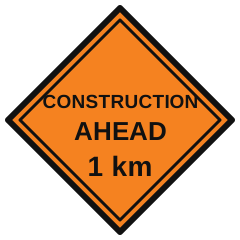
- Construction starting in one kilometre
- A lower speed limit in one kilometre
- Construction ending in one kilometre
- A road closure one kilometre long
Before you carry a passenger, what must your motorcycle have?
- A backrest and a top box
- A windshield and a pair of locking saddlebags
- A two-person seat and passenger footrests
- Highway pegs and a sidecar
You cannot avoid a patch of wet wooden planks or ice. What should you do?
- Speed up to get across faster
- Brake firmly while crossing it to keep your speed down
- Slow down before it and stay off the brakes on it
- Lean the bike to one side
All Ontario M1 practice tests
- Ontario M1 Mock Exam 1 – 30 QuestionsUntimed practice · answers explained
- Ontario M1 Mock Exam 2 – 30 QuestionsUntimed practice · answers explained
- Ontario M1 Mock Exam 3 – 30 QuestionsUntimed practice · answers explained
- Ontario M1 Mock Exam 4 – 30 QuestionsUntimed practice · answers explained
- Ontario M1 Mock Exam 5 – 30 QuestionsUntimed practice · answers explained
- Regulatory signsStop, yield, school zone and railway crossbuck shapes, green-ring and red-slash signs, turn and lane controls, stopping, standing and parking zones, community safety zones and HOV lanes.
- Warning, construction and guide signsYellow diamond warning signs for curves, hills, lane endings, crossings and hazards, orange temporary condition signs in work zones, green guide and exit signs, and the slow-moving vehicle sign.
- Traffic lights and pedestrian signalsGreen, yellow and red lights, turns on red, advance green and turn arrows, flashing lights and beacons, blank signals during a power failure, transit priority signals and pedestrian walk signals.
- Pavement markingsYellow and white lines, solid and broken lines for passing, continuity lines, stop lines, crosswalks, lane arrows, pedestrian crossovers and markings around fixed objects.
- M1, M2 and M licensingWho needs a class M licence, the M1 and M2 conditions, minimum times at each level, licence expiry, safety courses, L and M conditions for mopeds, scooters and three-wheelers, and rules for visitors and new residents.
About this practice test
How many questions are in Ontario M1 practice test 4?
30 original multiple-choice practice questions covering alcohol, drugs and fatigue, freeway driving, helmets and protective gear, space cushion and sharing the road, mounting, starting and shifting, controls and pre-ride check, road hazards, night and weather, traffic lights and pedestrian signals, turning, cornering and braking, group riding, passengers and cargo, pavement markings, seeing, being seen and signalling, emergencies, lane position, regulatory signs, insurance, registration and maintenance, m1, m2 and m licensing, warning, construction and guide signs. Each answer includes an explanation. This mixed practice set does not reproduce the official exam format or predict an official score.
Are the questions the same every time?
Yes. Practice test 4 always has the same 30 questions, so you can repeat it until you get them all right. The other 11 sets use different questions.
Are these real test questions?
No. The official question bank is not published. These are original questions written from the official handbook, which is what the real Ontario M1 test is based on.