When braking hard, how should you hold your motorcycle?
Ontario M1 overview
Ontario M1 Practice Test 9
30 questions on turning, cornering and braking, road hazards, night and weather, traffic lights and pedestrian signals, warning, construction and guide signs, insurance, registration and maintenance and more.
- No sign-up
- Every answer explained
- Independent · not a government site
- Set 9 of 12
- 30 questions
- Instant feedback
0/30
All 30 questions in this test
Every question and its answer choices. The correct answers and explanations appear when you take the test above.
When braking hard, how should you hold your motorcycle?
- Weaving side to side
- As upright as possible
- Leaned to the left
- Leaned to the right
Streetcar tracks run parallel to your path and you need to cross them. How should you do it?
- Edging across slowly while braking
- At a shallow angle of 10 to 15 degrees
- At an angle of at least 45 degrees
- Riding along between the rails first
A busy main road has an intersection pedestrian signal with push buttons. What controls the quieter side street?
- A crossing guard
- Stop signs
- Its own traffic lights
- Yield signs
Freeway exit numbers in Ontario are based on what?
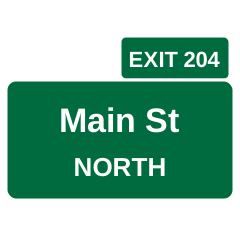
- Distance to the next large city
- The order the exits were built
- The freeway's posted speed limit
- Distance from where the freeway begins
You are selling your used motorcycle privately. What must you buy and give the buyer?
- A used-vehicle information package (UVIP)
- A new set of licence plates
- A safety standards certificate only
- A copy of your insurance card
You hold an M1 licence. Sunset today is at 8:30 p.m. What is the latest you may be riding?
- 9:00 p.m.
- 8:30 p.m.
- 9:30 p.m.
- 8:00 p.m.
Before slowing down where others may not expect it, how can you warn drivers behind you?
- Turn on your high beam
- Rev your engine loudly
- Tap the brake to flash your brake light
- Wave your left arm up and down beside the bike
You are passing a car on a multi-lane road. How should you handle its blind spot?
- Stay beside it until the driver signals you to pass
- Approach carefully, then get past quickly
- Slow down to match its speed
- Ride in it as long as you like
On a motorcycle with a clutch, how should you make an emergency stop?
- Apply only the rear brake as hard as you can to avoid a flip
- Apply only the front brake and lean
- Pull in the clutch and apply both brakes without locking
- Downshift quickly and avoid the brakes
When does the handbook say you are most likely to have someone try to share your lane?
- In heavy bumper-to-bumper traffic
- On an empty rural road
- When you are stopped at a railway crossing
- When you ride in the blocking position
You see this green-ringed sign on a northern road in winter. What does it allow?
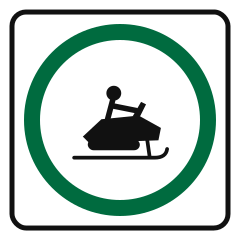
- Snowmobiles may park here only
- A snowmobile trail crosses ahead
- Snowmobile rentals are nearby
- Snowmobiles may travel on this road
What colour is the licence plate issued to limited-speed motorcycles?
- Yellow with black lettering
- Green with white lettering
- White with blue lettering
- Red with white lettering
You slow down by downshifting without touching the brakes. What problem does this create?
- The engine will stall right away
- Your brake light does not come on
- Your turn signal will cancel
- The front wheel will lock up
Why should you not pile cargo against a frame on the back of the seat?
- It blocks your mirrors
- It makes the seat too hot
- It hides your licence plate
- It upsets the bike's balance
While passing a truck, the air stream is pulling you toward it. What should you do?
- Lean away from the truck
- Brake hard to drop back
- Lean toward the truck
- Sit upright and hold still
Your light is red but shows a green arrow pointing left. What might drivers coming toward you be doing?
- Turning right on a red light
- Waiting with no signal at all
- Turning left at the same time as you
- Going straight on their own green
What must you always do before changing gears on a motorcycle with a clutch?
- Switch on your turn signal
- Turn off the throttle completely
- Apply the front brake
- Disengage the clutch
You will carry a passenger. What should you adjust while they sit on the seat?
- Mirrors and headlight
- The throttle cable
- The kickstand spring
- Only the handlebars
You rock your motorcycle forward off its centre stand. How do you stop it from rolling on?
- Put both feet down hard
- Apply the rear brake with your hand
- Drag your boot on the ground
- Apply the front brake
You are on a slow scooter, but the lane is too narrow for cars to pass you safely. What may you do?
- Use a blocking position in the lane
- Stop and wait for traffic to clear
- Ride on the sidewalk
- Ride on the line between lanes
You plan to slow down and turn, but the driver behind you does not seem to notice. What may be safer?
- Waving them past with your left arm
- Continuing straight instead of turning
- Turning sharply before they reach you
- Braking hard to get their attention
You count from when the car ahead passes a hydro pole. You reach the pole at 'one thousand and one'. What does that mean?
- You are following too closely
- You are following too far back
- You should speed up to keep pace
- You have a safe two-second gap
As an M1 rider, what must your blood-alcohol level be?
- Under 0.05
- Under 0.08
- Zero
- Under 0.02
At highway speed, your front wheel starts to wobble. What should you do?
- Grip firmly and close the throttle gradually
- Accelerate firmly to steady the front of the bike
- Fight the wobble with sharp steering
- Brake hard to stop quickly
How will you know if your motorcycle's chain breaks while riding?
- The steering becomes very heavy and hard to turn
- The headlight flickers and dims
- Lost rear-wheel power and a racing engine
- The front brake stops working
Which of these braking habits does the handbook say to never use?
- Braking before you enter a turn
- Relying only on gearing down to stop
- Applying both brakes together
- Gearing down as you slow
You must ride a long stretch of snow-covered road. Which snow gives better traction?
- Snow in the centre of the lane
- Loose or fresh snow
- Hard-packed snow
- Snow mixed with ice
According to the handbook, what may you need to do when you see this sign?

- Move to the left lane
- Shut off your engine
- Use a lower gear
- Turn on your high beams
You are stuck behind a slow car on a road with this sign. What does the sign mean?

- Pass only on the right shoulder
- Pass only if the car is under the limit
- Two lanes merge into one ahead
- Passing is not allowed on this road
At an intersection with separate left-turn lights, your arrow has ended and through traffic now has green. May you begin your left turn?
- Yes, once oncoming traffic has cleared
- Only if you are already past the stop line
- No, you must wait for the next left-turn arrow
- Yes, if you yield to pedestrians first
All Ontario M1 practice tests
- Ontario M1 Mock Exam 1 – 30 QuestionsUntimed practice · answers explained
- Ontario M1 Mock Exam 2 – 30 QuestionsUntimed practice · answers explained
- Ontario M1 Mock Exam 3 – 30 QuestionsUntimed practice · answers explained
- Ontario M1 Mock Exam 4 – 30 QuestionsUntimed practice · answers explained
- Ontario M1 Mock Exam 5 – 30 QuestionsUntimed practice · answers explained
- Regulatory signsStop, yield, school zone and railway crossbuck shapes, green-ring and red-slash signs, turn and lane controls, stopping, standing and parking zones, community safety zones and HOV lanes.
- Warning, construction and guide signsYellow diamond warning signs for curves, hills, lane endings, crossings and hazards, orange temporary condition signs in work zones, green guide and exit signs, and the slow-moving vehicle sign.
- Traffic lights and pedestrian signalsGreen, yellow and red lights, turns on red, advance green and turn arrows, flashing lights and beacons, blank signals during a power failure, transit priority signals and pedestrian walk signals.
- Pavement markingsYellow and white lines, solid and broken lines for passing, continuity lines, stop lines, crosswalks, lane arrows, pedestrian crossovers and markings around fixed objects.
- M1, M2 and M licensingWho needs a class M licence, the M1 and M2 conditions, minimum times at each level, licence expiry, safety courses, L and M conditions for mopeds, scooters and three-wheelers, and rules for visitors and new residents.
About this practice test
How many questions are in Ontario M1 practice test 9?
30 original multiple-choice practice questions covering turning, cornering and braking, road hazards, night and weather, traffic lights and pedestrian signals, warning, construction and guide signs, insurance, registration and maintenance, m1, m2 and m licensing, seeing, being seen and signalling, emergencies, lane position, regulatory signs, controls and pre-ride check, group riding, passengers and cargo, space cushion and sharing the road, mounting, starting and shifting. Each answer includes an explanation. This mixed practice set does not reproduce the official exam format or predict an official score.
Are the questions the same every time?
Yes. Practice test 9 always has the same 30 questions, so you can repeat it until you get them all right. The other 11 sets use different questions.
Are these real test questions?
No. The official question bank is not published. These are original questions written from the official handbook, which is what the real Ontario M1 test is based on.