When must a motorcycle's headlight and tail light be on?
Ontario M1 overview
Ontario M1 Practice Test 2
30 questions on controls and pre-ride check, alcohol, drugs and fatigue, insurance, registration and maintenance, freeway driving, lane position and more.
- No sign-up
- Every answer explained
- Independent · not a government site
- Set 2 of 12
- 30 questions
- Instant feedback
0/30
All 30 questions in this test
Every question and its answer choices. The correct answers and explanations appear when you take the test above.
When must a motorcycle's headlight and tail light be on?
- Only between sunset and sunrise
- At all times, day and night
- Only on highways over 80 km/h
- Only in rain, fog or snow
While riding, you start to feel dizzy and weak. What should you do?
- Keep riding but stay in the right lane
- Stop and wait until you feel normal
- Speed up to get home sooner
- Open your visor for fresh air
A police officer asks for your insurance card and you do not have it. What fine can you face?
- Up to $100
- Up to $5,000
- Up to $400
- Up to $1,000
Cruising on Highway 401, how often should you glance at your mirrors?
- Only before exits
- Every minute
- Every five to 10 seconds
- Every 30 seconds
You turn left from the passing lane into the passing lane of the new road. Which tire track do you keep through the turn?
- The centre of the lane
- The left tire track
- The right tire track
- Switch tracks halfway through
A new resident from the United States has ridden motorcycles for two of the last three years. What can they get?
- A full M licence without knowledge or road tests
- An M2 licence after a road test
- An M1 licence after passing a written knowledge test
- A 60-day temporary permit only
A stone kicked up by a truck cracks your face shield. What should you do?
- Lift the shield at once while riding so you can see
- Brake hard and stop in your lane
- Keep control, then pull off when safe to fix it
- Take a hand off to wipe the shield
Someone is using a pedestrian crossover in front of you. How long must you stay stopped?
- Only until they make eye contact
- Until they reach the middle of the road
- Until they have completely crossed the road
- Until they pass the centre of your lane
You are in a left turn and want to straighten up. What do you do?
- Push the right handlebar and close the throttle
- Push the right handlebar and add throttle
- Push the left handlebar and brake
- Pull the left handlebar and brake
A staggered group wants to pass a slow car. How should they do it?
- Two riders at a time
- All riders together
- Only the leader passes
- One rider at a time
A car ahead of you is stopped, waiting to turn left. Under what condition may you pass it on the right shoulder?
- Only if the shoulder is paved
- Only if the shoulder is gravel
- Only after signalling for five seconds
- Never; shoulders are off-limits
How long should you keep your eyes on any one spot while scanning?
- No more than five seconds
- No more than two seconds
- As long as it takes
- No more than ten seconds
The truck on this sign is drawn on the right side. What does that tell you?
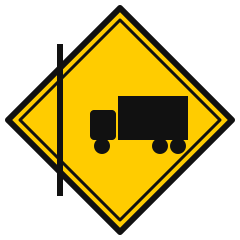
- Trucks must keep to the right lane
- Trucks are not allowed on the left
- Truck parking is on the right
- The truck entrance is on the right
Why may Level One (M1) riders not ride at night?
- Because of their inexperience
- Because motorcycle headlights are dim
- Because night roads are closed to them
- Because insurance does not cover it
An oncoming vehicle is about to pass you on a two-lane road. Where should you move in your lane?
- Toward the centre line
- Wherever you are already riding
- Toward the centre of your lane
- Onto the right shoulder
When should you slow down for a turn?
- As you come out of the turn
- In the middle of the turn
- Only if the turn is very sharp
- Before you enter the turn
A round signal above the traffic light shows a white vertical bar. What does it mean?
- Pedestrians may start to cross
- Bicycles may cross the intersection before other traffic
- Transit vehicles may proceed while others face red
- Emergency vehicles are approaching
Your Level One road test was part of an approved safety course. How long is the course certificate valid?
- One year
- 60 days
- 90 days
- Six months
On a cold-weather ride, what does the handbook call probably your greatest danger?
- Fatigue brought on by the cold
- Lower fuel economy
- A dead battery after short stops
- Too much tire grip
Your motorcycle is on its kickstand. From which side should you get on?
- Either side
- The left side
- The right side
- From behind the bike
A decorative frame partly covers your licence plate. Is that allowed?
- Yes, if the numbers can be read
- No, the entire plate must be visible
- Yes, on a motorcycle only
- Only during the winter
You face this sign where your road joins a busy street. What does it require?

- Merge at your current speed without looking
- Let traffic in or near the intersection go first
- Go first, because you have the right-of-way
- Stop every time, even if the street is empty
You are first in the left-turn lane and the green arrow turns to a yellow arrow before you move. What now?
- Turn as long as nobody is coming
- Hurry through before the red
- Back up to clear the intersection
- Hold back, and stop if you safely can
You took an allergy pill this morning. What should you do before riding?
- Ride, but only on quiet streets
- Ride, since it is not a prescription
- Know how the drug affects you first
- Drink coffee to cancel its effects
What does this sign warn you about?

- A sharp curve to the right
- The pavement is slippery when wet
- Loose gravel on the shoulder
- A car wash entrance ahead
A car is waiting to pull out of a side street on your right. Which way should you move in your lane?
- To the left, away from it
- Onto the right shoulder
- To the right, closer to it
- To the exact centre of the lane
Why can freeway entrance ramps be especially difficult on a motorcycle?
- Ramps have lower speed limits for motorcycles
- Ramps are always uphill
- Motorcycles are not allowed to signal on ramps
- Tight turns and slippery surfaces slow you down
You are stopped at the roadside and need help. What signal do riders recognize?
- Your seat turned sideways
- A jacket hung on the left mirror, facing traffic
- Your kickstand left up
- A helmet placed on the ground near the road
Who is covered by the exemption to Ontario's mandatory motorcycle helmet law?
- Passengers riding in a sidecar
- Sikh riders who meet the Highway Traffic Act requirements
- Riders on roads posted at 50 km/h or less during daylight hours
- Riders with a full M licence
What should you do when you see this X-shaped sign ahead?

- Stop only if a train is already in view
- Slow down, look both ways and be ready to stop
- Speed up so you spend less time on the tracks
- Keep going unless a gate has come down
All Ontario M1 practice tests
- Ontario M1 Mock Exam 1 – 30 QuestionsUntimed practice · answers explained
- Ontario M1 Mock Exam 2 – 30 QuestionsUntimed practice · answers explained
- Ontario M1 Mock Exam 3 – 30 QuestionsUntimed practice · answers explained
- Ontario M1 Mock Exam 4 – 30 QuestionsUntimed practice · answers explained
- Ontario M1 Mock Exam 5 – 30 QuestionsUntimed practice · answers explained
- Regulatory signsStop, yield, school zone and railway crossbuck shapes, green-ring and red-slash signs, turn and lane controls, stopping, standing and parking zones, community safety zones and HOV lanes.
- Warning, construction and guide signsYellow diamond warning signs for curves, hills, lane endings, crossings and hazards, orange temporary condition signs in work zones, green guide and exit signs, and the slow-moving vehicle sign.
- Traffic lights and pedestrian signalsGreen, yellow and red lights, turns on red, advance green and turn arrows, flashing lights and beacons, blank signals during a power failure, transit priority signals and pedestrian walk signals.
- Pavement markingsYellow and white lines, solid and broken lines for passing, continuity lines, stop lines, crosswalks, lane arrows, pedestrian crossovers and markings around fixed objects.
- M1, M2 and M licensingWho needs a class M licence, the M1 and M2 conditions, minimum times at each level, licence expiry, safety courses, L and M conditions for mopeds, scooters and three-wheelers, and rules for visitors and new residents.
About this practice test
How many questions are in Ontario M1 practice test 2?
30 original multiple-choice practice questions covering controls and pre-ride check, alcohol, drugs and fatigue, insurance, registration and maintenance, freeway driving, lane position, m1, m2 and m licensing, emergencies, pavement markings, turning, cornering and braking, group riding, passengers and cargo, seeing, being seen and signalling, warning, construction and guide signs, road hazards, night and weather, space cushion and sharing the road, traffic lights and pedestrian signals, mounting, starting and shifting, regulatory signs, helmets and protective gear. Each answer includes an explanation. This mixed practice set does not reproduce the official exam format or predict an official score.
Are the questions the same every time?
Yes. Practice test 2 always has the same 30 questions, so you can repeat it until you get them all right. The other 11 sets use different questions.
Are these real test questions?
No. The official question bank is not published. These are original questions written from the official handbook, which is what the real Ontario M1 test is based on.