M1 test questions: 50 printable practice questions with answers
50 original Ontario M1 practice questions on one printable sheet, with a separate answer key, an explanation and the handbook chapter for every answer. Print it or save it as a PDF. Free; not the official test.
- No sign-up
- Every answer explained
- Independent · not a government site
- 50 questions
- Answer key included
- Free, no sign-up
This page puts 50 original practice questions for the Ontario M1 Motorcycle Knowledge Test on one sheet you can print or save as a PDF. They are drawn evenly from our 18 topics (regulatory signs, warning, construction and guide signs, traffic lights and pedestrian signals, pavement markings, m1, m2 and m licensing, helmets and protective gear, alcohol, drugs and fatigue and controls and pre-ride check, among others), so one sitting covers the whole test, not just the easy chapters.
The answer key starts on a new page after the last question. Each answer has a short explanation and the chapter of the Official MTO Motorcycle Handbook it comes from, so you can check the rule in the official source instead of memorising our wording. These are not the official test questions: the Ontario Ministry of Transportation (MTO) does not publish its question bank. When the sheet feels easy, sit a timed mock exam of 30 questions (you need 24 correct to pass our mock).
M1 test questions: 50 printable practice questions with answers
1.You park on the kickstand. Which way do you lean the motorcycle?
- To the right
- Forward
- To the left
- Straight up
2.You have a green light and the hand symbol appears while someone is halfway across. Who has the right-of-way?
- Whoever reached the crosswalk first, pedestrian or vehicle
- The pedestrian, until they reach a safe area
- You, once the hand symbol is steady
- You, because your light is green
3.When should you turn on your signal on a freeway entrance ramp?
- Only after you have merged
- Only when you reach the end of the ramp
- As soon as freeway traffic can see you
- Not at all; merging is obvious
4.An oncoming vehicle is about to pass you on a two-lane road. Where should you move in your lane?
- Toward the centre line
- Wherever you are already riding
- Toward the centre of your lane
- Onto the right shoulder
5.What should you do when you see this sign?

- Move onto the shoulder to avoid it
- Slow down and keep control of your bike
- Stop and walk your motorcycle across
- Speed up to get over it quickly
6.How does your lean change with the turn and your speed?
- Less lean as your speed goes up
- The same lean for every turn and speed
- More lean for sharper turns and higher speeds
- Lean away from the turn at higher speeds
7.What is the only sure way to see a vehicle behind you in the next lane?
- Check your left mirror twice
- Check over your shoulder
- Watch for its headlight glare
- Listen for its engine
8.How do you operate a motorcycle's shift lever?
- Pull it with your right hand
- Press it down with the toe of your right foot
- Lift or press it with your left foot
- Twist it with your left hand
9.What colour is the licence plate issued to limited-speed motorcycles?
- Yellow with black lettering
- Green with white lettering
- White with blue lettering
- Red with white lettering
10.Where do most collisions between motorcycles and other vehicles happen?
- On freeways
- At intersections
- On rural curves
- In parking lots
11.What does this sign mean?

- One-way road, enter slowly
- Stop and yield to oncoming traffic
- Road closed to motorcycles only
- Do not enter this road
12.Why should you never ride directly alongside another motorcycle?
- It confuses traffic lights
- It is too loud for other drivers and pedestrians nearby
- It uses more fuel
- You have nowhere to go if you must avoid something
13.Your engine starts to seize on a motorcycle with a clutch. What should you do?
- Squeeze the clutch, then pull off the road
- Open the throttle fully
- Turn off the lights
- Downshift quickly to slow the engine and the wheel
14.Which privilege do you gain when you move from M1 to M2?
- Riding at night and carrying passengers
- Riding with any blood-alcohol level
- Skipping the helmet on short trips
- Carrying passengers on a moped
15.You are buying a rain suit for riding. What does the handbook recommend?
- Any loose plastic poncho
- One piece and brightly coloured
- A long coat that covers your legs
- Two pieces in a dark colour
16.On a cold-weather ride, what does the handbook call probably your greatest danger?
- Fatigue brought on by the cold
- Lower fuel economy
- A dead battery after short stops
- Too much tire grip
17.Which riding skills does the handbook say alcohol can throw off?
- Only your night vision
- Only your reaction time to traffic lights and stop signs
- Only your ability to shift gears
- Balance, steering, speed control and judging distance
18.On a freeway, you see wide, closely spaced broken lines on the left side of your lane. What do they usually mean?
- The shoulder is starting
- Your lane continues unaffected
- Your lane is ending or exiting
- A passing lane is beginning
19.When is the best time to shift gears for a turn?
- Right after you brake in the turn
- Before you enter the turn
- In the middle of the turn
- As you lean the furthest
20.A single flashing yellow beacon hangs over a warning sign. What does it tell you?
- The road is closed ahead
- Drive with caution
- Yield to traffic from the right
- Stop before going on
21.You are in the curb lane approaching an entrance ramp where cars are merging. What should you do?
- Ride on the shoulder past the ramp
- Hold your speed and lane; merging cars must yield to you
- Speed up to block them from merging
- Adjust speed, or move over a lane, so they can merge
22.Why should you avoid riding directly beside another vehicle in the next lane?
- It makes your engine run hotter in the trapped exhaust air
- It makes your signals harder to use
- It could move into your lane and blocks your escape
- It is illegal on all roads
23.An intersection warning sign shows one thick arrow and one thinner line. What does the thick arrow show?
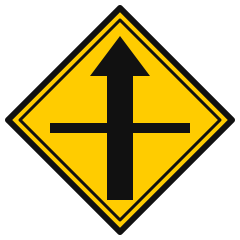
- That the road ends ahead
- The road you must turn onto
- That traffic merges from the side
- Which road has the right-of-way
24.You want to turn right. Using counter-steering, how do you start the turn?
- Push forward on the left handlebar
- Turn the handlebars sharply right
- Pull back on the right handlebar
- Push forward on the right handlebar
25.Why is the tire-track position also called the blocking position?
- It blocks the view of drivers behind you so they slow down
- It blocks your bike from rolling
- It blocks wind from hitting you
- It discourages others from squeezing past in your lane
26.How do you speed up using a motorcycle's throttle?
- Twist the right handgrip toward you
- Twist the left handgrip toward you
- Twist the right handgrip away from you
- Press the right foot lever down
27.What is the minimum tire tread depth the handbook gives for a motorcycle?
- 5 millimetres
- 1.5 millimetres
- 3 millimetres
- 0.5 millimetres
28.How long should you keep your eyes on any one spot while scanning?
- No more than five seconds
- No more than two seconds
- As long as it takes
- No more than ten seconds
29.Who may use a lane marked with this diamond sign?
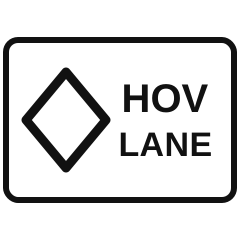
- Trucks over 4,500 kg
- Any vehicle with its lights on during off-peak hours
- Buses or vehicles with the set number of people
- Motorcycles and scooters only
30.On a long trip with cargo, what should you do each time you stop?
- Check that the load has not moved or come loose
- Let some air out of the tires
- Remove the load to rest the bike's suspension and tires
- Repack everything from scratch
31.What usually causes an engine to seize?
- Using the high beam
- Overheating or a lack of oil
- Riding in the rain
- Too much fuel in the tank
32.A new resident from the United States has ridden motorcycles for two of the last three years. What can they get?
- A full M licence without knowledge or road tests
- An M2 licence after a road test
- An M1 licence after passing a written knowledge test
- A 60-day temporary permit only
33.Which footwear is best for riding?
- Sandals with hard soles for a good grip
- Dress shoes with tall heels for leverage
- Sturdy boots covering the ankles, with short heels
- Running shoes with long laces for a snug fit
34.Crossing a very slippery surface on a motorcycle with gears, why should you pull in the clutch and coast?
- It lets the engine's heat warm up the rear tire
- It removes engine drag from the rear wheel
- It turns on your brake light
- It lowers the motorcycle's height
35.When can alcohol start to affect your ability to handle a motorcycle safely?
- Only once you pass the legal limit
- Only after three or more drinks
- At levels far below the legal limit
- Only when you feel drunk
36.How is a crosswalk usually marked at an intersection?
- Two parallel white lines across the road
- A large white X in each lane
- One solid yellow line across the road
- Broken white lines along the curb
37.Why should you keep your toes up while riding?
- So your boots stay dry in the rain
- So they do not catch between the road and footrest
- So you can drag them to slow down
- So you can reach the shift lever and rear brake faster
38.A pedestrian is waiting at the corner while your signal shows a flashing green. May they start to cross?
- No, pedestrians may never cross there
- Yes, if no vehicles are turning
- Yes, flashing green means walk
- Only if a pedestrian signal tells them to
39.Your freeway exit is coming up. At what point do you begin reducing speed?
- Before you move into the exit lane
- After you are fully in the exit lane
- As soon as you see the exit sign
- Only at the end of the ramp
40.You count from when the car ahead passes a hydro pole. You reach the pole at 'one thousand and one'. What does that mean?
- You are following too closely
- You are following too far back
- You should speed up to keep pace
- You have a safe two-second gap
41.What does this sign tell you?

- The road ends ahead
- Stopping is not allowed ahead
- A yield sign is ahead
- A stop sign is ahead, so slow down
42.You are holding a steady lean in a curve. What happens if you add throttle?
- Nothing changes in the curve
- The bike leans over further
- The bike turns in more tightly
- The bike runs in a wider curve
43.You are turning right where the curb lane widens near the intersection. What should you do?
- Move into the left lane first, then turn from there
- Shoulder check and move to the right tire track
- Ride along the curb edge
- Stay in the left tire track
44.Your motorcycle has convex mirrors. What should you keep in mind?
- They show the road in front
- Vehicles look closer than they are
- They remove your blind spots
- Vehicles look farther away than they are
45.What does the handbook say longer-than-standard forks do?
- Improve braking and cornering stability on wet roads
- Make the bike more visible
- Reduce steering precision and stress the frame
- Lower fuel consumption
46.Before slowing down where others may not expect it, how can you warn drivers behind you?
- Turn on your high beam
- Rev your engine loudly
- Tap the brake to flash your brake light
- Wave your left arm up and down beside the bike
47.On a multi-lane highway with no centre median, a sign tells drivers to stop for school buses. Who must stop when a bus's signals flash?
- Only drivers of trucks and buses
- Only drivers behind the bus
- Only drivers in the bus's own lane
- Drivers coming from both directions
48.What should you tell your passenger to do with their feet?
- Rest them on the exhaust pipes
- Keep both feet on the footrests, even when stopped
- Put both feet down at every stop to help hold the bike
- Hold them out to help balance
49.Your throttle sticks open. What should you do at the same time as you let up on it?
- Brake hard with the rear brake only
- Pull in the clutch and use the kill switch
- Shift into a higher gear
- Turn off the fuel valve
50.What is the minimum age to apply for a motorcycle licence in Ontario?
- 18
- 14
- 16
- 17
Answer key with explanations
1. C — To the left
Push the kickstand down with your foot and carefully lean the bike to the left so it rests on the stand.
Mounting, starting and shifting · Based on: MTO Motorcycle Handbook (online edition, 2026), Ch. 3 Basic motorcycle and moped driving skills, Basic motorcycle and moped driving skills — Parking your motorcycle or moped
2. B — The pedestrian, until they reach a safe area
Pedestrians who already started crossing should hurry to safety, and while they are crossing they still have the right-of-way over vehicles.
Traffic lights and pedestrian signals · Based on: MTO Driver's Handbook (online edition, 2026), Ch. 3 Traffic signs and lights, Pedestrian signals
3. C — As soon as freeway traffic can see you
Signal as soon as traffic on the freeway can see your motorcycle on the ramp so drivers can make room for you.
Freeway driving · Based on: MTO Motorcycle Handbook (online edition, 2026), Ch. 5 Dealing with particular situations, Freeway driving (excludes LSMs and mopeds) — Entering a freeway
4. C — Toward the centre of your lane
When you are being passed, by an oncoming vehicle or from behind, move toward the centre of your lane to avoid a sideswipe.
Space cushion and sharing the road · Based on: MTO Motorcycle Handbook (online edition, 2026), Ch. 4 Safe and responsible driving, Keeping a cushion of space around you — Distance to the side
5. B — Slow down and keep control of your bike
The sign warns of a bump or uneven pavement ahead. Slow down and keep control of your vehicle.
Warning, construction and guide signs · Based on: MTO Driver's Handbook (online edition, 2026), Ch. 3 Traffic signs and lights, Signs — Warning signs
6. C — More lean for sharper turns and higher speeds
Lean with the vehicle into the turn. Sharper turns and higher speeds call for more lean.
Turning, cornering and braking · Based on: MTO Motorcycle Handbook (online edition, 2026), Ch. 3 Basic motorcycle and moped driving skills, Basic motorcycle and moped driving skills — Turning
7. B — Check over your shoulder
Mirrors miss your blind spots. Turning your head to check over your shoulder is the only sure way to see a vehicle in the next lane.
Lane position · Based on: MTO Motorcycle Handbook (online edition, 2026), Ch. 4 Safe and responsible driving, Positioning — Changing lanes
8. C — Lift or press it with your left foot
The shift lever is near the left footrest. Use your foot to lift or press it, and only while the clutch is disengaged.
Controls and pre-ride check · Based on: MTO Motorcycle Handbook (online edition, 2026), Ch. 2 Getting ready to drive, Know your vehicle — Primary controls
9. B — Green with white lettering
Limited-speed motorcycles get a distinct plate the same size as a motorcycle plate, but green with white lettering.
Insurance, registration and maintenance · Based on: MTO Motorcycle Handbook (online edition, 2026), Ch. 7 Keeping your motorcycle or moped on the road, Keeping your motorcycle or moped on the road — Registering your motorcycle or moped
10. B — At intersections
Most motorcycle collisions happen at intersections, often when a driver turns left across your path or pulls out from a side street.
Seeing, being seen and signalling · Based on: MTO Motorcycle Handbook (online edition, 2026), Ch. 4 Safe and responsible driving, Visibility — Being seen at intersections
11. D — Do not enter this road
The red circle with a white bar is the do not enter sign. You must not drive onto the road it guards.
Regulatory signs · Based on: MTO Driver's Handbook (online edition, 2026), Ch. 3 Traffic signs and lights, Signs — Regulatory signs
12. D — You have nowhere to go if you must avoid something
Side-by-side riders have no escape room. Wait until you have both stopped if you want to talk.
Group riding, passengers and cargo · Based on: MTO Motorcycle Handbook (online edition, 2026), Ch. 5 Dealing with particular situations, Driving in a group
13. A — Squeeze the clutch, then pull off the road
Squeezing the clutch disconnects the engine from the rear wheel. Then pull off the road, stop and let the engine cool.
Emergencies · Based on: MTO Motorcycle Handbook (online edition, 2026), Ch. 6 Dealing with emergencies, Dealing with emergencies — What to do if your engine seizes
14. A — Riding at night and carrying passengers
At Level Two you may ride at night and carry passengers (except on a moped), but your blood-alcohol level must still be zero.
M1, M2 and M licensing · Based on: MTO Motorcycle Handbook (online edition, 2026), Ch. 1 Getting your motorcycle licence, Graduated licensing — While at Level Two
15. B — One piece and brightly coloured
Rain suits should be one piece and brightly coloured. Suits not made for motorcycles may balloon and let wind and water in at freeway speeds.
Helmets and protective gear · Based on: MTO Motorcycle Handbook (online edition, 2026), Ch. 2 Getting ready to drive, Getting ready to drive — Wear protective clothing
16. A — Fatigue brought on by the cold
Cold causes fatigue and slower reactions. Dress in layers, keep dry, cover bare skin and watch for your own slowed reactions.
Road hazards, night and weather · Based on: MTO Motorcycle Handbook (online edition, 2026), Ch. 5 Dealing with particular situations, Driving in difficult weather conditions — Driving in cold weather
17. D — Balance, steering, speed control and judging distance
Even small amounts of alcohol can upset your balance, steering, speed control and distance perception, all critical on two wheels.
Alcohol, drugs and fatigue · Based on: MTO Motorcycle Handbook (online edition, 2026), Ch. 2 Getting ready to drive, Getting ready to drive — Avoid drugs and alcohol
18. C — Your lane is ending or exiting
Continuity lines on your left generally mean your lane is ending or leaving the road, so change lanes if you want to stay on your route.
Pavement markings · Based on: MTO Driver's Handbook (online edition, 2026), Ch. 3 Traffic signs and lights, Pavement markings — Continuity lines
19. B — Before you enter the turn
Do not shift gears while turning, because a jerky downshift or too much power can make the rear wheel skid. Shift before the turn.
Mounting, starting and shifting · Based on: MTO Motorcycle Handbook (online edition, 2026), Ch. 3 Basic motorcycle and moped driving skills, Basic motorcycle and moped driving skills — Using clutch controls and shifting gears (if applicable)
20. B — Drive with caution
A flashing yellow beacon above an intersection, a warning sign or an obstruction warns you to proceed with caution.
Traffic lights and pedestrian signals · Based on: MTO Driver's Handbook (online edition, 2026), Ch. 3 Traffic signs and lights, Traffic lights — Traffic beacons
21. D — Adjust speed, or move over a lane, so they can merge
Adjust your speed so merging vehicles can get in ahead or behind you, or move over one lane and return when safe, to avoid drivers who do not see you.
Freeway driving · Based on: MTO Motorcycle Handbook (online edition, 2026), Ch. 5 Dealing with particular situations, Freeway driving (excludes LSMs and mopeds) — Changing lanes on a freeway
22. C — It could move into your lane and blocks your escape
A vehicle beside you can drift into your lane without warning and leaves you nowhere to go. Drop back or speed up to find clear space.
Space cushion and sharing the road · Based on: MTO Motorcycle Handbook (online edition, 2026), Ch. 4 Safe and responsible driving, Keeping a cushion of space around you — Distance to the side
23. D — Which road has the right-of-way
This intersection-ahead sign uses the heavier arrow to show which direction of traffic has the right-of-way.
Warning, construction and guide signs · Based on: MTO Driver's Handbook (online edition, 2026), Ch. 3 Traffic signs and lights, Signs — Warning signs
24. D — Push forward on the right handlebar
To start a turn, press forward on the handlebar on the side you want to go: push right to go right. The bike then leans that way.
Turning, cornering and braking · Based on: MTO Motorcycle Handbook (online edition, 2026), Ch. 3 Basic motorcycle and moped driving skills, Basic motorcycle and moped driving skills — 'Counter-steering' or 'push steering'
25. D — It discourages others from squeezing past in your lane
Riding in a tire track discourages other drivers from trying to squeeze past you in the same lane.
Lane position · Based on: MTO Motorcycle Handbook (online edition, 2026), Ch. 4 Safe and responsible driving, Positioning — Lane position
26. A — Twist the right handgrip toward you
The throttle is the right handgrip. Twist it toward you to speed up and away from you to slow down.
Controls and pre-ride check · Based on: MTO Motorcycle Handbook (online edition, 2026), Ch. 2 Getting ready to drive, Know your vehicle — Primary controls
27. B — 1.5 millimetres
Tread should be at least 1.5 mm deep. Low tread greatly reduces braking traction on wet roads.
Insurance, registration and maintenance · Based on: MTO Motorcycle Handbook (online edition, 2026), Ch. 7 Keeping your motorcycle or moped on the road, Keeping your motorcycle or moped on the road — Maintaining your motorcycle or moped
28. B — No more than two seconds
Keep your eyes moving. Do not look at one place for more than two seconds, because trouble could develop elsewhere.
Seeing, being seen and signalling · Based on: MTO Motorcycle Handbook (online edition, 2026), Ch. 4 Safe and responsible driving, Visibility — Seeing
29. C — Buses or vehicles with the set number of people
An HOV lane is for public vehicles such as buses, or passenger vehicles carrying at least the posted minimum number of occupants.
Regulatory signs · Based on: MTO Driver's Handbook (online edition, 2026), Ch. 3 Traffic signs and lights, Signs — High Occupancy Vehicle (HOV) signs
30. A — Check that the load has not moved or come loose
Check the load regularly when stopped, and make sure it is securely fastened near the centre of gravity.
Group riding, passengers and cargo · Based on: MTO Motorcycle Handbook (online edition, 2026), Ch. 5 Dealing with particular situations, Carrying cargo
31. B — Overheating or a lack of oil
Overheating or poor lubrication makes the engine's parts stop moving smoothly. Early signs include lost power or a change in sound.
Emergencies · Based on: MTO Motorcycle Handbook (online edition, 2026), Ch. 6 Dealing with emergencies, Dealing with emergencies — What to do if your engine seizes
32. A — A full M licence without knowledge or road tests
Licensed riders with two or more years of experience in the last three years from these places can get full class M privileges without tests.
M1, M2 and M licensing · Based on: MTO Motorcycle Handbook (online edition, 2026), Ch. 1 Getting your motorcycle licence, Visitors and new Ontario residents — New residents from Australia, Canada, Northern Ireland, Switzerland and the United States
33. C — Sturdy boots covering the ankles, with short heels
Boots should be sturdy and high enough to protect your ankles, with hard, grippy soles and short heels. Avoid rings or laces that can catch on controls.
Helmets and protective gear · Based on: MTO Motorcycle Handbook (online edition, 2026), Ch. 2 Getting ready to drive, Getting ready to drive — Wear protective clothing
34. B — It removes engine drag from the rear wheel
Pulling in the clutch removes engine drag from the rear wheel, which helps prevent a skid. If needed, use your foot to hold the bike up.
Road hazards, night and weather · Based on: MTO Motorcycle Handbook (online edition, 2026), Ch. 5 Dealing with particular situations, Driving on dangerous surfaces
35. C — At levels far below the legal limit
Alcohol can affect your riding at blood-alcohol levels far below the legal limit, and it clouds your judgment so you may not notice.
Alcohol, drugs and fatigue · Based on: MTO Motorcycle Handbook (online edition, 2026), Ch. 2 Getting ready to drive, Getting ready to drive — Avoid drugs and alcohol
36. A — Two parallel white lines across the road
A crosswalk is marked by two parallel white lines, though some crosswalks at intersections are not marked at all.
Pavement markings · Based on: MTO Driver's Handbook (online edition, 2026), Ch. 3 Traffic signs and lights, Pavement markings — Crosswalks
37. B — So they do not catch between the road and footrest
Keep your toes up so they do not get caught between the road surface and the footrest, and never drag your foot along the ground.
Mounting, starting and shifting · Based on: MTO Motorcycle Handbook (online edition, 2026), Ch. 3 Basic motorcycle and moped driving skills, Basic motorcycle and moped driving skills — Driving along
38. D — Only if a pedestrian signal tells them to
Pedestrians must not cross on a flashing green light unless a pedestrian signal tells them they may.
Traffic lights and pedestrian signals · Based on: MTO Driver's Handbook (online edition, 2026), Ch. 3 Traffic signs and lights, Traffic lights — Advance green light or arrow
39. B — After you are fully in the exit lane
Move into the exit lane without slowing, then reduce speed gradually to the posted ramp speed.
Freeway driving · Based on: MTO Motorcycle Handbook (online edition, 2026), Ch. 5 Dealing with particular situations, Freeway driving (excludes LSMs and mopeds) — Leaving a freeway
40. A — You are following too closely
If you reach the marker before finishing 'one thousand and two', you are closer than two seconds and following too closely.
Space cushion and sharing the road · Based on: MTO Motorcycle Handbook (online edition, 2026), Ch. 4 Safe and responsible driving, Keeping a cushion of space around you — Distance in front
41. D — A stop sign is ahead, so slow down
This warning sign gives advance notice of a stop sign so you have time to slow down smoothly.
Warning, construction and guide signs · Based on: MTO Driver's Handbook (online edition, 2026), Ch. 3 Traffic signs and lights, Signs — Warning signs
42. D — The bike runs in a wider curve
Once leaned, easing off the throttle makes the bike turn in, while adding throttle makes it run wider.
Turning, cornering and braking · Based on: MTO Motorcycle Handbook (online edition, 2026), Ch. 3 Basic motorcycle and moped driving skills, Basic motorcycle and moped driving skills — 'Counter-steering' or 'push steering'
43. B — Shoulder check and move to the right tire track
Where the lane opens up, move from the left track to the right track so no one can come up on your inside, then return to the left track after the turn.
Lane position · Based on: MTO Motorcycle Handbook (online edition, 2026), Ch. 4 Safe and responsible driving, Positioning — Right turn — wider lane
44. D — Vehicles look farther away than they are
Convex mirrors make other vehicles appear farther away than they really are. They also do not replace a shoulder check.
Controls and pre-ride check · Based on: MTO Motorcycle Handbook (online edition, 2026), Ch. 2 Getting ready to drive, Do a pre-vehicle check — Adjust your mirrors
45. C — Reduce steering precision and stress the frame
Extended forks, often added for style, reduce steering precision and add stress to the frame and steering parts.
Insurance, registration and maintenance · Based on: MTO Motorcycle Handbook (online edition, 2026), Ch. 7 Keeping your motorcycle or moped on the road, Keeping your motorcycle or moped on the road — Accessories and modifications
46. C — Tap the brake to flash your brake light
Lightly tap the brake to flash your brake light before slowing, especially when followed closely or turning off a fast road.
Seeing, being seen and signalling · Based on: MTO Motorcycle Handbook (online edition, 2026), Ch. 4 Safe and responsible driving, Communicating with other drivers
47. D — Drivers coming from both directions
Without a median, the sign warns traffic approaching from either direction that it must stop for a school bus with flashing signal lights.
Regulatory signs · Based on: MTO Driver's Handbook (online edition, 2026), Ch. 3 Traffic signs and lights, Signs — Regulatory signs
48. B — Keep both feet on the footrests, even when stopped
Instruct your passenger to keep both feet on the footrests at all times, hold your waist or hips, lean with the motorcycle and avoid unnecessary movement.
Group riding, passengers and cargo · Based on: MTO Motorcycle Handbook (online edition, 2026), Ch. 5 Dealing with particular situations, Carrying passengers
49. B — Pull in the clutch and use the kill switch
Relax and let up on the throttle while pulling in the clutch and shutting the engine off with the kill switch. Then park the bike until it is fixed.
Emergencies · Based on: MTO Motorcycle Handbook (online edition, 2026), Ch. 6 Dealing with emergencies, Dealing with emergencies — What to do if the throttle gets stuck (if applicable)
50. C — 16
You must be at least 16 to apply for a class M licence, and you also need to pass a vision test and the written tests.
M1, M2 and M licensing · Based on: MTO Motorcycle Handbook (online edition, 2026), Ch. 1 Getting your motorcycle licence, Graduated licensing — Level One
Original practice questions by Canada Exam Prep, written from the official handbook. Not official test questions. Free to print for personal study.
FAQ
Ontario M1 questions and answers (printable): common questions
Are these the real Ontario M1 test questions?
No. The Ontario Ministry of Transportation (MTO) keeps its question bank private. Every question here is original and written from the Official MTO Motorcycle Handbook, the material the real test is based on. Understanding the rules, not memorising answers, is what helps on test day.
How do I save the Ontario M1 questions and answers as a PDF?
Press the print button and choose Save as PDF instead of a printer. Menus, buttons and ads are hidden when you print, and the answer key starts on a new page after question 50.
How many questions are on the printable sheet?
50, chosen from all 18 topics in our bank of 347 questions. For more, use the online practice tests, which show the correct answer and an explanation after every question.
Keep practising
- Ontario M1 study guide
- How to get a motorcycle licence in Ontario
- Ontario M1 Mock Exam 1 – 30 QuestionsUntimed practice · answers explained
- Ontario M1 Mock Exam 2 – 30 QuestionsUntimed practice · answers explained
- Ontario M1 Practice Test 130 questions with explanations
- Ontario M1 Practice Test 230 questions with explanations
- Ontario M1 Practice Test 330 questions with explanations
Practice by topic
- Regulatory signsStop, yield, school zone and railway crossbuck shapes, green-ring and red-slash signs, turn and lane controls, stopping, standing and parking zones, community safety zones and HOV lanes.
- Warning, construction and guide signsYellow diamond warning signs for curves, hills, lane endings, crossings and hazards, orange temporary condition signs in work zones, green guide and exit signs, and the slow-moving vehicle sign.
- Traffic lights and pedestrian signalsGreen, yellow and red lights, turns on red, advance green and turn arrows, flashing lights and beacons, blank signals during a power failure, transit priority signals and pedestrian walk signals.
- Pavement markingsYellow and white lines, solid and broken lines for passing, continuity lines, stop lines, crosswalks, lane arrows, pedestrian crossovers and markings around fixed objects.
- M1, M2 and M licensingWho needs a class M licence, the M1 and M2 conditions, minimum times at each level, licence expiry, safety courses, L and M conditions for mopeds, scooters and three-wheelers, and rules for visitors and new residents.
- Helmets and protective gearOntario's helmet law, what makes a helmet approved and well fitted, and choosing jackets, pants, rain suits, boots and gloves that protect you and help others see you.
- Alcohol, drugs and fatigueZero blood-alcohol for novice riders, how alcohol and medication affect balance and judgment, cellphone and screen rules, fatigue, cold and strong emotions.
- Controls and pre-ride checkThe six primary controls, secondary controls such as the kill switch, choke and fuel valve, and the checks to make before every ride: tires, brakes, lights, mirrors and stands.
- Mounting, starting and shiftingGetting on and off the stands, starting a motorcycle, moped or scooter, using the clutch and gears, riding posture, starting on a hill and parking.
- Turning, cornering and brakingSlowing before a turn, leaning and looking through it, counter-steering, using both brakes, the front brake's share of stopping power, and choosing speed and tire track in curves.
- Seeing, being seen and signallingScanning ahead, mirror checks and shoulder checks, making yourself visible, collisions at intersections and with left-turning cars, horn use, turn signals and flashing your brake light.
- Space cushion and sharing the roadThe two-second following distance, space when stopped, side space and passing vehicles, tailgaters, and riding near trucks and buses: blind spots, wide turns, roll-back, spray, turbulence and bus bays.
- Lane positionTire-track blocking positions, which track to use in the curb, passing and centre lanes and in turns, slower mopeds and scooters, lane changes, lane sharing, lane splitting and passing on the shoulder.
- Freeway drivingWho may use freeways, safe speed and scanning, following distance, entering from a ramp, changing lanes near ramps and leaving at an exit.
- Road hazards, night and weatherLeft-turning cars, starting on a hill, riding at night and overdriving your headlight, slippery and uneven surfaces, gravel, gratings, railway crossings, rain, fog, cold and black ice.
- Group riding, passengers and cargoStaggered formation and single file, passing as a group, who may carry a passenger, adjusting the motorcycle and your riding for a passenger, and loading cargo safely.
- EmergenciesEmergency braking and ABS, swerving, running wide in a turn, riding over objects, animals, tire blowouts, stuck throttle, wobble, broken chain, engine seizure and pulling off the road.
- Insurance, registration and maintenanceCompulsory insurance and fines, plates and permits, the six-day reporting rules, buying and selling a used motorcycle, safety standards certificates, weekly maintenance checks and risky modifications.