Railway signal lights start flashing as a train comes. What is the minimum distance from the nearest rail or gate to stop?
Ontario M1 overview
Ontario M1 Practice Test 11
30 questions on road hazards, night and weather, m1, m2 and m licensing, group riding, passengers and cargo, controls and pre-ride check, regulatory signs and more.
- No sign-up
- Every answer explained
- Independent · not a government site
- Set 11 of 12
- 30 questions
- Instant feedback
0/30
All 30 questions in this test
Every question and its answer choices. The correct answers and explanations appear when you take the test above.
Railway signal lights start flashing as a train comes. What is the minimum distance from the nearest rail or gate to stop?
- One motorcycle length
- Ten metres
- Five metres
- Two metres
In cold weather, where are icy patches especially likely to appear?
- Only on gravel roads
- On bridges, shady spots and windswept areas
- Only in parking lots
- On sunny, open stretches of highway at midday
Fog is thick and the centre line is hard to see. What should guide your path?
- The tail lights of oncoming cars
- The left shoulder
- The right edge of the road
- The centre line
Which privilege do you gain when you move from M1 to M2?
- Riding at night and carrying passengers
- Riding with any blood-alcohol level
- Skipping the helmet on short trips
- Carrying passengers on a moped
When should your passenger get on the motorcycle?
- Before you get on
- After the engine has started
- Before you start the engine
- While you are rolling slowly
In an emergency, which control lets you stop the engine quickly?
- The fuel supply valve
- The engine kill switch
- The choke
- The horn button
What is a lane marked with this sign meant for?
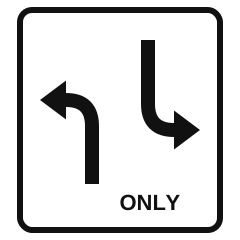
- U-turns in either direction
- Buses and taxis only
- Passing slower vehicles
- Left turns from both directions
How should you test your brakes before riding?
- Look at the brake pads only
- Squeeze both and rev the engine to check they hold
- Ride fast and brake hard
- Try the front and rear brakes one at a time
Besides warning you of a railway crossing, what else does this sign show?
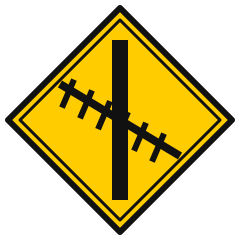
- How many sets of railway tracks cross the road ahead
- Whether the crossing has gates
- The distance to the crossing
- The angle at which the tracks cross the road
You are approaching this sign on a two-lane road. What lies ahead?

- The road splits into a divided highway
- A divided highway comes to an end
- A two-way road begins
- The pavement narrows to one lane
You ride up to this sign at a quiet rural crossroad. What must you do?

- Come to a full stop and wait until the way is clear
- Slow down and roll through if nobody is coming
- Sound your horn and continue with caution
- Stop only if a vehicle is coming from the right
Besides the alcohol, daylight, road and passenger limits, what else must every M1 rider do by law?
- Display an L sign on the bike
- Ride only on weekends
- Wear an approved helmet
- Ride with a fully licensed rider
With no label on it, which feature helps identify a limited-speed motorcycle?
- A manual six-speed gearbox
- An engine of 50 cubic centimetres or less
- An engine of 125 cubic centimetres or less
- A top speed of 90 km/h
You finish a turn on a motorcycle whose signals do not cancel by themselves. Why does it matter if you forget to switch the signal off?
- Your headlight will switch to high beam and dazzle drivers
- Your battery will drain within minutes
- Your brake light will stop working
- Other drivers may pull out or turn in front of you
What does this sign tell you?

- The road ends ahead
- Stopping is not allowed ahead
- A yield sign is ahead
- A stop sign is ahead, so slow down
A truck with a do-not-pass sign is leading traffic through a road work zone. How do you ride?
- Follow it and do not pass
- Pass it on the right shoulder
- Pass it on the left when clear
- Pass it if it slows below 40 km/h
Where is the front brake lever on most motorcycles?
- Near the left footrest
- On the left handlebar, in front of the grip
- Near the right footrest
- On the right handlebar, in front of the throttle
Why should you approach intersections slowly on a motorcycle?
- Your brakes work only at low speed
- You can stop or turn quickly if a car pulls out
- Drivers expect motorcycles to be slow near intersections
- It saves fuel at the lights
A car waits to turn left across your path at an intersection ahead. How should you position yourself?
- Move close to the centre line so the driver sees you
- Move as far right as possible to add space
- Stay exactly where you are
- Ride on the right shoulder
A school-zone speed limit sign has yellow lights on it. When does its lower limit apply?
- Only when children can be seen
- Only between 8 a.m. and 4 p.m.
- Only on weekdays in September
- When the yellow lights are flashing
You pass interchange 204 on Highway 401 and plan to leave at interchange 250. About how far do you still have to ride?
- 46 kilometres
- 54 kilometres
- 204 kilometres
- 250 kilometres
You enter a blind curve where you cannot see all the way around. Where in the lane should you ride?
- Exactly in the centre of the lane
- Always tight against the right edge
- On the side where you can see the most road ahead
- Wherever the pavement looks smoothest and has the most grip
What does cold weather do to your tires?
- It raises their air pressure
- It makes their tread deeper
- It lowers their air pressure
- It has no effect on them
How do you operate a motorcycle's shift lever?
- Pull it with your right hand
- Press it down with the toe of your right foot
- Lift or press it with your left foot
- Twist it with your left hand
An orange sign warns that the pavement ahead has been milled or grooved. What does the handbook say riders may experience there?
- Reduced traction
- Louder tire noise only
- Better grip than usual
- A smoother ride than usual
You cannot avoid a piece of tailpipe on the road. How should you ride over it?
- Grip firmly, keep straight and rise slightly on the footrests
- Lean the bike hard and swerve around it at the very last second
- Sit back and lift the front wheel
- Brake hard just before hitting it
What does this sign tell you to do?

- Keep to the right of the traffic island
- Turn right at the next corner or driveway
- The road curves right ahead
- The right lane ends soon
Your Level Two road test is booked for 10:00 a.m. By what time does the handbook say you should arrive?
- 10:00 a.m.
- 9:30 a.m.
- 9:00 a.m.
- 9:50 a.m.
Riding into town, you pass this five-sided fluorescent sign. What is coming up?

- A hospital entrance
- A park with a bike path crossing the road
- A pedestrian crossover
- A school zone, so watch for children
As an M1 rider, which roads are generally off-limits to you?
- Roads with speed limits over 100 km/h
- Roads with speed limits over 80 km/h
- Any road outside your home city
- Roads with speed limits over 60 km/h
All Ontario M1 practice tests
- Ontario M1 Mock Exam 1 – 30 QuestionsUntimed practice · answers explained
- Ontario M1 Mock Exam 2 – 30 QuestionsUntimed practice · answers explained
- Ontario M1 Mock Exam 3 – 30 QuestionsUntimed practice · answers explained
- Ontario M1 Mock Exam 4 – 30 QuestionsUntimed practice · answers explained
- Ontario M1 Mock Exam 5 – 30 QuestionsUntimed practice · answers explained
- Regulatory signsStop, yield, school zone and railway crossbuck shapes, green-ring and red-slash signs, turn and lane controls, stopping, standing and parking zones, community safety zones and HOV lanes.
- Warning, construction and guide signsYellow diamond warning signs for curves, hills, lane endings, crossings and hazards, orange temporary condition signs in work zones, green guide and exit signs, and the slow-moving vehicle sign.
- Traffic lights and pedestrian signalsGreen, yellow and red lights, turns on red, advance green and turn arrows, flashing lights and beacons, blank signals during a power failure, transit priority signals and pedestrian walk signals.
- Pavement markingsYellow and white lines, solid and broken lines for passing, continuity lines, stop lines, crosswalks, lane arrows, pedestrian crossovers and markings around fixed objects.
- M1, M2 and M licensingWho needs a class M licence, the M1 and M2 conditions, minimum times at each level, licence expiry, safety courses, L and M conditions for mopeds, scooters and three-wheelers, and rules for visitors and new residents.
About this practice test
How many questions are in Ontario M1 practice test 11?
30 original multiple-choice practice questions covering road hazards, night and weather, m1, m2 and m licensing, group riding, passengers and cargo, controls and pre-ride check, regulatory signs, warning, construction and guide signs, seeing, being seen and signalling, emergencies. Each answer includes an explanation. This mixed practice set does not reproduce the official exam format or predict an official score.
Are the questions the same every time?
Yes. Practice test 11 always has the same 30 questions, so you can repeat it until you get them all right. The other 11 sets use different questions.
Are these real test questions?
No. The official question bank is not published. These are original questions written from the official handbook, which is what the real Ontario M1 test is based on.