A dog chases your motorcycle. What should you not do?
Ontario M1 overview
Ontario M1 Practice Test 7
30 questions on emergencies, seeing, being seen and signalling, warning, construction and guide signs, regulatory signs, lane position and more.
- No sign-up
- Every answer explained
- Independent · not a government site
- Set 7 of 12
- 30 questions
- Instant feedback
0/30
All 30 questions in this test
Every question and its answer choices. The correct answers and explanations appear when you take the test above.
A dog chases your motorcycle. What should you not do?
- Keep both hands on the bars
- Keep riding with control
- Kick at the dog
- Watch the road ahead
You have stopped at a blind intersection where parked cars block your view. What should you do next?
- Go immediately at normal speed
- Wait until a driver waves you on into the intersection
- Sound your horn and go
- Ease forward past the obstructions to look
What are emergency detour route (EDR) markers used for?
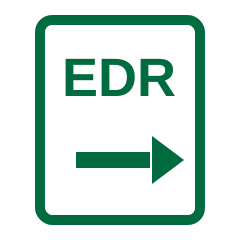
- Showing the way to the nearest hospital
- Marking routes for ambulances only
- Marking roads closed for the winter
- Guiding traffic around a sudden highway closure
On a multi-lane highway with no centre median, a sign tells drivers to stop for school buses. Who must stop when a bus's signals flash?
- Only drivers of trucks and buses
- Only drivers behind the bus
- Only drivers in the bus's own lane
- Drivers coming from both directions
Your scooter cannot keep up with the posted speed limit. Where may you ride?
- As close as safely possible to the right edge
- In the centre of the lane
- On the paved shoulder
- In the left tire track, at any speed you can manage
It is a hot summer day. What should you wear on your arms and legs while riding?
- A jacket and pants that cover them completely
- Shorts and a T-shirt to stay cool
- Whatever is comfortable for short trips
- A light jacket with shorts
When does the law require a moped's headlight and tail light to be on?
- Only when riding on roads over 50 km/h
- From sunset to sunrise, and in heavy rain only
- Only from one hour after sunset until dawn
- Half an hour before sunset to half an hour after sunrise
How should your riding clothes fit?
- Snug enough not to flap, but loose enough to move
- Tight enough to keep your arms from moving around
- Loose at the neck, wrists and waist
- Very loose so air can circulate
The fog becomes too dense to continue. What should you do?
- Stop in your lane with your four-way flashers on
- Pull completely off the road to a safe area
- Follow closely behind a truck
- Speed up to get through it
Why should you stay well back from large vehicles in bad weather?
- They drive faster in the rain
- Their brakes work better when wet
- Their spray can block your vision
- They are required to stay in the left lane
Your brakes feel spongy and make a scraping sound. What should you do?
- Add air to the tires
- Use only the rear brake for now
- Ride gently until the next oil change
- Have them serviced right away
You want to turn right. Using counter-steering, how do you start the turn?
- Push forward on the left handlebar
- Turn the handlebars sharply right
- Pull back on the right handlebar
- Push forward on the right handlebar
Why should you pull as far off the road as you can when stopping on the roadside?
- A stopped motorcycle is very hard for others to see
- Police require at least five metres from the edge of the road
- The kickstand only works on grass
- It keeps the engine cooler
A truck ahead swings left to make a right turn, opening space in the right lane. What should you do?
- Pass it on the left quickly
- Ride into the space on its right and pass it there
- Stay well back until it has cleared the turn
- Sound your horn and move up
On a rural highway at dusk you see this sign. What should you be alert for?

- A wildlife park entrance
- Hunters beside the road
- Deer crossing the road
- A petting zoo ahead
How is a crosswalk usually marked at an intersection?
- Two parallel white lines across the road
- A large white X in each lane
- One solid yellow line across the road
- Broken white lines along the curb
How are most mopeds started?
- By pedalling first, then turning the key
- By rolling downhill in gear
- By kicking a lever above the right footrest
- By pulling a cord under the seat
How does your lean change with the turn and your speed?
- Less lean as your speed goes up
- The same lean for every turn and speed
- More lean for sharper turns and higher speeds
- Lean away from the turn at higher speeds
Which tests must you pass to get an M1 licence?
- A vision test and a short riding test
- Only a written test on traffic signs
- A written test on the rules and a medical exam signed by your family doctor
- A vision test and written tests on signs and on motorcycles and rules
Which of these vehicles is not allowed on Ontario freeways?
- A full-speed motorcycle
- A motor tricycle
- A moped or limited-speed motorcycle
- A motorcycle with a sidecar attached
You are stopped at a red light with no sign against turning. When may you turn right?
- After a full stop, once the way is clear
- Without stopping, if the road is empty
- Never while the light is red
- Only when a green arrow appears
How long is a safety standards certificate valid after the inspection?
- 36 days
- 30 days
- 90 days
- 6 days
An M2-L licence lets you ride a moped or scooter that cannot go faster than what speed?
- 90 km/h
- 70 km/h
- 80 km/h
- 50 km/h
Why is the tire-track position also called the blocking position?
- It blocks the view of drivers behind you so they slow down
- It blocks your bike from rolling
- It blocks wind from hitting you
- It discourages others from squeezing past in your lane
Which indicator light glows green on a motorcycle's instrument panel?
- The turn signal light
- The neutral light
- The high-beam light
- The low-fuel light
Which lights should you use when riding in fog?
- Four-way flashers only
- Low beams, plus fog lights if you have them
- No lights, to avoid glare
- High beams, to light up as much of the fog as possible
What following distance does the handbook recommend on a freeway?
- At least two to three seconds
- Exactly one motorcycle length
- At least one second
- At least ten seconds
How does a passenger change the way your motorcycle handles?
- It responds more slowly to speeding up, braking and turning
- It makes no difference to handling
- It turns more sharply than usual
- It stops faster because the extra weight adds grip to the tires
You are putting a motorcycle on its centre stand. Which foot lowers and pushes down on the stand?
- Your right foot
- Your left foot
- Both feet together
- Either foot
In a staggered formation, how far behind the leader does the second rider stay?
- About one second, on the right side
- Directly beside the leader
- About three seconds, in the centre
- About two seconds, on the left side
All Ontario M1 practice tests
- Ontario M1 Mock Exam 1 – 30 QuestionsUntimed practice · answers explained
- Ontario M1 Mock Exam 2 – 30 QuestionsUntimed practice · answers explained
- Ontario M1 Mock Exam 3 – 30 QuestionsUntimed practice · answers explained
- Ontario M1 Mock Exam 4 – 30 QuestionsUntimed practice · answers explained
- Ontario M1 Mock Exam 5 – 30 QuestionsUntimed practice · answers explained
- Regulatory signsStop, yield, school zone and railway crossbuck shapes, green-ring and red-slash signs, turn and lane controls, stopping, standing and parking zones, community safety zones and HOV lanes.
- Warning, construction and guide signsYellow diamond warning signs for curves, hills, lane endings, crossings and hazards, orange temporary condition signs in work zones, green guide and exit signs, and the slow-moving vehicle sign.
- Traffic lights and pedestrian signalsGreen, yellow and red lights, turns on red, advance green and turn arrows, flashing lights and beacons, blank signals during a power failure, transit priority signals and pedestrian walk signals.
- Pavement markingsYellow and white lines, solid and broken lines for passing, continuity lines, stop lines, crosswalks, lane arrows, pedestrian crossovers and markings around fixed objects.
- M1, M2 and M licensingWho needs a class M licence, the M1 and M2 conditions, minimum times at each level, licence expiry, safety courses, L and M conditions for mopeds, scooters and three-wheelers, and rules for visitors and new residents.
About this practice test
How many questions are in Ontario M1 practice test 7?
30 original multiple-choice practice questions covering emergencies, seeing, being seen and signalling, warning, construction and guide signs, regulatory signs, lane position, helmets and protective gear, controls and pre-ride check, road hazards, night and weather, space cushion and sharing the road, insurance, registration and maintenance, turning, cornering and braking, pavement markings, mounting, starting and shifting, m1, m2 and m licensing, freeway driving, traffic lights and pedestrian signals, group riding, passengers and cargo. Each answer includes an explanation. This mixed practice set does not reproduce the official exam format or predict an official score.
Are the questions the same every time?
Yes. Practice test 7 always has the same 30 questions, so you can repeat it until you get them all right. The other 11 sets use different questions.
Are these real test questions?
No. The official question bank is not published. These are original questions written from the official handbook, which is what the real Ontario M1 test is based on.