Two years into your M2, you have one beer at a barbecue. Can you legally ride home?
Ontario M1 overview
Ontario M1 Practice Test 5
30 questions on m1, m2 and m licensing, emergencies, traffic lights and pedestrian signals, group riding, passengers and cargo, turning, cornering and braking and more.
- No sign-up
- Every answer explained
- Independent · not a government site
- Set 5 of 12
- 30 questions
- Instant feedback
0/30
All 30 questions in this test
Every question and its answer choices. The correct answers and explanations appear when you take the test above.
Two years into your M2, you have one beer at a barbecue. Can you legally ride home?
- Yes, after waiting 30 minutes per drink
- Yes, if you are under 0.08
- No, M2 riders must have zero alcohol
- Yes, if you are under 0.05
Your throttle sticks open. What should you do at the same time as you let up on it?
- Brake hard with the rear brake only
- Pull in the clutch and use the kill switch
- Shift into a higher gear
- Turn off the fuel valve
You are stopped at a red light on a one-way street and want to turn left onto another one-way street. Is it allowed?
- No, left turns on red are never allowed
- Yes, after a full stop, when the way is clear
- Yes, without stopping if the road is clear
- Only once a green arrow appears
Why should you never ride directly alongside another motorcycle?
- It confuses traffic lights
- It is too loud for other drivers and pedestrians nearby
- It uses more fuel
- You have nowhere to go if you must avoid something
You want to turn left. Which handlebar do you push first?
- Both handlebars evenly
- The right handlebar
- The left handlebar
- Neither; you shift your hips only
You have a green light and the hand symbol appears while someone is halfway across. Who has the right-of-way?
- Whoever reached the crosswalk first, pedestrian or vehicle
- The pedestrian, until they reach a safe area
- You, once the hand symbol is steady
- You, because your light is green
Which vehicles must be counter-steered to turn?
- Only vehicles with three wheels
- Only motorcycles with a sidecar
- Only heavy motorcycles with engines over 500 cc
- Any two-wheeled vehicle, including a bicycle
What is one of the most common causes of crashes between motorcycles and cars?
- A car turning left in front of the motorcycle
- A motorcycle rear-ending a stopped car
- A car backing out of a driveway
- A car passing a motorcycle on the right
On a freeway, you see wide, closely spaced broken lines on the left side of your lane. What do they usually mean?
- The shoulder is starting
- Your lane continues unaffected
- Your lane is ending or exiting
- A passing lane is beginning
In the area marked by this sign, for what reason may you stop?
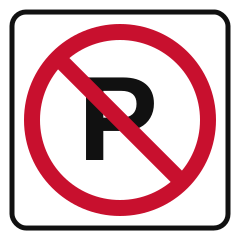
- To let your engine cool down
- To wait for a parking space
- To load or unload passengers or goods
- To check a map on your phone for a minute or two
What should you do after riding over an object on the road?
- Speed up to test the suspension
- Let air out of the tires
- Keep riding unless it feels odd
- Stop and check your tires and rims
This sign warns that another road is about to join yours. Whose job is it to make the merge work?

- Whoever is travelling faster
- Drivers on both roads share it
- Only drivers on the main road
- Only drivers on the joining road
You are in the curb lane approaching an entrance ramp where cars are merging. What should you do?
- Ride on the shoulder past the ramp
- Hold your speed and lane; merging cars must yield to you
- Speed up to block them from merging
- Adjust speed, or move over a lane, so they can merge
On what kind of surface should you use a kickstand or centre stand?
- Any surface at all
- Loose gravel
- Soft grass
- A hard surface
How should an approved helmet fit?
- Tight enough to press on your ears
- Snugly, without sliding around on your head
- Loosely, so air can flow freely around your head
- One size larger than your head
Your motorcycle will not start. Which switch should you check, since it can be turned off by accident?
- The turn signal switch
- The high-beam switch
- The engine kill switch
- The horn button
When can alcohol start to affect your ability to handle a motorcycle safely?
- Only once you pass the legal limit
- Only after three or more drinks
- At levels far below the legal limit
- Only when you feel drunk
At a stop sign, some markings may be missing. In what order do you choose where to stop?
- Sidewalk edge, stop line, crosswalk, intersection edge
- Intersection edge, crosswalk, stop line, sidewalk edge
- Crosswalk, stop line, intersection edge, sidewalk edge
- Stop line, crosswalk, sidewalk edge, intersection edge
As you approach a car waiting to turn left, what else should you pay attention to?
- Only the traffic light colour
- Only the car's turn signal
- Only the left-turning car's front wheels and driver
- Everything else happening around the intersection
Once on the exit ramp, why should you check your speedometer?
- Ramp speed cameras are common
- The ramp limit is higher than the freeway
- Your gears may have slipped
- You may be going faster than you think
You are riding at night with a group of cars behind you. Why does the handbook say to slow down?
- Your headlight dims at low speeds
- Cars behind you will flash their lights
- A driver ahead may not pick out your light from theirs
- Night speed limits are 10 km/h lower on most Ontario roads
You are riding in heavy traffic. What does the handbook advise?
- Ride on the line between lanes
- Weave between lanes to keep moving
- Use the shoulder to get ahead
- Stay in the same lane as much as possible
How might a cyclist on the road signal that they are turning right?
- By pointing the left arm down
- By holding the right arm straight out
- By tapping their helmet
- By waving the right hand overhead
Your bike has a display screen. What does the handbook say about watching screens unrelated to riding?
- It is allowed at low speeds
- It is allowed with a full M licence
- It is prohibited while driving
- It is allowed if mounted on the bars
Your motorcycle bounces several times after a bump. What may need attention?
- The headlight aim
- The spark plugs
- The fuel valve
- The shock absorbers
Why may M1 riders use Highways 11, 17, 61, 69, 71, 101, 102, 144 and 655 even though some are posted above 80 km/h?
- Some riders have no other route available
- They have lower traffic volumes at night
- They are all posted at 80 km/h or less
- They have wider shoulders for motorcycles
In the curb lane, you come up on a bus leaving an indented bus bay with its left signals flashing. What must you do?
- Speed up to pass it first
- Sound your horn and continue
- Swerve into the bus bay
- Yield and let it back into traffic
What do green rectangular signs with white letters usually tell you?
- Speed limits and fines
- Parking rules and times
- Distances and destinations
- Road work zones ahead
You want to change into the middle lane of a three-lane road. What else should you check?
- The road surface behind you
- The far lane, for drivers heading for the same spot
- Your speedometer, to see your speed
- The oncoming lanes across the median for drivers turning
You paint your motorcycle a new colour. How soon must you report it?
- Within six days
- Within 15 days
- Within 30 days
- At your next renewal
All Ontario M1 practice tests
- Ontario M1 Mock Exam 1 – 30 QuestionsUntimed practice · answers explained
- Ontario M1 Mock Exam 2 – 30 QuestionsUntimed practice · answers explained
- Ontario M1 Mock Exam 3 – 30 QuestionsUntimed practice · answers explained
- Ontario M1 Mock Exam 4 – 30 QuestionsUntimed practice · answers explained
- Ontario M1 Mock Exam 5 – 30 QuestionsUntimed practice · answers explained
- Regulatory signsStop, yield, school zone and railway crossbuck shapes, green-ring and red-slash signs, turn and lane controls, stopping, standing and parking zones, community safety zones and HOV lanes.
- Warning, construction and guide signsYellow diamond warning signs for curves, hills, lane endings, crossings and hazards, orange temporary condition signs in work zones, green guide and exit signs, and the slow-moving vehicle sign.
- Traffic lights and pedestrian signalsGreen, yellow and red lights, turns on red, advance green and turn arrows, flashing lights and beacons, blank signals during a power failure, transit priority signals and pedestrian walk signals.
- Pavement markingsYellow and white lines, solid and broken lines for passing, continuity lines, stop lines, crosswalks, lane arrows, pedestrian crossovers and markings around fixed objects.
- M1, M2 and M licensingWho needs a class M licence, the M1 and M2 conditions, minimum times at each level, licence expiry, safety courses, L and M conditions for mopeds, scooters and three-wheelers, and rules for visitors and new residents.
About this practice test
How many questions are in Ontario M1 practice test 5?
30 original multiple-choice practice questions covering m1, m2 and m licensing, emergencies, traffic lights and pedestrian signals, group riding, passengers and cargo, turning, cornering and braking, road hazards, night and weather, pavement markings, regulatory signs, warning, construction and guide signs, freeway driving, controls and pre-ride check, helmets and protective gear, mounting, starting and shifting, alcohol, drugs and fatigue, seeing, being seen and signalling, lane position, insurance, registration and maintenance, space cushion and sharing the road. Each answer includes an explanation. This mixed practice set does not reproduce the official exam format or predict an official score.
Are the questions the same every time?
Yes. Practice test 5 always has the same 30 questions, so you can repeat it until you get them all right. The other 11 sets use different questions.
Are these real test questions?
No. The official question bank is not published. These are original questions written from the official handbook, which is what the real Ontario M1 test is based on.