You load both saddlebags. What does the handbook recommend?
Ontario M1 overview
Ontario M1 Practice Test 6
30 questions on group riding, passengers and cargo, road hazards, night and weather, m1, m2 and m licensing, mounting, starting and shifting, controls and pre-ride check and more.
- No sign-up
- Every answer explained
- Independent · not a government site
- Set 6 of 12
- 30 questions
- Instant feedback
0/30
All 30 questions in this test
Every question and its answer choices. The correct answers and explanations appear when you take the test above.
You load both saddlebags. What does the handbook recommend?
- Fill one and leave the other empty
- Put the heaviest items on the left
- Put about the same weight in each
- Put the heaviest items on top
On a wet road, what do shiny areas on the pavement often mean?
- A recently salted surface
- Worn, polished pavement that is very slippery
- A painted bicycle lane
- Freshly laid pavement that gives good grip in the rain
What is the longest you may stay at Level Two?
- There is no time limit at Level Two
- Five years from passing the Level One road test
- Three years from getting your M1 licence
- Two years from passing the Level One road test
How can you tell a motorcycle is not too big or heavy for you?
- You can reach the handlebars standing beside it
- You can put both feet flat on the ground when seated
- You can lift the front wheel off the ground
- You can touch the ground with one toe
When you let go of the throttle, what should it do?
- Lock in place until you brake
- Spring back to the idle position
- Stay where you left it
- Twist fully open
When are speeding fines doubled in a construction zone marked with this sign?
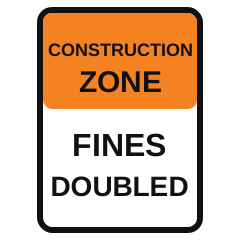
- Every hour of every day
- Only on weekends
- When workers are present
- Only at night
You have a green light and want to turn right. Who must you yield to first?
- Pedestrians crossing and vehicles already in the intersection
- Only cyclists riding in a bike lane
- No one, because the green light gives you the full right-of-way
- Only vehicles approaching from your left
Who must wear an approved helmet when you ride your motorcycle on an Ontario road?
- Both you and your passenger
- Only you, as the driver
- Only riders under 18
- Only riders on highways
Which pavement markings tell you that you are coming up to a pedestrian crossover?
- A row of white triangles in each lane
- One yellow line across the road
- Two double white lines with an X in each lane
- Green paint across the whole lane
Fog limits how far you can clearly see. At what distance does poor visibility require a moped's lights to be on?
- When you cannot see 300 metres away
- When you cannot see 500 metres away
- When you cannot see 150 metres away
- When you cannot see 50 metres away
How does being tired affect you on a motorcycle, even if you do not fall asleep?
- It improves your focus on the road
- It has no effect on short rides
- You notice less and react more slowly
- It only affects you at night
Leaving space when stopped behind a vehicle protects you in several ways. Which is one of them?
- You can pull around it if it stalls
- It saves fuel at long lights
- You can share its lane if needed
- It lets you lane split forward
Your turn signals stop working on the road. What does the handbook say to do?
- Use your horn instead of signals
- Flash your high beam to signal each turn until you reach home
- Keep riding normally and fix it later
- Use hand signals, then get the bike off the road for repair
According to the handbook, how do many riders end up running off the road in a turn?
- Using the front brake gently before they enter the turn
- Misjudging speed, or braking so hard the wheels lock
- Leaning too far into the turn
- Shifting up before the turn
You bought a motorcycle without a safety standards certificate. What can you not do yet?
- Insure it with a company
- Store it in your garage
- Register it in your name at ServiceOntario
- Put your plates on it and ride it
Which brakes should you use every time you slow down or stop?
- Both front and rear, at the same time
- The rear brake only
- The front brake only
- Whichever one is easier to reach
Riding in the right lane, you see this sign. How should you respond?

- Ride onto the right shoulder
- Speed up to stay ahead of traffic in the left lane
- Move safely into the left lane before yours ends
- Stop and wait for a gap in traffic
Between two signs like this one, when may you stop your motorcycle?
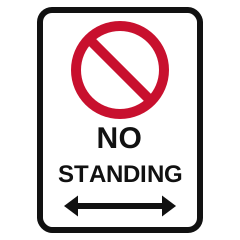
- To park for up to 15 minutes
- Only while loading or unloading cargo
- Never, for any reason
- Only while loading or unloading passengers
When should a staggered group switch to single file?
- Only when stopped at a red light
- Only when the group has more than six riders
- On curves, in turns and entering or leaving a freeway
- Only on gravel roads at night
You are riding in the passing (left) lane. Which tire track gives you a blocking position?
- Right next to the centre line
- The right tire track
- The left tire track
- The centre of the lane
Who may use a lane marked with this diamond sign?
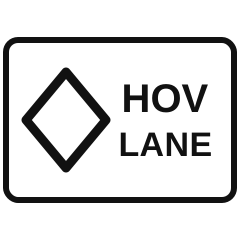
- Trucks over 4,500 kg
- Any vehicle with its lights on during off-peak hours
- Buses or vehicles with the set number of people
- Motorcycles and scooters only
A single flashing yellow beacon hangs over a warning sign. What does it tell you?
- The road is closed ahead
- Drive with caution
- Yield to traffic from the right
- Stop before going on
You are wearing an approved helmet but leave the chin strap loose for comfort. Why is that a problem?
- It is only a problem at night or in heavy rain
- It makes the visor fog up
- It makes road noise louder
- A loose helmet can come off in a collision
Why should you keep your wrists low while riding?
- So you can reach the horn quickly
- So your arms do not get tired
- So the mirrors stay in position
- So you do not speed up by mistake
To keep track of traffic coming up behind you, how often does the Visibility section say to check your mirrors?
- Every five to seven seconds
- Only before turning
- Every 20 to 30 seconds
- Once every minute
What is the minimum third-party liability insurance you must carry?
- $1,000,000
- $100,000
- $200,000
- $50,000
Your freeway exit is coming up. At what point do you begin reducing speed?
- Before you move into the exit lane
- After you are fully in the exit lane
- As soon as you see the exit sign
- Only at the end of the ramp
A white arrow is painted on the pavement in your lane. What does it mean?
- You may only travel in the arrow's direction
- The lane is for passing only
- The arrow is just a suggestion for drivers new to the area
- You must change lanes ahead
Where is the best riding position in a lane usually found?
- Along the right edge of the lane
- In the left or right tire track
- In the exact centre of the lane
- On the line between lanes
Why should you leave plenty of room when you are stopped behind a large vehicle?
- Its exhaust is dangerous to breathe
- Its turn signals are hard to see
- It may roll back when the brakes are released
- It may back up a short way to change lanes or turn
All Ontario M1 practice tests
- Ontario M1 Mock Exam 1 – 30 QuestionsUntimed practice · answers explained
- Ontario M1 Mock Exam 2 – 30 QuestionsUntimed practice · answers explained
- Ontario M1 Mock Exam 3 – 30 QuestionsUntimed practice · answers explained
- Ontario M1 Mock Exam 4 – 30 QuestionsUntimed practice · answers explained
- Ontario M1 Mock Exam 5 – 30 QuestionsUntimed practice · answers explained
- Regulatory signsStop, yield, school zone and railway crossbuck shapes, green-ring and red-slash signs, turn and lane controls, stopping, standing and parking zones, community safety zones and HOV lanes.
- Warning, construction and guide signsYellow diamond warning signs for curves, hills, lane endings, crossings and hazards, orange temporary condition signs in work zones, green guide and exit signs, and the slow-moving vehicle sign.
- Traffic lights and pedestrian signalsGreen, yellow and red lights, turns on red, advance green and turn arrows, flashing lights and beacons, blank signals during a power failure, transit priority signals and pedestrian walk signals.
- Pavement markingsYellow and white lines, solid and broken lines for passing, continuity lines, stop lines, crosswalks, lane arrows, pedestrian crossovers and markings around fixed objects.
- M1, M2 and M licensingWho needs a class M licence, the M1 and M2 conditions, minimum times at each level, licence expiry, safety courses, L and M conditions for mopeds, scooters and three-wheelers, and rules for visitors and new residents.
About this practice test
How many questions are in Ontario M1 practice test 6?
30 original multiple-choice practice questions covering group riding, passengers and cargo, road hazards, night and weather, m1, m2 and m licensing, mounting, starting and shifting, controls and pre-ride check, warning, construction and guide signs, traffic lights and pedestrian signals, helmets and protective gear, pavement markings, alcohol, drugs and fatigue, space cushion and sharing the road, seeing, being seen and signalling, emergencies, insurance, registration and maintenance, turning, cornering and braking, regulatory signs, lane position, freeway driving. Each answer includes an explanation. This mixed practice set does not reproduce the official exam format or predict an official score.
Are the questions the same every time?
Yes. Practice test 6 always has the same 30 questions, so you can repeat it until you get them all right. The other 11 sets use different questions.
Are these real test questions?
No. The official question bank is not published. These are original questions written from the official handbook, which is what the real Ontario M1 test is based on.