A driver who is required to use an ignition interlock is caught driving a car without one. What happens to the vehicle?
Ontario G1 overview
Ontario G1 Practice Test 9
40 questions on impaired driving and other suspensions, regulatory signs, construction, information and direction signs, warning signs, turning, signalling and changing lanes and more.
- No sign-up
- Every answer explained
- Independent · not a government site
- Set 9 of 15
- 40 questions
- Instant feedback
0/40
All 40 questions in this test
Every question and its answer choices. The correct answers and explanations appear when you take the test above.
A driver who is required to use an ignition interlock is caught driving a car without one. What happens to the vehicle?
- It is impounded for 90 days
- It is given a warning tag only
- It is impounded for 45 days
- It is impounded for seven days
On a regulatory sign, what does a red circle with a line through it mean?
- The activity shown is required
- The activity shown is allowed
- The activity is allowed with caution
- The activity shown is not allowed
What does this green sign show?
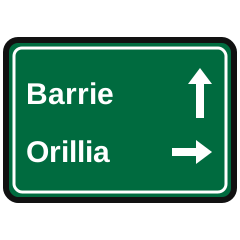
- Towns closed to through traffic
- Speed limits in nearby towns
- Distances to nearby towns and cities
- Directions to nearby towns and cities
What does the larger arrow on this intersection-ahead sign show?
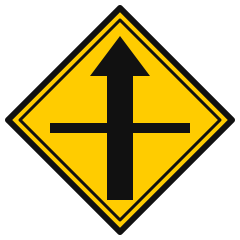
- Which road is a one-way street
- Which traffic has the right-of-way
- Which way the detour goes
- Which road has a stop sign
Some electronic signs change their messages with traffic conditions. What do they tell you?
- Directions to the nearest town
- The posted speed limit for trucks
- Current delays and lane closures ahead
- Weather forecasts for tomorrow
At a typical two-lane roundabout where signs and markings allow straight travel from both lanes, which lane may you use to go straight?
- Whichever lane is empty, then switch inside
- Only the right lane
- Only the left lane
- Either the left or the right lane
You have just overtaken a vehicle. When is it safe to move back into the original lane?
- When its entire front shows in your inside mirror
- When you are about one car length ahead
- When its driver flashes the headlights
- As soon as your rear bumper clears its front
Which part of the road usually freezes first as temperatures drop?
- Roads near cities
- Bridges and overpasses
- Uphill sections
- Sunny straight stretches
What does this sign warn you about?

- The pavement narrows ahead
- A lane is closed for work
- A narrow bridge ahead
- A divided highway ends ahead
Your brakes failed but you managed to stop safely. What should you do next?
- Drive slowly to a garage
- Drive home using the parking brake
- Stay put and call for help
- Wait ten minutes and try again
You just moved to Ontario with a valid licence from another province. How long may you drive on it?
- 60 days
- 6 months
- 30 days
- 90 days
How should the lap part of a seatbelt be worn?
- Loosely over the thighs
- Low over the hips
- Across the stomach
- High across the waist
A driver leaves the scene of a collision without stopping. How many demerit points does this carry?
- 3
- 4
- 6
- 7
What does this sign mean?
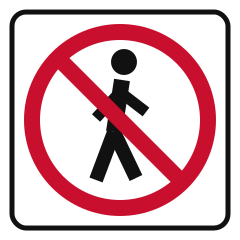
- Pedestrian crossing ahead
- Watch for children playing
- Pedestrians have the right-of-way
- No pedestrians allowed on this road
How should you choose the recline angle for a rear-facing child car seat?
- Always set it to 60 degrees
- Use the angle range on the seat or in its manual
- Keep it upright at 90 degrees
- Use the same angle for every child and seat
In which situation do you need more than the minimum two-second following distance?
- When driving under the limit
- When driving on a dry, clear day
- When following a motorcycle
- When following a small car
You believe an angry driver is following you. Where should you go?
- Straight to your home
- To a quiet side street to let them pass
- To an empty parking lot to talk it out
- To a police station or busy public place
What are continuity lines?
- Wider broken lines spaced closer together
- Narrow broken lines spaced far apart
- A single solid line across the lane
- Two solid lines side by side
You want to park near an intersection that has traffic lights. What is the closest you may park to it?
- 9 metres
- 15 metres
- 6 metres
- 30 metres
You are visiting Ontario from another country for five months. What do you need besides your home licence?
- A letter from your country's embassy
- An international driver's permit
- An Ontario G1 licence
- Nothing else is needed
According to the handbook, what is the major cause of collisions?
- Bad weather conditions
- Poor road maintenance and design
- Breaking the rules of the road
- Mechanical failures
On a rainy, slushy day you start passing a transport truck. What hazard should you be ready for?
- Hail bouncing off the trailer roof
- Spray suddenly covering your windshield
- The truck's lights blinding you
- The truck speeding up to block you
You are in an intersection waiting to turn left when an ambulance approaches. What should you do?
- Back out of the intersection
- Complete the left turn quickly
- Go straight instead, then pull over
- Stop where you are in the intersection
What is a traffic beacon?
- A lighted speed display
- A row of three steady lights
- A single flashing light
- A pair of steady red lights
A driver is caught in the warn range for a second time. What penalty applies?
- 90-day suspension and an interlock
- 14-day suspension and a 16-hour treatment program
- 30-day suspension and 6 demerit points
- 3-day suspension and a warning letter
A driver is convicted because their 12-year-old passenger was not wearing a seatbelt. How many demerit points does the driver get?
- 0
- 2
- 4
- 3
Defensive driving is built on three main ideas. What are they?
- Visibility, space and communication
- Speed, signals and mirrors
- Patience, courtesy and concentration
- Distance, timing and braking
An orange sign warns that a survey crew is ahead. Where are they working?
- In a field beside the road
- On the next exit ramp
- On the road ahead
- On the road behind you
You are pulling out of a private driveway onto a road. Whom must you yield to?
- Only pedestrians on the sidewalk
- Road traffic and sidewalk pedestrians
- Only vehicles approaching from your left side
- No one, if you signal first
According to the handbook, which drivers hit far more pedestrians at signalled crosswalks?
- Drivers backing up
- Drivers turning right
- Drivers turning left
- Drivers going straight
Under Ontario’s current policy, how long can a temporary Accessible Parking Permit be valid?
- Up to five years without recertification
- Up to twelve months, with medical recertification required to renew
- Only two weeks, with no possibility of another permit
- Indefinitely while it is displayed
You see a warning sign for a hidden school bus stop. What should you do?
- Slow down and watch for children and the bus
- Keep your speed; the stop is hidden
- Stop and wait until a bus arrives
- Honk to warn children you are coming
A flashing red beacon is mounted above this sign at an intersection. What must you do?

- Come to a complete stop
- Yield only to vehicles on your left
- Slow down and check for traffic
- Stop only if traffic is coming
A driver passes a school bus that has its red lights flashing. How many demerit points can this bring?
- 7
- 6
- 3
- 4
After your brakes have dried, the pedal still feels spongy. What should you do?
- Keep driving until your next service
- Drive through more water to clear them
- Have the vehicle repaired right away
- Pump the brakes before every stop
You must stop at an intersection that has no stop line, but there is a crosswalk. Where do you stop?
- Wherever you can see cross traffic
- At the crosswalk
- Past the crosswalk, at the curb line
- At the edge of the intersection
When must a collision be reported to police?
- Only if someone is killed
- If damage exceeds $1,000
- Only if a vehicle must be towed from the scene
- If anyone is hurt or damage exceeds $5,000
Driving at night on a country road with high beams on, you approach a hilltop. What should you do?
- Keep high beams on to see over
- Switch to low beams
- Turn off your headlights briefly
- Flash your high beams twice
Without an exemption, which combination meets the current HOV requirements for a commercial truck?
- Three people, any length and weight
- Two people, under 10 m, any weight
- One person, under 6.5 m, any weight
- At least two people, under 6.5 m, gross weight no more than 4,500 kg
A non-exempt heavy commercial truck over 6.5 metres long carries two people. May it use a provincial-highway HOV lane?
- Only if it is under 10 metres long
- Yes, since it carries two people
- No, large trucks are never allowed
- Yes, but only outside rush hour
All Ontario G1 practice tests
- Ontario G1 Mock Exam 1 – 40 QuestionsUntimed practice · answers explained
- Ontario G1 Mock Exam 2 – 40 QuestionsUntimed practice · answers explained
- Ontario G1 Mock Exam 3 – 40 QuestionsUntimed practice · answers explained
- Ontario G1 Mock Exam 4 – 40 QuestionsUntimed practice · answers explained
- Ontario G1 Mock Exam 5 – 40 QuestionsUntimed practice · answers explained
- Regulatory signsStop, yield, school zone and railway crossbuck shapes, permissive and prohibitive signs, no stopping, standing and parking, community safety zones, school bus and HOV lane signs.
- Warning signsYellow diamond warning signs for curves, hills, merges, lane endings, crossings, animals and hazards, plus the slow-moving vehicle and long commercial vehicle placards.
- Construction, information and direction signsOrange temporary condition signs in work zones, doubled construction-zone fines, green guide signs, freeway exit numbering, emergency detour routes and bilingual signs.
- Traffic lights and pedestrian signalsGreen, yellow and red lights, turns on red, advance green and left-turn arrows, flashing lights, transit priority signals, dark signals during power failures and pedestrian signals.
- Pavement markingsYellow and white lines, solid and broken lines, continuity lines, stop lines, crosswalks, lane arrows, pedestrian crossovers and markings around obstacles.
About this practice test
How many questions are in Ontario G1 practice test 9?
40 original multiple-choice practice questions covering impaired driving and other suspensions, regulatory signs, construction, information and direction signs, warning signs, turning, signalling and changing lanes, night driving and bad weather, emergencies and collisions, graduated licensing: g1, g2 and g, getting ready to drive, demerit points and keeping your licence, driving along and intersections, special situations on the road, pavement markings, stopping and parking, safe, responsible and efficient driving, sharing the road, traffic lights and pedestrian signals, freeway driving. Each answer includes an explanation. This mixed practice set does not reproduce the official exam format or predict an official score.
Are the questions the same every time?
Yes. Practice test 9 always has the same 40 questions, so you can repeat it until you get them all right. The other 14 sets use different questions.
Are these real test questions?
No. The official question bank is not published. These are original questions written from the official handbook, which is what the real Ontario G1 test is based on.