G1 Test Questions and Answers – Printable PDF
100 Ontario G1 practice questions with a separate answer key and explanations. Print it or save it as a PDF from your browser. Free, no sign-up.
- No sign-up
- Every answer explained
- Independent · not a government site
- 100 questions
- Answer key included
- Free, no sign-up
Want to study on paper or offline? This page lays out 100 G1 practice questions, signs and rules mixed, with the answer key and explanations on separate pages at the end so you can test yourself first. Press the print button and choose Save as PDF to keep a copy on your phone or computer.
The questions are original, written from the Official MTO Driver's Handbook, and each answer names the handbook section it comes from. For the full handbook itself, the official ontario.ca version is free to read online. When you are ready to test yourself with instant feedback, use the interactive practice tests linked below.
G1 Test Questions and Answers – Printable PDF
1.How many demerit points can a driver get for not obeying a school-crossing guard's stop sign?
- 6
- 2
- 4
- 3
2.Your wheels went off the pavement and you have slowed down. When should you steer back?
- Only after a complete stop
- Immediately, at full speed
- Once the vehicle is under control
- Never; drive on the shoulder
3.What is hydroplaning?
- Wipers lifting off the glass
- Tires riding on top of water
- Brakes overheating in the rain
- Water entering the engine
4.You are eating a burger while driving and weave across a lane. What could happen?
- You can only receive a warning
- Nothing, since eating is not illegal
- You could be charged with careless driving
- You get an automatic licence suspension
5.In normal conditions, what minimum following-time gap does the handbook recommend?
- Half a second
- Two seconds
- One second
- One car length
6.Before a long trip you check the oil and coolant. When should you look under the hood?
- With the engine running
- While the engine is hot
- Right after a long drive
- When the engine is cold
7.What is a traffic beacon?
- A lighted speed display
- A row of three steady lights
- A single flashing light
- A pair of steady red lights
8.How many demerit points are given for a careless driving conviction?
- 4
- 3
- 7
- 6
9.You are at interchange 250 on a freeway and want to get off at interchange 204. About how far do you have to drive?
- 204 km
- 54 km
- 250 km
- 46 km
10.Your passenger puts the shoulder strap behind her back because it rubs her neck. What should she do?
- Tuck it under her arm
- Unbuckle it on short trips
- Leave it behind her back
- Wear it over her shoulder
11.You realize you have just missed your freeway exit. What should you do?
- Make a U-turn across the median
- Stop on the shoulder and reverse
- Take the next exit
- Slow down and back up in your lane
12.What are continuity lines?
- Wider broken lines spaced closer together
- Narrow broken lines spaced far apart
- A single solid line across the lane
- Two solid lines side by side
13.What does this sign mean?

- Two-way traffic ahead
- Turn around at the next exit
- Winding road ahead
- No U-turns allowed
14.After failing a road test, how long must you wait before taking it again?
- At least 7 days
- At least 10 days
- At least 48 hours
- At least 30 days
15.The driver ahead holds their left arm out, bent downward at a right angle. What does this signal mean?
- They are slowing down or stopping
- They want you to pass them
- They are about to turn left
- They are about to turn right
16.A car in the lane beside you has stopped at a crosswalk, but you can't see why. What should you do?
- Pass it if your light is green
- Sound your horn and pass
- Pass it carefully at low speed
- Do not pass it
17.In Ontario, what minimum licence suspension follows a first criminal conviction for impaired driving?
- Three years
- Six months
- Ninety days
- One year
18.You are behind a motorcycle that is turning left at an intersection. What should you do?
- Pull up beside it and turn together
- Sound your horn so it turns faster
- Pass it on the right before the turn
- Stay behind it and turn after it does
19.A warning sign shows a bus entrance on the right ahead. What should you be prepared to do?
- Yield to buses entering the road
- Stop until a bus appears
- Speed up to get past the bus entrance
- Pull into the bus lane
20.You are parking on the right side of the road, facing uphill with no curb. How should you set your wheels?
- Turned sharply to the left
- Pointing straight ahead
- Turned sharply to the right
- Turned slightly to the left
21.Your car is towed after a collision. What information should you get?
- The tow truck's fuel level
- The tow driver's home phone number
- The tow driver's insurance card and policy number
- The tow operator's name and licence number
22.In thick fog, what should you use as a guide to stay in your lane?
- The left shoulder
- The right edge of the road
- The tail lights of a car far ahead
- The centre line
23.You notice you can't remember the last few kilometres you drove. What should you do?
- Pull off and rest in a safe place
- Turn the radio up louder
- Drink a coffee and keep driving
- Open the window and keep going
24.According to the handbook’s fuel-saving advice, about how long is the usual initial engine warm-up before driving gently in cold weather?
- About 30 seconds
- About 10 minutes
- About 15 minutes
- About 5 minutes
25.You move to Ontario and bring your car. How long do you have to register it here?
- 30 days
- 90 days
- 60 days
- 6 months
26.At an intersection pedestrian signal on a busy main road, how is traffic on the smaller crossroad controlled?
- By a crossing guard
- By stop signs
- By yield signs
- By traffic lights
27.A bus driver fails to stop at an unprotected railway crossing. How many demerit points apply?
- 5
- 3
- 6
- 4
28.When do the doubled fines shown on this sign apply?
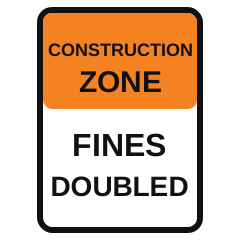
- Speeding only after dark
- Any offence at any time of day
- Parking in the zone at any time
- Speeding while workers are present
29.Your 14-year-old nephew is riding with you and refuses to buckle up. Who is legally responsible?
- Your nephew
- No one; he is over 12
- You, the driver
- His parents
30.What is 'velocitization'?
- Speeding up to match freeway traffic
- Losing your sense of how fast you are going
- Skidding when braking at high speed
- Feeling sleepy on a long, straight road
31.You are riding a bicycle and someone is using a pedestrian crossover ahead. What must you do?
- Ring your bell and keep going
- Yield only if you are on the road
- Stop before the line and yield
- Ride around the person slowly
32.A sign at an intersection says you may not turn right on a red light. What does it forbid?
- Turning right at any time
- Turning right while facing a red light
- Turning left while facing a red light
- Turning right on a green light
33.Your 35-year-old aunt is a qualified accompanying driver supervising your G1 practice. What blood-alcohol limit must she stay below?
- Less than .05%
- Less than .08%
- Less than .10%
- Zero
34.You are driving beside a large commercial truck. Why should you avoid staying alongside it?
- It cannot use its turn signals
- It has large blind spots
- It must stop at every intersection
- It is not allowed to change lanes
35.A school crossing guard is helping children across the street in front of you. When may you continue?
- As soon as your lane is clear
- When the guard turns to face you
- When the children pass the centre line
- When everyone is safely on the sidewalk
36.A driver under a Criminal Code driving prohibition order is convicted of driving for the second time. What suspension applies?
- Six months
- Five years
- Two years
- One year
37.You are in the inside lane of a roundabout and realize you have missed your exit. What should you do?
- Stop and wait for a gap to cut across
- Keep circling until you reach your exit again
- Change to the outside lane right away
- Reverse back to the exit you missed
38.At the point this sign shows, two roads join into one. Who is responsible for a smooth, safe merge?

- Only drivers on the joining road
- Drivers on both roads
- Only drivers on the main road
- Whichever driver is going faster
39.A train is approaching a railway crossing ahead of you. How far from the nearest rail or gate must you stop?
- At least 2 metres
- At least 15 metres
- At least 5 metres
- At least 30 metres
40.You stopped on a freeway shoulder with car trouble. Which door should you use to get out?
- The driver's door, always
- The rear hatch or trunk
- The door away from traffic
- Whichever door is closest
41.On a freeway, several snow plows are staggered across the lanes. What should you do?
- Pass on the shoulder
- Flash your lights so they move over
- Pass between them in a clear gap
- Stay back and don't pass between them
42.Which of these is permitted under Ontario's distracted-driving law?
- Watching a video on a mounted tablet
- Playing a hand-held game at a stop
- Talking on a Bluetooth hands-free device
- Typing a text while stopped in traffic
43.Another driver runs a stop sign and hits you, but you could have avoided the crash by braking. How does the handbook view your role?
- You may be found partly responsible
- You are never at fault without a ticket
- Only the other driver can be blamed
- Fault depends on whose car is newer
44.Why is a faulty exhaust system especially dangerous in winter?
- Snow blocks the tailpipe every time
- Windows and vents are usually closed
- Exhaust freezes the brake lines
- Cold air makes exhaust explode
45.What does a transit priority signal show?
- A green diamond on a white background
- A white vertical bar on a dark background
- A white horizontal bar on a dark background
- A flashing blue light under the signal
46.A fully licensed G driver is convicted for the first time of holding a phone while driving. How many demerit points apply?
- 3
- 4
- 6
- 2
47.What does this sign mean?

- A temporary detour from the usual route
- Trucks must take another route
- A new road has opened ahead
- The road ahead is closed for good
48.How can you check that your seat is the right distance from the pedals?
- Press the gas pedal to the floor
- Put your feet flat under the brake pedal
- Touch the dashboard with your knees
- Fully straighten your arms on the wheel
49.An entrance ramp joins the freeway on the left side. How does this change how you merge?
- You may merge at a slower speed
- You must speed up more quickly to merge
- You must first move to the right lane
- You should stop at the end of the ramp
50.Near an interchange, you see continuity lines on the left side of your lane. What does this generally mean?
- Your lane is ending or exiting
- You may pass on the right only
- Your lane continues unaffected
- A bus lane begins just ahead
51.You see this sign at the entrance to a road. What does it mean?

- Do not enter this road
- Emergency vehicles only
- Road closed for winter
- No parking at any time
52.It is 12:30 a.m. and you hold only a G1 licence. Your accompanying driver is with you. Can you drive?
- Yes, because an accompanying driver is present
- No, G1 drivers may not drive from midnight to 5 a.m.
- No, G1 drivers may not drive after 10 p.m.
- Yes, but only on roads under 80 km/h
53.You are approaching a green light that has been green for a while. What should you be ready to do?
- Stop when it turns yellow
- Turn on your hazard lights
- Yield to cars on your right
- Speed up before it turns red
54.What kind of pavement line typically marks a bike lane?
- A double yellow line
- A solid yellow line
- A broken yellow line
- A solid white line
55.Under Ontario’s current policy, what is the minimum ignition-interlock period after a first criminal impaired-driving conviction?
- At least one year
- Only one month
- No interlock requirement
- Exactly ninety days
56.You are passing a car on a two-lane road when it suddenly speeds up. What should you do?
- Sound your horn and keep passing
- Stay beside it until it slows
- Speed up and finish passing quickly
- Drop back and return to your original lane
57.What does this sign warn you about?

- The pavement narrows ahead
- A lane is closed for work
- A narrow bridge ahead
- A divided highway ends ahead
58.You are alone and borrowing your neighbour's car, which has an Accessible Parking Permit inside. May you use a disabled parking space?
- No, the permit holder must be with you
- Yes, the permit is in the car
- Yes, for up to 15 minutes
- Yes, if you display the permit on the dashboard
59.You suspect a fuel leak at a crash scene. What must you prevent?
- Turning on the vehicles' emergency flashers
- Covering people with blankets
- Smoking, matches or flares near vehicles
- Using a cell phone to call 911
60.When doing threshold braking, what should you do if a wheel begins to lock?
- Pull the parking brake
- Ease off slightly, then reapply
- Release the brake completely
- Pump the brake rapidly to unlock it
61.Between 1999 and 2008, by about how much did wild animal–vehicle collisions increase?
- 10 per cent
- 43 per cent
- 60 per cent
- 25 per cent
62.Defensive driving is built on three main ideas. What are they?
- Visibility, space and communication
- Speed, signals and mirrors
- Patience, courtesy and concentration
- Distance, timing and braking
63.Which habit helps your tires last longer?
- Mixing tire types
- Braking hard often
- Driving with low pressure
- Rotating them regularly
64.At an intersection with traffic lights but no pedestrian signals, when may a pedestrian cross?
- When facing a left-turn green arrow
- When facing a flashing green light
- When facing a steady green light
- When facing a yellow light
65.After a novice driver finishes a demerit-point suspension, how many points remain on their record?
- 4
- 7
- 0
- 2
66.Under which law are speeding fines doubled in a designated construction zone?
- The Motor Vehicle Safety Act
- A municipal bylaw
- The Criminal Code
- The Highway Traffic Act
67.How should you choose the recline angle for a rear-facing child car seat?
- Always set it to 60 degrees
- Use the angle range on the seat or in its manual
- Keep it upright at 90 degrees
- Use the same angle for every child and seat
68.The HOV lane is separated from the general lanes by striped buffer markings. May you cross them to enter the lane?
- Yes, if traffic is light
- Yes, if you signal first
- No, crossing the buffer is illegal
- Yes, at speeds under 80 km/h
69.You are thinking of passing on a broken line, but the line becomes solid a short way ahead. What must you judge?
- Whether the car ahead waves you on
- Whether oncoming drivers flash their lights
- Whether you can finish before it turns solid
- Whether you can pass faster than the limit
70.You are stopping at a stop sign and a stop line is painted on the pavement. Where do you stop?
- Wherever you can see cross traffic
- Just past the stop line
- At the stop line
- At the edge of the intersection
71.What is the minimum total time needed to complete Ontario's two-step graduated licensing system?
- 16 months
- 20 months
- 12 months
- 24 months
72.What can happen if you are caught driving with a radar detector in Ontario?
- You get a warning with no penalty
- You are fined but get no demerits
- You are fined and get demerit points
- Nothing, since they are legal
73.As you approach from behind, a cyclist moves out toward the middle of the lane. Which of these is a legitimate safety reason for doing so?
- To avoid potholes or a sewer grate
- To signal that they will stop
- To ride beside a parked car door
- To make you pass more quickly
74.A driver is convicted of driving while their licence was suspended for an HTA offence. Besides a large fine, what is added?
- Six demerit points to the record
- Thirty days to the suspension
- One year to the suspension
- Six months to the suspension
75.On a two-lane, two-way road, in which situation may you pass another vehicle on the right?
- When it is a large truck
- When it signals a right turn
- When it is going below the limit
- When it is turning left
76.Which of these must display a slow-moving vehicle sign when it is on a road?
- A farm tractor
- A motorcycle
- A loaded dump truck
- A school bus
77.You are following a school bus toward a railway crossing that has gates and signal lights. What should you expect the bus to do?
- Stop with its upper red lights flashing
- Stop at the crossing, without its red lights
- Cross without stopping, since it has gates
- Stop only if the signal lights are flashing
78.Your car starts making strange noises on a freeway. When should you pull over?
- At the next exit, however far
- Only when the engine stalls
- At the first sign of trouble
- When smoke appears
79.You are stranded in your car during a severe snowstorm. What does the handbook recommend?
- Seal every window completely
- Walk to find help right away
- Stay with the car and run the engine sparingly
- Keep the engine running nonstop with windows shut
80.You are driving on a one-way street with three lanes and a fire truck approaches with siren on. Where should you stop?
- Wherever you are in your lane
- In the centre lane
- Always at the right-hand curb
- At the closest curb or edge
81.A pedestrian at the curb is looking at their phone and stepping toward the road in front of you. What should you use to get their attention?
- Your turn signal
- Your high beams
- Your hazard lights
- Your horn
82.Which item belongs in your winter emergency kit?
- A spare licence plate
- Booster cables
- A tire pressure sticker
- A roof rack
83.During a power failure, the traffic lights at an intersection are completely dark. How should you treat the intersection?
- As if it had no rules at all
- As a yield sign for you only
- As if the light were green
- As an all-way stop
84.How long do demerit points stay on your driving record?
- Three years from the offence date
- Two years from the offence date
- One year from the offence date
- Five years from the offence date
85.You are driving in a designated bilingual area. How should you read the signs?
- Read the language you understand best
- Read both parts fully before acting on either
- Read the French part only
- Read the English part only
86.How far in front of your vehicle should you be able to see the ground from the driver's seat?
- 4 metres
- 10 metres
- 15 metres
- 1 metre
87.You are leaving the freeway. When should you begin to slow down?
- Once you are in the deceleration lane
- At the start of the exit ramp curve
- Before you signal for the exit
- While still in the through lane
88.What do yellow lines painted on the road separate?
- Traffic moving in the same direction
- Traffic moving in opposite directions
- Parking spaces from travel lanes
- Bicycles from motor vehicles
89.You are in the middle lane under this overhead sign. What may you do?
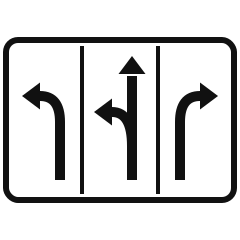
- Turn right or go straight
- Turn left only
- Go straight only
- Turn left or go straight
90.You pass a ministry-approved driver-education course while holding a G1. How soon can you finish Level One?
- After 6 months
- After 8 months
- After 4 months
- After 10 months
91.You stop at a school crossing where a crossing guard is helping children across. When may you go?
- When the children leave your lane
- After waiting about ten seconds
- When everyone has fully crossed
- When they reach the centre line
92.You notice two chevrons painted above a bicycle symbol in your lane. What does this marking tell you?
- Bikes and vehicles share this lane
- The lane is for bicycles only
- A bike lane starts at the next block
- Vehicles may not enter the lane
93.A driver with no alcohol-related history is convicted of dangerous driving under the Criminal Code. Which remedial measure applies?
- A warn-range education course
- A driver-improvement interview
- An ignition interlock only
- The Back on Track program
94.When should you turn on your right signal to leave a roundabout?
- After passing the exit before yours
- As soon as you enter the roundabout
- Two exits before the one you want to take
- Only once you are on the exit road
95.An underpass warning sign shows a measurement. Who needs to pay most attention to it?
- Motorcycle riders
- Drivers of tall vehicles
- Drivers of small cars
- Drivers towing a short trailer
96.You are stopping for a red light. There is no stop line, but there is an unmarked crosswalk. Where should you stop?
- At the edge of the intersection
- At the crosswalk
- Three car lengths back
- In the middle of the crosswalk
97.You are not trained in first aid. A collision victim seems to be in shock. What can you do?
- Cover them with a jacket or blanket
- Lay them down in a cold, shaded spot
- Make them walk around
- Give them a drink of water
98.What does it mean to 'overdrive' your headlights?
- Your high beams are aimed too high above the road
- You can't stop within the range you can see
- You use high beams near other cars
- Your headlights are left on in daylight
99.How may you program your GPS while driving?
- By typing at a red light
- By typing at low speed
- Only with one hand
- Only by voice commands
100.Which of these is an example of courteous driving?
- Speeding up when someone signals
- Driving close so no one cuts in
- Using the horn to hurry slow drivers
- Leaving room for others to change lanes
Answer key with explanations
1. D — 3
Failing to stop for a school-crossing guard can bring a substantial fine plus three demerit points.
Stopping and parking · Based on: MTO Driver's Handbook (online edition, 2026), Ch. 2 Driving safely and responsibly, Stopping — Stopping at school crossings
2. C — Once the vehicle is under control
Once in control, steer toward the pavement and be ready to correct your steering and speed up when the wheels are fully back on.
Emergencies and collisions · Based on: MTO Driver's Handbook (online edition, 2026), Ch. 2 Driving safely and responsibly, Dealing with emergencies — If your wheels go off the pavement
3. B — Tires riding on top of water
With too much water or too much speed, tires can ride on the water like water skis, making control very difficult.
Night driving and bad weather · Based on: MTO Driver's Handbook (online edition, 2026), Ch. 2 Driving safely and responsibly, Driving at night and in bad weather — Rain
4. C — You could be charged with careless driving
Eating is not covered by the distracted-driving law itself, but distracted behaviour that endangers others can still bring careless or dangerous driving charges.
Special situations on the road · Based on: MTO Driver's Handbook (online edition, 2026), Ch. 2 Driving safely and responsibly, Dealing with particular situations — Distracted driving
5. B — Two seconds
In normal conditions, keep at least a two-second gap, measured between the two vehicles passing a fixed point. Increase the gap when visibility, traction, traffic or other conditions require more stopping room.
Safe, responsible and efficient driving · Based on: MTO Driver's Handbook (online edition, 2026), Ch. 2 Driving safely and responsibly, Driving efficiently — 10 ways you can help make Ontario's roads the safest in North America
6. D — When the engine is cold
Detailed under-hood checks of oil, coolant, belts and hoses should be done when the engine is cold.
Your vehicle: maintenance, insurance and registration · Based on: MTO Driver's Handbook (online edition, 2026), Ch. 7 Your vehicle, Maintaining your vehicle — Driver Habits
7. C — A single flashing light
A traffic beacon is one flashing light hung over an intersection, mounted over signs or placed on obstacles in the road.
Traffic lights and pedestrian signals · Based on: MTO Driver's Handbook (online edition, 2026), Ch. 3 Traffic signs and lights, Traffic lights — Traffic beacons
8. D — 6
Careless driving carries six demerit points, the same as racing and failing to stop for a school bus.
Demerit points and keeping your licence · Based on: MTO Driver's Handbook (online edition, 2026), Ch. 4 Keeping your driver's licence, Keeping your driver's licence — Table of offences
9. D — 46 km
Interchange numbers are distances from the freeway's start, so subtract one from the other: 250 − 204 = 46 km.
Construction, information and direction signs · Based on: MTO Driver's Handbook (online edition, 2026), Ch. 3 Traffic signs and lights, Signs — Information and direction signs
10. D — Wear it over her shoulder
The shoulder strap must go over the shoulder, never under the arm or behind the back, or it cannot protect her.
Getting ready to drive · Based on: MTO Driver's Handbook (online edition, 2026), Ch. 2 Driving safely and responsibly, Getting ready to drive — Fasten your seatbelt
11. C — Take the next exit
Never stop or reverse on a freeway if you miss an exit; continue to the next exit.
Freeway driving · Based on: MTO Driver's Handbook (online edition, 2026), Ch. 2 Driving safely and responsibly, Freeway driving — Leaving a freeway
12. A — Wider broken lines spaced closer together
Continuity lines are broken lines that are wider and closer together than ordinary broken lane lines.
Pavement markings · Based on: MTO Driver's Handbook (online edition, 2026), Ch. 3 Traffic signs and lights, Pavement markings — Diagram 3-4: continuity lines
13. D — No U-turns allowed
The U-shaped arrow inside a red circle and slash means U-turns are not allowed.
Regulatory signs · Based on: MTO Driver's Handbook (online edition, 2026), Ch. 3 Traffic signs and lights, Signs — Regulatory signs
14. B — At least 10 days
You must wait a minimum of 10 days between road tests, giving you time to practise the skills on your report.
Graduated licensing: G1, G2 and G · Based on: MTO Driver's Handbook (online edition, 2026), Ch. 1 Getting your driver's licence, Getting your driver's licence — Road tests
15. A — They are slowing down or stopping
A left arm bent down at a right angle is the hand signal for slowing or stopping.
Driving along and intersections · Based on: MTO Driver's Handbook (online edition, 2026), Ch. 2 Driving safely and responsibly, Driving along — Use of turn signals and brake lights
16. D — Do not pass it
A vehicle stopped at a crosswalk may be waiting for a pedestrian you cannot see, so never pass it.
Sharing the road · Based on: MTO Driver's Handbook (online edition, 2026), Ch. 2 Driving safely and responsibly, Sharing the road with other road users — Sharing the road with pedestrians
17. D — One year
Ontario’s current impaired-driving policy lists a licence suspension of at least one year for a first criminal impaired-driving conviction, along with other requirements.
Impaired driving and other suspensions · Based on: Ontario — current impaired-driving penalties (checked 2026-10-18).
18. D — Stay behind it and turn after it does
Motorcycles, bicycles and mopeds turn left like larger vehicles; don't pull alongside to turn with them, and wait for them to move right before passing.
Turning, signalling and changing lanes · Based on: MTO Driver's Handbook (online edition, 2026), Ch. 2 Driving safely and responsibly, Changing directions — Left turns
19. A — Yield to buses entering the road
This sign warns that buses may enter the roadway from the right; be ready to yield to them.
Warning signs · Based on: MTO Driver's Handbook (online edition, 2026), Ch. 3 Traffic signs and lights, Signs — Warning signs
20. C — Turned sharply to the right
Without a curb, turn the wheels sharply right so that if the vehicle rolls back it goes off the road instead of into traffic.
Stopping and parking · Based on: MTO Driver’s Handbook — parking along roadways, distances and right-side parking
21. D — The tow operator's name and licence number
Get the name and licence number of the tow operator or company, and be sure you know where your vehicle is being taken.
Emergencies and collisions · Based on: MTO Driver's Handbook (online edition, 2026), Ch. 2 Driving safely and responsibly, Dealing with emergencies — In a collision where no one is injured
22. B — The right edge of the road
The handbook advises following the right edge of the road and pavement markings rather than the centre line in fog.
Night driving and bad weather · Based on: MTO Driver's Handbook (online edition, 2026), Ch. 2 Driving safely and responsibly, Driving at night and in bad weather — Fog
23. A — Pull off and rest in a safe place
Not recalling recent kilometres is one of the eight warning signs; you should park somewhere safe and secure, lock up and take a nap.
Special situations on the road · Based on: MTO Driver's Handbook (online edition, 2026), Ch. 2 Driving safely and responsibly, Dealing with particular situations — Drowsy driving
24. A — About 30 seconds
The handbook gives about 30 seconds as general initial warm-up advice. This does not mean the engine reaches its full operating temperature in that time. Follow your vehicle’s instructions and clear windows before driving.
Safe, responsible and efficient driving · Based on: MTO Driver's Handbook (online edition, 2026), Ch. 2 Driving safely and responsibly, Driving efficiently — While driving
25. A — 30 days
New residents have 30 days to register their vehicles, a shorter period than the 60 days allowed for their licence.
Your vehicle: maintenance, insurance and registration · Based on: MTO Driver's Handbook (online edition, 2026), Ch. 7 Your vehicle, Vehicle insurance and registration — New residents
26. B — By stop signs
An intersection pedestrian signal has traffic lights on the main road only; the quieter crossroad is controlled by stop signs.
Traffic lights and pedestrian signals · Based on: MTO Driver's Handbook (online edition, 2026), Ch. 3 Traffic signs and lights, Pedestrian signals — Intersection pedestrian signals
27. A — 5
This is the only five-point offence in the table, applying to bus drivers at unprotected railway crossings.
Demerit points and keeping your licence · Based on: MTO Driver's Handbook (online edition, 2026), Ch. 4 Keeping your driver's licence, Keeping your driver's licence — Table of offences
28. D — Speeding while workers are present
This sign enforces doubled Highway Traffic Act fines for speeding in a designated construction zone when workers are present.
Construction, information and direction signs · Based on: MTO Driver's Handbook (online edition, 2026), Ch. 3 Traffic signs and lights, Signs — Temporary condition signs
29. C — You, the driver
Drivers are responsible for making sure every passenger under 16 is properly secured in a seatbelt, booster or car seat.
Getting ready to drive · Based on: MTO Driver's Handbook (online edition, 2026), Ch. 2 Driving safely and responsibly, Getting ready to drive — Child safety
30. B — Losing your sense of how fast you are going
After driving fast for a while, slower speeds feel slower than they are; check your speedometer, especially when leaving a freeway.
Freeway driving · Based on: MTO Driver's Handbook (online edition, 2026), Ch. 2 Driving safely and responsibly, Freeway driving — Leaving a freeway
31. C — Stop before the line and yield
The crossover rule applies to cyclists as well as drivers: stop before the line and yield until pedestrians are off the road.
Pavement markings · Based on: MTO Driver's Handbook (online edition, 2026), Ch. 3 Traffic signs and lights, Pavement markings — Diagram 3-8: pedestrian crossover
32. B — Turning right while facing a red light
This sign only bans right turns when you face a red light; you may still turn right on a green if it is safe.
Regulatory signs · Based on: MTO Driver's Handbook (online edition, 2026), Ch. 3 Traffic signs and lights, Signs — Regulatory signs
33. A — Less than .05%
A qualified accompanying driver aged over 21 must have a blood-alcohol level below .05% while supervising a G1 driver. Young drivers aged 21 or under are subject to zero-alcohol rules.
Graduated licensing: G1, G2 and G · Based on: Current official Ontario licensing requirements; graduated licensing and road tests (checked 2026-10-18).
34. B — It has large blind spots
Large commercial vehicles usually have big blind spots to the sides and rear, so don't linger where the driver can't see you.
Driving along and intersections · Based on: MTO Driver's Handbook (online edition, 2026), Ch. 2 Driving safely and responsibly, Driving along — Driving along
35. D — When everyone is safely on the sidewalk
Drivers must stop and yield the whole road at school crossings, moving on only once the guard and pedestrians are off the road.
Sharing the road · Based on: MTO Driver's Handbook (online edition, 2026), Ch. 2 Driving safely and responsibly, Sharing the road with other road users — Sharing the road with pedestrians
36. C — Two years
Violating a Criminal Code prohibition order brings a one-year suspension for a first offence and two years for a later one.
Impaired driving and other suspensions · Based on: MTO Driver's Handbook (online edition, 2026), Ch. 5 Other ways to lose your licence, Other ways to lose your licence — Driving while prohibited
37. B — Keep circling until you reach your exit again
Don't stop or change lanes inside a roundabout; if you miss your exit from the inside lane, continue around until you come back to it.
Turning, signalling and changing lanes · Based on: MTO Driver's Handbook (online edition, 2026), Ch. 2 Driving safely and responsibly, Changing directions — Driving through roundabouts
38. B — Drivers on both roads
Where two roads going the same direction join, drivers on both roads are equally responsible for merging safely.
Warning signs · Based on: MTO Driver's Handbook (online edition, 2026), Ch. 3 Traffic signs and lights, Signs — Warning signs
39. C — At least 5 metres
When a train is coming, stop at least five metres from the nearest rail or gate and don't cross until all trains have passed.
Stopping and parking · Based on: MTO Driver's Handbook (online edition, 2026), Ch. 2 Driving safely and responsibly, Stopping — Stopping at railway crossings
40. C — The door away from traffic
If possible, leave through the door on the side away from traffic to avoid being hit.
Emergencies and collisions · Based on: MTO Driver's Handbook (online edition, 2026), Ch. 2 Driving safely and responsibly, Dealing with emergencies — If you have trouble on a freeway
41. D — Stay back and don't pass between them
There isn't enough room between staggered plows, and the ridge of snow can throw your vehicle out of control.
Night driving and bad weather · Based on: MTO Driver's Handbook (online edition, 2026), Ch. 2 Driving safely and responsibly, Driving at night and in bad weather — Snow plows
42. C — Talking on a Bluetooth hands-free device
Hands-free devices with an earpiece, lapel button or Bluetooth are allowed, although any distraction that endangers others can still lead to a careless driving charge.
Special situations on the road · Based on: MTO Driver's Handbook (online edition, 2026), Ch. 2 Driving safely and responsibly, Dealing with particular situations — Distracted driving
43. A — You may be found partly responsible
Everyone must try to avoid collisions; if you could have prevented one, you may share responsibility even when the other driver broke the law.
Safe, responsible and efficient driving · Based on: MTO Driver's Handbook (online edition, 2026), Ch. 2 Driving safely and responsibly, Safe and responsible driving — Introduction
44. B — Windows and vents are usually closed
In winter drivers keep windows and vents closed, so a faulty exhaust is more dangerous; have it checked if it is noisy.
Your vehicle: maintenance, insurance and registration · Based on: MTO Driver's Handbook (online edition, 2026), Ch. 7 Your vehicle, Maintaining your vehicle — Winter maintenance
45. B — A white vertical bar on a dark background
The transit priority signal is a round light mounted above a regular signal that shows a white vertical bar on a dark background.
Traffic lights and pedestrian signals · Based on: MTO Driver's Handbook (online edition, 2026), Ch. 3 Traffic signs and lights, Traffic lights — Transit priority signals
46. A — 3
Ontario lists three demerit points for a first distracted-driving conviction with a full G licence. A repeat conviction within five years carries six points. Novice drivers instead face longer suspensions without demerit points.
Demerit points and keeping your licence · Based on: Ontario — licence suspension and demerit rules for the specified offence
47. A — A temporary detour from the usual route
An orange detour sign means traffic is being sent on a temporary route away from the normal one.
Construction, information and direction signs · Based on: MTO Driver's Handbook (online edition, 2026), Ch. 3 Traffic signs and lights, Signs — Temporary condition signs
48. B — Put your feet flat under the brake pedal
If you can put your feet flat on the floor under the brake pedal without stretching, you are seated properly.
Getting ready to drive · Based on: MTO Driver's Handbook (online edition, 2026), Ch. 2 Driving safely and responsibly, Getting ready to drive — Get into position
49. B — You must speed up more quickly to merge
A left-side ramp puts you straight into the fastest lane, so use the acceleration lane to reach traffic speed more quickly.
Freeway driving · Based on: MTO Driver's Handbook (online edition, 2026), Ch. 2 Driving safely and responsibly, Freeway driving — Entering a freeway
50. A — Your lane is ending or exiting
Continuity lines on your left usually mean your lane ends or exits, so change lanes if you want to keep going the same way.
Pavement markings · Based on: MTO Driver's Handbook (online edition, 2026), Ch. 3 Traffic signs and lights, Pavement markings — Diagram 3-4: continuity lines
51. A — Do not enter this road
The red circle with a white bar means do not enter this road.
Regulatory signs · Based on: MTO Driver's Handbook (online edition, 2026), Ch. 3 Traffic signs and lights, Signs — Regulatory signs
52. B — No, G1 drivers may not drive from midnight to 5 a.m.
Level One drivers are not allowed to drive at all between midnight and 5 a.m., even with an accompanying driver.
Graduated licensing: G1, G2 and G · Based on: MTO Driver's Handbook (online edition, 2026), Ch. 1 Getting your driver's licence, Getting your driver's licence — Level One (Class G1)
53. A — Stop when it turns yellow
A stale green may change soon, so be prepared to stop on yellow unless you are already too close to stop safely.
Driving along and intersections · Based on: MTO Driver's Handbook (online edition, 2026), Ch. 2 Driving safely and responsibly, Driving through intersections — Controlled intersections
54. D — A solid white line
Bike lanes are reserved for cyclists and are usually separated from traffic by a solid white line.
Sharing the road · Based on: MTO Driver's Handbook (online edition, 2026), Ch. 2 Driving safely and responsibly, Sharing the road with other road users — Sharing the road with cyclists
55. A — At least one year
Ontario’s current impaired-driving policy requires an ignition interlock for at least one year after a first criminal impaired-driving conviction, alongside a licence suspension and education or treatment.
Impaired driving and other suspensions · Based on: Ontario — current impaired-driving penalties (checked 2026-10-18).
56. D — Drop back and return to your original lane
Don't race a vehicle that speeds up while you pass; go back to your lane. The other driver speeding up is unlawful and dangerous.
Turning, signalling and changing lanes · Based on: MTO Driver's Handbook (online edition, 2026), Ch. 2 Driving safely and responsibly, Changing positions — Passing
57. A — The pavement narrows ahead
Both road edges stepping inward show that the paved road becomes narrower ahead.
Warning signs · Based on: MTO Driver's Handbook (online edition, 2026), Ch. 3 Traffic signs and lights, Signs — Warning signs
58. A — No, the permit holder must be with you
You may use a designated space only if the displayed permit belongs to you or one of your passengers.
Stopping and parking · Based on: MTO Driver's Handbook (online edition, 2026), Ch. 2 Driving safely and responsibly, Parking along roadways — Parking for people with disabilities
59. C — Smoking, matches or flares near vehicles
Keep flames away from the vehicles in case of a fuel leak; turn engines off and flashers on.
Emergencies and collisions · Based on: MTO Driver's Handbook (online edition, 2026), Ch. 2 Driving safely and responsibly, Dealing with emergencies — In a collision where someone is injured
60. B — Ease off slightly, then reapply
Threshold braking means braking as hard as possible without locking; ease off slightly when a wheel locks, then re-apply, and don't pump.
Night driving and bad weather · Based on: MTO Driver's Handbook (online edition, 2026), Ch. 2 Driving safely and responsibly, Driving at night and in bad weather — Threshold braking
61. B — 43 per cent
Collisions rose from 8,964 in 1999 to 12,791 in 2008, about a 43 per cent increase, and many go unreported.
Special situations on the road · Based on: MTO Driver's Handbook (online edition, 2026), Ch. 2 Driving safely and responsibly, Dealing with particular situations — Animals on the road
62. A — Visibility, space and communication
Defensive driving means seeing and being seen, keeping a space cushion around you, and making sure others know what you plan to do.
Safe, responsible and efficient driving · Based on: MTO Driver's Handbook (online edition, 2026), Ch. 2 Driving safely and responsibly, Safe and responsible driving — Defensive driving
63. D — Rotating them regularly
Keeping the right pressure, inspecting tires, rotating them regularly and driving smoothly all extend tire life.
Your vehicle: maintenance, insurance and registration · Based on: MTO Driver's Handbook (online edition, 2026), Ch. 7 Your vehicle, Maintaining your vehicle — Tires
64. C — When facing a steady green light
Without pedestrian signals, pedestrians may cross on a green light but not on a flashing green or a left-turn green arrow.
Traffic lights and pedestrian signals · Based on: MTO Driver's Handbook (online edition, 2026), Ch. 3 Traffic signs and lights, Pedestrian signals — Pedestrian signals
65. A — 4
Once the novice suspension ends, the record is reduced to four points, so a few more offences can quickly push it back up.
Demerit points and keeping your licence · Based on: MTO Driver's Handbook (online edition, 2026), Ch. 4 Keeping your driver's licence, Keeping your driver's licence — New drivers: Level One and Level Two
66. D — The Highway Traffic Act
The fines-doubled sign enforces doubling of Highway Traffic Act (HTA) speeding fines when workers are present.
Construction, information and direction signs · Based on: MTO Driver's Handbook (online edition, 2026), Ch. 3 Traffic signs and lights, Signs — Temporary condition signs
67. B — Use the angle range on the seat or in its manual
Transport Canada says to use the recline-angle range marked on the specific seat or in its manual, appropriate for the child’s weight. Follow both the child-seat and vehicle instructions. A general 45-degree example does not replace the manufacturer’s requirements.
Getting ready to drive · Based on: MTO Driver's Handbook (online edition, 2026), Ch. 2 Driving safely and responsibly, Getting ready to drive — Seatbelts and child car seats save lives
68. C — No, crossing the buffer is illegal
Crossing the striped buffer is illegal and unsafe; enter and leave the HOV lane only at the designated entry/exit zones.
Freeway driving · Based on: MTO Driver's Handbook (online edition, 2026), Ch. 2 Driving safely and responsibly, Freeway driving — High Occupancy Vehicle (HOV) Lane
69. C — Whether you can finish before it turns solid
You may pass on a broken line only if there are enough broken lines ahead to complete the pass safely.
Pavement markings · Based on: MTO Driver's Handbook (online edition, 2026), Ch. 3 Traffic signs and lights, Pavement markings — Diagram 3-3: broken line
70. C — At the stop line
When a stop line is marked, that is where your vehicle must stop; the other stopping points only apply when there is no line.
Regulatory signs · Based on: MTO Driver's Handbook (online edition, 2026), Ch. 3 Traffic signs and lights, Signs — Stop sign
71. B — 20 months
The G1 and G2 levels together take at least 20 months, even with a driver-education course shortening Level One.
Graduated licensing: G1, G2 and G · Based on: MTO Driver's Handbook (online edition, 2026), Ch. 1 Getting your driver's licence, Getting your driver's licence — Graduated licensing
72. C — You are fined and get demerit points
Ontario prohibits radar-detecting speed-measurement warning devices. Driving with such a device can bring a fine and demerit points.
Driving along and intersections · Based on: MTO Driver’s Handbook — Driving along (checked 2026-10-18).
73. A — To avoid potholes or a sewer grate
Cyclists may use any part of the lane when needed for safety, such as steering around potholes, debris, ice or sewer grates.
Sharing the road · Based on: MTO Driver's Handbook (online edition, 2026), Ch. 2 Driving safely and responsibly, Sharing the road with other road users — Sharing the road with cyclists
74. D — Six months to the suspension
Driving under an HTA suspension adds six months to the current suspension, and a court may also order up to six months in jail.
Impaired driving and other suspensions · Based on: MTO Driver's Handbook (online edition, 2026), Ch. 5 Other ways to lose your licence, Other ways to lose your licence — Driving under suspension
75. D — When it is turning left
Passing on the right is allowed on multi-lane or one-way roads, and when overtaking a streetcar or a vehicle turning left.
Turning, signalling and changing lanes · Based on: MTO Driver's Handbook (online edition, 2026), Ch. 2 Driving safely and responsibly, Changing positions — Passing on the right
76. A — A farm tractor
Farm tractors, farm machinery and vehicles that cannot sustain speeds over 40 km/h must show the sign on a road.
Warning signs · Based on: MTO Driver's Handbook (online edition, 2026), Ch. 3 Traffic signs and lights, Signs — Other signs — slow-moving vehicle
77. B — Stop at the crossing, without its red lights
School buses must stop at every railway crossing, protected or not, and they don't use the upper red lights for these stops, so stay alert behind them.
Stopping and parking · Based on: MTO Driver's Handbook (online edition, 2026), Ch. 2 Driving safely and responsibly, Stopping — Stopping at railway crossings
78. C — At the first sign of trouble
Begin pulling over as soon as trouble appears rather than waiting for your vehicle to stall in a live lane.
Emergencies and collisions · Based on: MTO Driver's Handbook (online edition, 2026), Ch. 2 Driving safely and responsibly, Dealing with emergencies — If you have trouble on a freeway
79. C — Stay with the car and run the engine sparingly
Stay with the vehicle, use emergency flashers and open a window slightly for ventilation. Run the engine only sparingly and only if the exhaust pipe is clear of snow; check it regularly to prevent carbon monoxide from entering. Public Safety Canada recommends this additional exhaust precaution.
Night driving and bad weather · Based on: MTO Driver's Handbook (online edition, 2026), Ch. 2 Driving safely and responsibly, Driving at night and in bad weather — Whiteouts
80. D — At the closest curb or edge
On a one-way road or divided highway with more than two lanes, move to the nearest curb or edge of the roadway and stop.
Special situations on the road · Based on: MTO Driver's Handbook (online edition, 2026), Ch. 2 Driving safely and responsibly, Dealing with particular situations — Reacting to an approaching emergency vehicle
81. D — Your horn
Communicating with others is part of defensive driving, and the horn is the tool for getting another person's attention.
Safe, responsible and efficient driving · Based on: MTO Driver's Handbook (online edition, 2026), Ch. 2 Driving safely and responsibly, Safe and responsible driving — Defensive driving
82. B — Booster cables
Winter supplies should include a shovel, booster cables, flares or warning lights, a blanket and a towing chain.
Your vehicle: maintenance, insurance and registration · Based on: MTO Driver's Handbook (online edition, 2026), Ch. 7 Your vehicle, Maintaining your vehicle — Winter maintenance
83. D — As an all-way stop
When signals are blank from a power loss, you go cautiously and use the intersection as you would one with stop signs on all corners.
Traffic lights and pedestrian signals · Based on: MTO Driver's Handbook (online edition, 2026), Ch. 3 Traffic signs and lights, Traffic lights — Blank traffic lights
84. B — Two years from the offence date
Demerit points are recorded when you are convicted and remain on your record for two years counted from the date of the offence.
Demerit points and keeping your licence · Based on: MTO Driver's Handbook (online edition, 2026), Ch. 4 Keeping your driver's licence, Keeping your driver's licence — The demerit point system
85. A — Read the language you understand best
In bilingual areas, read the message in whichever language you understand best.
Construction, information and direction signs · Based on: MTO Driver's Handbook (online edition, 2026), Ch. 3 Traffic signs and lights, Signs — Bilingual signs
86. A — 4 metres
Sit high enough to see over the wheel and hood and see the ground four metres ahead; use a firm cushion if needed.
Getting ready to drive · Based on: MTO Driver's Handbook (online edition, 2026), Ch. 2 Driving safely and responsibly, Getting ready to drive — Get into position
87. A — Once you are in the deceleration lane
Signal and move into the deceleration lane without slowing, then reduce speed gradually to the posted ramp speed.
Freeway driving · Based on: MTO Driver's Handbook (online edition, 2026), Ch. 2 Driving safely and responsibly, Freeway driving — Leaving a freeway
88. B — Traffic moving in opposite directions
Yellow lines divide traffic going opposite ways, while white lines divide lanes of traffic going the same way.
Pavement markings · Based on: MTO Driver's Handbook (online edition, 2026), Ch. 3 Traffic signs and lights, Pavement markings — Diagram 3-1: yellow and white lines
89. D — Turn left or go straight
Lane-use signs show the direction each lane must travel. Here the middle lane's arrows allow a left turn or straight ahead.
Regulatory signs · Based on: MTO Driver's Handbook (online edition, 2026), Ch. 3 Traffic signs and lights, Signs — Regulatory signs
90. B — After 8 months
An approved BDE course takes four months off the 12-month Level One period, letting you finish in eight months.
Graduated licensing: G1, G2 and G · Based on: MTO Driver's Handbook (online edition, 2026), Ch. 1 Getting your driver's licence, Getting your driver's licence — Level One (Class G1)
91. C — When everyone has fully crossed
At school crossings with a crossing guard you must wait until pedestrians have completely crossed the road.
Driving along and intersections · Based on: MTO Driver's Handbook (online edition, 2026), Ch. 2 Driving safely and responsibly, Driving through intersections — Yielding the right-of-way
92. A — Bikes and vehicles share this lane
A sharrow shows a shared lane where either cars or bicycles may be travelling, an extra reminder to watch for cyclists.
Sharing the road · Based on: MTO Driver's Handbook (online edition, 2026), Ch. 2 Driving safely and responsibly, Sharing the road with other road users — Sharing the road with cyclists
93. B — A driver-improvement interview
Drivers convicted of non-drinking Criminal Code driving offences, with no prior alcohol convictions, must complete a ministry driver-improvement interview.
Impaired driving and other suspensions · Based on: MTO Driver's Handbook (online edition, 2026), Ch. 5 Other ways to lose your licence, Other ways to lose your licence — Driver-improvement interview
94. A — After passing the exit before yours
Signal right once you have passed the exit just before yours, so other drivers know you are about to leave.
Turning, signalling and changing lanes · Based on: MTO Driver's Handbook (online edition, 2026), Ch. 2 Driving safely and responsibly, Changing directions — Driving through roundabouts
95. B — Drivers of tall vehicles
The underpass sign shows how much room there is, which matters if you are driving a tall vehicle.
Warning signs · Based on: MTO Driver's Handbook (online edition, 2026), Ch. 3 Traffic signs and lights, Signs — Warning signs
96. B — At the crosswalk
With no stop line, stop at the crosswalk whether or not it is marked; if there is no crosswalk, stop at the edge of the sidewalk.
Stopping and parking · Based on: MTO Driver's Handbook (online edition, 2026), Ch. 2 Driving safely and responsibly, Stopping — Where to stop
97. A — Cover them with a jacket or blanket
People in collisions often go into shock, and covering them with a jacket or blanket helps reduce its effects.
Emergencies and collisions · Based on: MTO Driver's Handbook (online edition, 2026), Ch. 2 Driving safely and responsibly, Dealing with emergencies — In a collision where someone is injured
98. B — You can't stop within the range you can see
Overdriving happens when your speed means you need more distance to stop than your headlights let you see, leaving no room for a safe stop.
Night driving and bad weather · Based on: MTO Driver's Handbook (online edition, 2026), Ch. 2 Driving safely and responsibly, Driving at night and in bad weather — Overdriving your headlights
99. D — Only by voice commands
Programming a GPS while driving is illegal except by voice; you may view a GPS screen that is built in or securely mounted.
Special situations on the road · Based on: MTO Driver's Handbook (online edition, 2026), Ch. 2 Driving safely and responsibly, Dealing with particular situations — Distracted driving
100. D — Leaving room for others to change lanes
Courtesy means giving other drivers space to change lanes, not cutting them off, and signalling turns and lane changes properly.
Safe, responsible and efficient driving · Based on: MTO Driver's Handbook (online edition, 2026), Ch. 2 Driving safely and responsibly, Safe and responsible driving — Introduction
Original practice questions by Canada Exam Prep, written from the official handbook. Not official test questions. Free to print for personal study.
FAQ
G1 questions and answers (printable PDF): common questions
Is there an official G1 test PDF?
The Ministry does not publish the test questions. The official study material is the MTO Driver's Handbook, free to read online at ontario.ca. Practice question PDFs online, including this one, are written by third parties.
How do I save this page as a PDF?
Press Print or save as PDF, then choose Save as PDF as the printer on your phone or computer. The site header, buttons and ads are hidden in the printed version.
Are the answers included?
Yes. The answer key starts on a new page after question 100, with the correct letter, the answer, a short explanation and the handbook section for each question.
Keep practising
- G1 road signs test60 Ontario road sign, traffic light and pavement marking questions for the signs section of the G1 test, each with the handbook rule explained.
- G1 rules of the road test60 rules-of-the-road questions for the G1 test: licensing, right-of-way, turning, parking, school buses, emergency vehicles, demerits and impaired driving.
- G1 practice test – 200 questionsOne long 200-question G1 practice test covering every chapter of the Ontario handbook, with instant feedback and an explanation for each answer.
- Ontario road signs chartEvery road sign in our G1 question bank on one page: regulatory, warning, construction and guide signs, each with what it means and what to do.
- Ontario G1 study guide
- How to get a G1 licence in Ontario
- G2 road test guide
- G road test guide
- Ontario G1 Mock Exam 1 – 40 QuestionsUntimed practice · answers explained
- Ontario G1 Mock Exam 2 – 40 QuestionsUntimed practice · answers explained
- Ontario G1 Practice Test 140 questions with explanations
- Ontario G1 Practice Test 240 questions with explanations
- Ontario G1 Practice Test 340 questions with explanations
Practice by topic
- Regulatory signsStop, yield, school zone and railway crossbuck shapes, permissive and prohibitive signs, no stopping, standing and parking, community safety zones, school bus and HOV lane signs.
- Warning signsYellow diamond warning signs for curves, hills, merges, lane endings, crossings, animals and hazards, plus the slow-moving vehicle and long commercial vehicle placards.
- Construction, information and direction signsOrange temporary condition signs in work zones, doubled construction-zone fines, green guide signs, freeway exit numbering, emergency detour routes and bilingual signs.
- Traffic lights and pedestrian signalsGreen, yellow and red lights, turns on red, advance green and left-turn arrows, flashing lights, transit priority signals, dark signals during power failures and pedestrian signals.
- Pavement markingsYellow and white lines, solid and broken lines, continuity lines, stop lines, crosswalks, lane arrows, pedestrian crossovers and markings around obstacles.
- Graduated licensing: G1, G2 and GG1 and G2 conditions, the accompanying driver, zero blood alcohol, highway and night limits, passenger limits for young drivers, waiting periods, road tests and new residents.
- Getting ready to driveSeat belts and who is responsible, child car seats and booster seats, seat, head restraint and mirror adjustment, blind spots and pre-trip checks.
- Driving along and intersectionsSteering, signalling, speed and following distance, scanning ahead, controlled and uncontrolled intersections, four-way stops and yielding the right-of-way.
- Turning, signalling and changing lanesRight and left turns, turns on red, left-turn lanes, roundabouts, backing up, U-turns and turning around, lane changes, passing, climbing lanes and passing streetcars.
- Stopping and parkingBraking, where to stop, railway crossings, school crossings and school buses, pedestrian crossovers, parallel parking, parking on a hill, accessible parking and roadside stops.
- Freeway drivingEntering and leaving a freeway, acceleration and deceleration lanes, lane choice, passing, HOV and toll lanes, and freeway safety.
- Special situations on the roadEmergency vehicles and the move-over law, construction zones, animals on the road, drowsy and distracted driving, aggressive driving, road rage and street racing.
- Night driving and bad weatherHeadlight rules and distances, glare, rain, hydroplaning, fog, snow, whiteouts, black ice, skids and winter driving.
- Emergencies and collisionsBrake failure, stuck accelerator, blowouts, running off the pavement, breakdowns, what to do at a collision and reporting thresholds.
- Sharing the roadPedestrians, cyclists and the one-metre passing rule, motorcycles, large trucks and blind spots, buses, farm machinery, horse-drawn vehicles and snowmobiles.
- Safe, responsible and efficient drivingDistracted driving and hand-held device rules, fatigue, defensive driving, and fuel-efficient driving habits.
- Demerit points and keeping your licenceDemerit point values for common offences, novice and fully licensed driver thresholds, interviews and suspensions, and licence renewal.
- Impaired driving and other suspensionsAlcohol and drug impairment, roadside suspensions, warn-range penalties, ignition interlock, stunt driving and street racing, and other ways to lose your licence.
- Your vehicle: maintenance, insurance and registrationBasic vehicle maintenance, tires and brakes, mandatory insurance, ownership permits, licence plates and what to carry.