What does a stop line look like?
Ontario G1 overview
Ontario G1 Practice Test 7
40 questions on pavement markings, safe, responsible and efficient driving, getting ready to drive, freeway driving, stopping and parking and more.
- No sign-up
- Every answer explained
- Independent · not a government site
- Set 7 of 15
- 40 questions
- Instant feedback
0/40
All 40 questions in this test
Every question and its answer choices. The correct answers and explanations appear when you take the test above.
What does a stop line look like?
- A single white line across the road
- Two parallel white lines across the road
- A white X painted in each lane
- A single yellow line across the road
How does keeping your tires properly inflated help?
- It increases your top speed
- It cuts fuel use, emissions and tire wear
- It lets you skip wheel alignments
- It shortens your following distance
Your seat has an active airbag. Do you still need to wear your seatbelt?
- Yes, airbags do not replace seatbelts
- Only if you sit in the back
- No, the airbag protects you in a crash
- Only on highways
You are leaving the freeway. When should you begin to slow down?
- Once you are in the deceleration lane
- At the start of the exit ramp curve
- Before you signal for the exit
- While still in the through lane
When are provincial HOV lanes in effect?
- 6 a.m. to 7 p.m. on weekdays
- Weekday rush hours only
- 24 hours a day, seven days a week
- Only during posted special events
You are following a school bus toward a railway crossing that has gates and signal lights. What should you expect the bus to do?
- Stop with its upper red lights flashing
- Stop at the crossing, without its red lights
- Cross without stopping, since it has gates
- Stop only if the signal lights are flashing
What does this sign mean?

- A temporary detour from the usual route
- Trucks must take another route
- A new road has opened ahead
- The road ahead is closed for good
What does this sign mean?

- Divided highway begins
- Passing lane ahead
- One-way road ahead
- Two-way traffic ahead
You stopped on a freeway shoulder with car trouble. Which door should you use to get out?
- The driver's door, always
- The rear hatch or trunk
- The door away from traffic
- Whichever door is closest
On your 21st birthday you are driving with a full G licence. What blood-alcohol level does the law allow you?
- Zero
- Under .08
- Under .02
- Under .05
A transit priority signal is lit for a bus at the intersection you are approaching. What must you do?
- Yield to the public transit vehicle
- Go ahead; the bus must yield to you
- Pass the bus on its left side
- Follow the bus closely through
According to the MTO handbook, how much more protection do booster seats provide than seatbelts alone?
- 75 per cent more
- 90 per cent more
- 25 per cent more
- 60 per cent more
When must you show proof of insurance?
- Only for commercial vehicles
- Only when buying a used car
- Only after a collision
- To register or renew a vehicle
When are signs like this used?
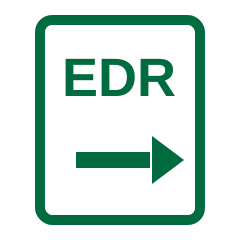
- When a road is closed for planned roadwork
- When police detour traffic off a closed highway
- When an evacuation drill is held
- When a school bus route is changed
Which signal combination works the same way as a flashing green advance light?
- A left-pointing green arrow with a green light
- A left-pointing green arrow with a red light
- A yellow arrow together with a green light
- A flashing yellow light with a red light
What is the correct way to check your blind spot?
- Check your outside mirror only
- Look over your shoulder
- Ask a passenger to look for you
- Glance into your rear-view mirror
Another driver runs a stop sign and hits you, but you could have avoided the crash by braking. How does the handbook view your role?
- You may be found partly responsible
- You are never at fault without a ticket
- Only the other driver can be blamed
- Fault depends on whose car is newer
A bus driver fails to stop at an unprotected railway crossing. How many demerit points apply?
- 5
- 3
- 6
- 4
How should you treat a motorcycle travelling in your lane?
- As if it uses only half a lane
- Like any other vehicle using a full lane
- As a vehicle you may share a lane with
- Like a bicycle near the right edge
You move to Ontario and bring your car. How long do you have to register it here?
- 30 days
- 90 days
- 60 days
- 6 months
You bring a photocopy of your passport to apply for a licence. Will it be accepted?
- Only for a G1 licence
- No, only valid originals
- Yes, if a parent signs it
- Yes, if it is a clear copy
Your light is red and a painted bike box with a white bicycle symbol is ahead. Where must your motor vehicle stop?
- At the front edge of the box
- Inside the painted bike box
- Beside the box in the bike lane
- Behind the painted bike box
You and an oncoming driver are both waiting in the intersection to turn left. After yielding to pedestrians and oncoming traffic, how should the two of you turn?
- Each turns passing to the left of the other
- Each turns passing to the right of the other
- Only one turns; the other waits for a green arrow
- The driver who arrived second goes first
You see this sign at the entrance to a road. What does it mean?

- Do not enter this road
- Emergency vehicles only
- Road closed for winter
- No parking at any time
You are riding a bicycle and someone is using a pedestrian crossover ahead. What must you do?
- Ring your bell and keep going
- Yield only if you are on the road
- Stop before the line and yield
- Ride around the person slowly
A school-crossing guard holds up a red and white stop sign. When may you drive on?
- As soon as the guard lowers the sign
- When everyone, guard included, has cleared the road
- When the children leave your lane
- When the children reach the painted centre line of the road
It is 12:30 a.m. and you hold only a G1 licence. Your accompanying driver is with you. Can you drive?
- Yes, because an accompanying driver is present
- No, G1 drivers may not drive from midnight to 5 a.m.
- No, G1 drivers may not drive after 10 p.m.
- Yes, but only on roads under 80 km/h
Your car starts making strange noises on a freeway. When should you pull over?
- At the next exit, however far
- Only when the engine stalls
- At the first sign of trouble
- When smoke appears
Why should you use low beams rather than high beams in blowing snow?
- High beams drain the battery in cold
- Low beams make the car more visible from behind
- Low beams melt the snow on the road
- High beams reflect off the snow particles
You are behind a motorcycle that is turning left at an intersection. What should you do?
- Pull up beside it and turn together
- Sound your horn so it turns faster
- Pass it on the right before the turn
- Stay behind it and turn after it does
You are stopping at a stop sign and a stop line is painted on the pavement. Where do you stop?
- Wherever you can see cross traffic
- Just past the stop line
- At the stop line
- At the edge of the intersection
A G2 driver who already served one demerit suspension climbs back to 9 points. What suspension may follow?
- 60 days
- Two years
- 30 days
- Six months
On a two-lane highway in your direction, you see a stopped police car with flashing lights on the shoulder. What must you do?
- Stop beside the police car
- Slow down and move over a lane if safe
- Keep your speed and stay in your lane
- Speed up to pass quickly
You reach a flooded stretch of road. What is the safest first choice?
- Avoid entering it and choose a safe alternative route
- Accelerate through it to keep the engine running
- Follow another vehicle closely through the water
- Enter it because road water cannot affect brakes
A fully licensed driver blows in the warn range for the first time. How long is the roadside licence suspension?
- One day
- Seven days
- Three days
- Thirty days
Which of these roads is a G1 driver with a regular (non-instructor) accompanying driver NOT allowed to use?
- A city street posted at 50 km/h
- The Gardiner Expressway
- A residential street posted at 40 km/h
- A two-lane rural highway posted at 80 km/h
A 7-year-old weighs 30 kg and is 146 cm tall. May he use a seatbelt instead of a booster?
- Yes, he meets the height criterion
- No, he must meet all three criteria
- No, he must be eight years old
- No, he must weigh 36 kg
Besides warning of a railway crossing ahead, what extra information does this sign give?
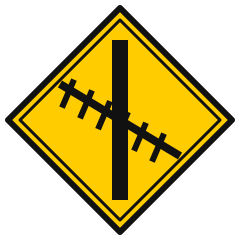
- Whether the crossing has gates
- The angle at which the tracks cross
- How far away the crossing is
- How many trains use the tracks
Using the two-second rule, your car reaches the marker before you finish “one thousand and one, one thousand and two.” What does that mean?
- You are following too closely
- The car ahead is speeding
- You are at a safe distance
- You are driving too slowly
What happens to speeding fines in a construction zone when workers are present?
- They are reduced by half
- They stay the same
- They are doubled
- They are tripled
All Ontario G1 practice tests
- Ontario G1 Mock Exam 1 – 40 QuestionsUntimed practice · answers explained
- Ontario G1 Mock Exam 2 – 40 QuestionsUntimed practice · answers explained
- Ontario G1 Mock Exam 3 – 40 QuestionsUntimed practice · answers explained
- Ontario G1 Mock Exam 4 – 40 QuestionsUntimed practice · answers explained
- Ontario G1 Mock Exam 5 – 40 QuestionsUntimed practice · answers explained
- Regulatory signsStop, yield, school zone and railway crossbuck shapes, permissive and prohibitive signs, no stopping, standing and parking, community safety zones, school bus and HOV lane signs.
- Warning signsYellow diamond warning signs for curves, hills, merges, lane endings, crossings, animals and hazards, plus the slow-moving vehicle and long commercial vehicle placards.
- Construction, information and direction signsOrange temporary condition signs in work zones, doubled construction-zone fines, green guide signs, freeway exit numbering, emergency detour routes and bilingual signs.
- Traffic lights and pedestrian signalsGreen, yellow and red lights, turns on red, advance green and left-turn arrows, flashing lights, transit priority signals, dark signals during power failures and pedestrian signals.
- Pavement markingsYellow and white lines, solid and broken lines, continuity lines, stop lines, crosswalks, lane arrows, pedestrian crossovers and markings around obstacles.
About this practice test
How many questions are in Ontario G1 practice test 7?
40 original multiple-choice practice questions covering pavement markings, safe, responsible and efficient driving, getting ready to drive, freeway driving, stopping and parking, construction, information and direction signs, warning signs, emergencies and collisions, impaired driving and other suspensions, traffic lights and pedestrian signals, your vehicle: maintenance, insurance and registration, driving along and intersections, demerit points and keeping your licence, sharing the road, graduated licensing: g1, g2 and g, turning, signalling and changing lanes, regulatory signs, night driving and bad weather, special situations on the road. Each answer includes an explanation. This mixed practice set does not reproduce the official exam format or predict an official score.
Are the questions the same every time?
Yes. Practice test 7 always has the same 40 questions, so you can repeat it until you get them all right. The other 14 sets use different questions.
Are these real test questions?
No. The official question bank is not published. These are original questions written from the official handbook, which is what the real Ontario G1 test is based on.