An oncoming car at night has very bright headlights. Where should you look?
Ontario G1 overview
Ontario G1 Practice Test 10
40 questions on night driving and bad weather, stopping and parking, impaired driving and other suspensions, demerit points and keeping your licence, turning, signalling and changing lanes and more.
- No sign-up
- Every answer explained
- Independent · not a government site
- Set 10 of 15
- 40 questions
- Instant feedback
0/40
All 40 questions in this test
Every question and its answer choices. The correct answers and explanations appear when you take the test above.
An oncoming car at night has very bright headlights. Where should you look?
- Slightly to the left of the lights
- Directly at the oncoming headlights
- Down at your own dashboard
- Up, beyond and slightly to the right
You are alone and borrowing your neighbour's car, which has an Accessible Parking Permit inside. May you use a disabled parking space?
- No, the permit holder must be with you
- Yes, the permit is in the car
- Yes, for up to 15 minutes
- Yes, if you display the permit on the dashboard
Which of these will cause your licence to be cancelled?
- Moving to a new address
- Failing a driver's re-examination
- Getting a warning letter from the ministry
- Receiving 2 demerit points
You are convicted of driving 35 km/h over the limit on a 100 km/h freeway. How many demerit points go on your record?
- 4
- 6
- 3
- 2
You are passing another vehicle at night on a clear road. When should you switch on your high beams?
- Before you signal to pull out
- As you come up behind the vehicle
- Only after you return to your lane
- When you move alongside the vehicle
A licensed airport limousine with only the driver on board approaches a provincial-highway HOV lane. May it use the lane?
- Only with three or more people
- Yes, it is permitted
- No, it needs one passenger
- Only during off-peak hours
You realize you have just missed your freeway exit. What should you do?
- Make a U-turn across the median
- Stop on the shoulder and reverse
- Take the next exit
- Slow down and back up in your lane
How many demerit points does a first offence for failing to stop for a school bus with red lights flashing carry?
- 2
- 6
- 4
- 3
For an ordinary passenger car without an exemption, what is the normal minimum number of people, including the driver, in a provincial-highway HOV lane?
- Two
- Three
- One
- Four
In the study summarized in the MTO handbook, how much farther did drivers texting or changing music travel before reacting to a hazard?
- 28 metres
- 50 metres
- 8 metres
- 15 metres
In thick fog, what should you use as a guide to stay in your lane?
- The left shoulder
- The right edge of the road
- The tail lights of a car far ahead
- The centre line
You are at interchange 250 on a freeway and want to get off at interchange 204. About how far do you have to drive?
- 204 km
- 54 km
- 250 km
- 46 km
What does a fully licensed driver receive when their record reaches 9 points?
- A licence cancellation
- A 30-day suspension
- A 60-day suspension
- A second warning letter
An older vehicle has only lap belts in every seating position. Under Ontario’s booster-seat exception, how is a child normally requiring a booster secured?
- In the booster with no belt
- On an adult's lap with the belt
- With the lap belt only, no booster
- In the booster with the lap belt
On a freeway, what does the exit number on this sign tell you?
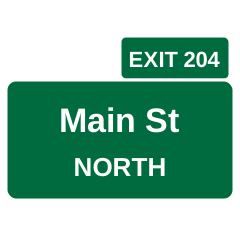
- The number of the road you exit onto
- Its distance from the freeway's start
- The distance to the next exit
- The order in which the exits were built
While waiting for help on a freeway shoulder, what should you not do?
- Stay inside your vehicle
- Lock your doors
- Turn on hazard lights
- Raise the hood
Which way do the arrows on a roundabout-ahead sign go, and why?
- Counter-clockwise, the way traffic flows
- Clockwise, toward the exits
- Clockwise, the way traffic flows
- Counter-clockwise, toward the exits
You see this five-sided sign ahead. What does it warn you about?

- A pedestrian crossover is ahead
- A playground is ahead
- A school zone is ahead
- A hospital zone is ahead
Which statement correctly describes limitations of large commercial trucks?
- Their size guarantees that other drivers can always be seen
- They have large blind spots, need stopping room and may turn wide
- They can stop as quickly as a small car in every condition
- Their trailers always stay completely within the cab’s path
Ground-level ozone, a component of smog, forms when which pollutants react in sunlight?
- Soot and carbon monoxide
- Hydrocarbons and nitrogen oxides
- Carbon dioxide and oxygen
- Sulphur oxides and water vapour
What does this X-shaped sign tell you?

- Do not enter this road
- The road is closed ahead
- Two roads cross at a four-way stop
- Railway tracks cross the road here
You suspect a fuel leak at a crash scene. What must you prevent?
- Turning on the vehicles' emergency flashers
- Covering people with blankets
- Smoking, matches or flares near vehicles
- Using a cell phone to call 911
How many years of driving experience must a G1 driver's accompanying driver have?
- At least five years
- At least four years
- At least two years
- At least three years
In which situation is a cyclist NOT required to stay close to the right edge of the road?
- When getting into position to turn left
- Whenever it is raining
- When riding with another cyclist
- When riding after sunset
You pull over for a short roadside stop. About how far from the curb should your vehicle be?
- No more than about 1 metre
- No more than about 60 centimetres
- At least 1 metre
- No more than about 30 centimetres
Besides the early morning, what other time of day is linked to drowsy-driving collisions?
- Between 5 p.m. and 7 p.m.
- Between 8 a.m. and 10 a.m.
- Between 2 p.m. and 4 p.m.
- Between 11 a.m. and 1 p.m.
On a road posted at 60 km/h or less, how much greater is the risk of death or serious injury in a crash at 50 km/h or more over the limit?
- Almost two times
- Almost ten times
- Almost eight times
- Almost five times
There is no stop line or crosswalk at a stop sign, but there is a sidewalk. Where do you stop?
- At the edge of the sidewalk
- At the edge of the intersection
- One car length before the sign
- Halfway across the sidewalk
At an intersection with stop signs on all corners, who has the right-of-way?
- The vehicle on the left
- The vehicle going straight
- The largest vehicle
- The first vehicle to stop
As a G1 driver, who may sit in the front passenger seat while you drive?
- A passenger with a G2 licence
- Any passenger with a seatbelt
- Only your accompanying driver
- Any adult over 21
A cyclist ahead of you holds their right arm straight out. What are they most likely signalling?
- That they are stopping
- A right turn
- A left turn
- That you may pass
What is the maximum prison sentence for impaired driving that causes bodily harm?
- 2 years
- 10 years
- 5 years
- 14 years
The light turns yellow just as you reach the stop line and braking hard would not be safe. What should you do?
- Go through the intersection with caution
- Speed up to beat the red light
- Stop past the line, in the crosswalk
- Brake hard and stop in the intersection
A pedestrian has started across the road at a pedestrian crossover. When may you drive on?
- When they pass the middle of the road
- When they have completely crossed the road
- When they reach the next lane over
- When they have cleared your lane
You are stopped at a red light where a stop line is painted on the pavement. Where should the front of your vehicle be?
- At the edge of the intersection
- At the stop line
- On the far side of the crosswalk
- Wherever you can see cross traffic
A road has a centre lane marked as a two-way left-turn lane. Which of these is NOT allowed in that lane?
- Entering it shortly before your turn
- Slowing down in it before turning
- Using it to pass slower vehicles
- Waiting there for a gap to turn left
How far ahead must your headlights be strong enough to light up objects?
- 150 metres
- 60 metres
- 110 metres
- 200 metres
Farm machinery on the road must display a slow-moving vehicle sign on the rear. What colours is it?
- Orange and black
- Red and white
- Orange and red
- Yellow and black
The driver ahead holds their left arm out, bent downward at a right angle. What does this signal mean?
- They are slowing down or stopping
- They want you to pass them
- They are about to turn left
- They are about to turn right
What shape and colour are most warning signs?
- Diamond-shaped and orange
- Diamond-shaped and yellow
- Rectangular and white
- Rectangular and green
All Ontario G1 practice tests
- Ontario G1 Mock Exam 1 – 40 QuestionsUntimed practice · answers explained
- Ontario G1 Mock Exam 2 – 40 QuestionsUntimed practice · answers explained
- Ontario G1 Mock Exam 3 – 40 QuestionsUntimed practice · answers explained
- Ontario G1 Mock Exam 4 – 40 QuestionsUntimed practice · answers explained
- Ontario G1 Mock Exam 5 – 40 QuestionsUntimed practice · answers explained
- Regulatory signsStop, yield, school zone and railway crossbuck shapes, permissive and prohibitive signs, no stopping, standing and parking, community safety zones, school bus and HOV lane signs.
- Warning signsYellow diamond warning signs for curves, hills, merges, lane endings, crossings, animals and hazards, plus the slow-moving vehicle and long commercial vehicle placards.
- Construction, information and direction signsOrange temporary condition signs in work zones, doubled construction-zone fines, green guide signs, freeway exit numbering, emergency detour routes and bilingual signs.
- Traffic lights and pedestrian signalsGreen, yellow and red lights, turns on red, advance green and left-turn arrows, flashing lights, transit priority signals, dark signals during power failures and pedestrian signals.
- Pavement markingsYellow and white lines, solid and broken lines, continuity lines, stop lines, crosswalks, lane arrows, pedestrian crossovers and markings around obstacles.
About this practice test
How many questions are in Ontario G1 practice test 10?
40 original multiple-choice practice questions covering night driving and bad weather, stopping and parking, impaired driving and other suspensions, demerit points and keeping your licence, turning, signalling and changing lanes, freeway driving, special situations on the road, construction, information and direction signs, getting ready to drive, emergencies and collisions, warning signs, regulatory signs, sharing the road, safe, responsible and efficient driving, graduated licensing: g1, g2 and g, driving along and intersections, traffic lights and pedestrian signals, pavement markings. Each answer includes an explanation. This mixed practice set does not reproduce the official exam format or predict an official score.
Are the questions the same every time?
Yes. Practice test 10 always has the same 40 questions, so you can repeat it until you get them all right. The other 14 sets use different questions.
Are these real test questions?
No. The official question bank is not published. These are original questions written from the official handbook, which is what the real Ontario G1 test is based on.