You are reversing straight back out of a driveway. How should you look?
Ontario G1 overview
Ontario G1 Practice Test 12
40 questions on turning, signalling and changing lanes, regulatory signs, night driving and bad weather, special situations on the road, getting ready to drive and more.
- No sign-up
- Every answer explained
- Independent · not a government site
- Set 12 of 15
- 40 questions
- Instant feedback
0/40
All 40 questions in this test
Every question and its answer choices. The correct answers and explanations appear when you take the test above.
You are reversing straight back out of a driveway. How should you look?
- Rely mainly on your inside mirror
- Watch your side mirrors only
- Look over your left shoulder only
- Look over your right shoulder
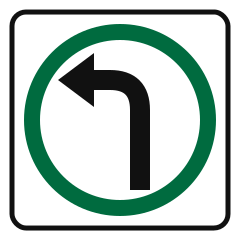
What does the green ring around the arrow on this sign mean?
- The action is allowed only at night
- The action is a suggestion only
- The action shown is not allowed
- The action shown is allowed or required
What happens in a zone marked with a school bus loading zone sign?
- All traffic must stop at all times
- Buses must use red lights and stop arm
- Only school buses may park overnight
- Buses load without red lights or stop arm
You are stranded in your car during a severe snowstorm. What does the handbook recommend?
- Seal every window completely
- Walk to find help right away
- Stay with the car and run the engine sparingly
- Keep the engine running nonstop with windows shut
You hit a deer with your car. Who should you report it to?
- No one, unless your car is damaged
- Your municipal animal shelter only
- Police or the Ministry of Natural Resources
- Only the Ministry of Transportation of Ontario
How far in front of your vehicle should you be able to see the ground from the driver's seat?
- 4 metres
- 10 metres
- 15 metres
- 1 metre
At the point this sign shows, two roads join into one. Who is responsible for a smooth, safe merge?

- Only drivers on the joining road
- Drivers on both roads
- Only drivers on the main road
- Whichever driver is going faster
You come up behind a vehicle showing a slow-moving vehicle sign. What top speed does that sign tell you to expect?
- 40 km/h or less
- 50 km/h or less
- 20 km/h or less
- 60 km/h or less
An HOV sign says lane changes into or out of the HOV lane are not allowed in this area. What does it mean?
- The HOV lane ends here
- Do not enter or leave the HOV lane here
- Change lanes only when signalling
- Only buses may leave the lane here
A police car signals you to pull over. Where should you stop if possible?
- On a highway on-ramp
- In your lane at the right edge
- In the middle of the nearest intersection
- On the shoulder, out of traffic lanes
You are about to pass a cyclist on a two-lane road. What is the minimum space Ontario law requires between your vehicle and the cyclist, where practical?
- Three metres
- Half a metre
- Two metres
- One metre
Why should you never stop on the travelled part of the road in fog?
- Your engine could stall in the damp
- Your lights drain the battery quickly
- You could start a chain-reaction collision
- It is only illegal on freeways
How long must you hold a G2 licence before you can take the road test for a full G?
- At least 8 months
- At least 12 months
- At least 6 months
- At least 24 months
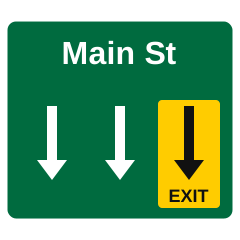
On this advance freeway sign, what does the arrow in the yellow box mean?
- That lane is for trucks only
- That lane leads off the freeway
- That lane is closed ahead
- That lane is a toll lane
You come to a stop sign with a stop line painted on the pavement. Where must you stop?
- Past the line, where you can see
- At the edge of the intersection
- At the far side of the crosswalk
- At the stop line
What colour is the hand symbol that tells pedestrians not to begin crossing?
- Red
- Orange
- White
- Yellow
A fully licensed G driver is convicted for the first time of holding a phone while driving. How many demerit points apply?
- 3
- 4
- 6
- 2
You are 18 with a new G2. At 1 a.m. you drive your three younger siblings home with no one else in the car. Is this allowed?
- No, G2 drivers cannot drive after midnight
- No, only one teen passenger is allowed
- Yes, siblings count as immediate family
- Yes, but only if all are over 16
A pilot vehicle leading traffic through a work zone carries a sign. What must you not do?
- Use your headlights
- Pass the pilot vehicle
- Slow down behind it
- Follow the pilot vehicle
When doing threshold braking, what should you do if a wheel begins to lock?
- Pull the parking brake
- Ease off slightly, then reapply
- Release the brake completely
- Pump the brake rapidly to unlock it
You notice two chevrons painted above a bicycle symbol in your lane. What does this marking tell you?
- Bikes and vehicles share this lane
- The lane is for bicycles only
- A bike lane starts at the next block
- Vehicles may not enter the lane
While you turn left on a green arrow shown with a red light, what should you expect from oncoming vehicles?
- They will all be stopped at a red
- They may also be turning left
- They must wait for you to clear
- They may be going straight through
You stop at a school crossing where a crossing guard is helping children across. When may you go?
- When the children leave your lane
- After waiting about ten seconds
- When everyone has fully crossed
- When they reach the centre line
You are in the inside lane of a roundabout and realize you have missed your exit. What should you do?
- Stop and wait for a gap to cut across
- Keep circling until you reach your exit again
- Change to the outside lane right away
- Reverse back to the exit you missed
As a novice driver, you carry more passengers than there are working seatbelts. What can happen to your licence?
- It is cancelled permanently, with no appeal
- It can be suspended for at least 30 days
- It can be suspended for 7 days
- You lose 2 demerit points only
After a young or novice driver is convicted of violating the zero-alcohol rule, can an additional licence sanction apply?
- No, only criminal convictions can affect a licence
- No, the roadside suspension is the only sanction
- Only two demerit points can be added
- Yes: an additional 30- or 90-day suspension, or cancellation, depending on age and licence class
Between 1999 and 2008, by about how much did wild animal–vehicle collisions increase?
- 10 per cent
- 43 per cent
- 60 per cent
- 25 per cent
On a two-way road with no median, you meet a school bus stopped with its upper red lights flashing, coming toward you. What must you do?
- Stop only if children are on your side
- Continue, since only traffic behind stops
- Slow down and pass carefully
- Stop at a safe distance for children to cross
Your friend has held a G2 for 1 year and a full G for 2 years, with no suspensions. Can she be your G1 accompanying driver?
- No, because G2 time never counts
- Yes, because G2 time counts double
- No, she has only three years of experience
- Yes, because she now holds a full G licence
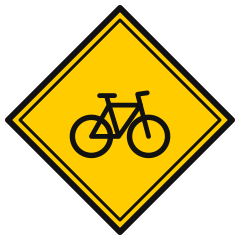
What does this sign warn you about?
- A bicycle lane ending
- No bicycles allowed
- An official bicycle route
- A bicycle crossing ahead
What is the closest you may park to a fire hydrant?
- 3 metres
- 1 metre
- 9 metres
- 5 metres
You are driving in a designated bilingual area. How should you read the signs?
- Read the language you understand best
- Read both parts fully before acting on either
- Read the French part only
- Read the English part only
Under Ontario’s current policy, what is the minimum ignition-interlock period after a first criminal impaired-driving conviction?
- At least one year
- Only one month
- No interlock requirement
- Exactly ninety days
A driver under a Criminal Code driving prohibition order is convicted of driving for the second time. What suspension applies?
- Six months
- Five years
- Two years
- One year
What does this sign warn you about?

- A railway crossing ahead
- A school zone ahead
- Traffic lights ahead
- A fire station ahead
At a fully protected left-turn intersection, your separate left-turn signal is red while through traffic has green. What must you do?
- Turn left after a complete stop
- Wait; you may not begin your turn now
- Turn left once oncoming lanes are clear
- Turn left if no pedestrians are crossing
Two vehicles reach an uncontrolled intersection from different roads at the same time. Who goes first?
- The driver going straight
- The driver on the left
- The faster driver
- The driver on the right
On a road with several lanes in your direction, which lane should you normally turn left from?
- Any lane, if you signal first
- The right curb lane
- The lane with the least traffic
- The far left lane in your direction
A driver is convicted of doing 100 km/h in a 60 km/h zone. How many demerit points apply?
- 6
- 4
- 3
- 5
An 81-year-old driver goes to a ServiceOntario appointment to renew. What will they be required to complete there?
- A medical exam by a ministry-appointed doctor
- A written test on road signs only
- A full road test and a written exam
- A vision test and a short screening exercise
All Ontario G1 practice tests
- Ontario G1 Mock Exam 1 – 40 QuestionsUntimed practice · answers explained
- Ontario G1 Mock Exam 2 – 40 QuestionsUntimed practice · answers explained
- Ontario G1 Mock Exam 3 – 40 QuestionsUntimed practice · answers explained
- Ontario G1 Mock Exam 4 – 40 QuestionsUntimed practice · answers explained
- Ontario G1 Mock Exam 5 – 40 QuestionsUntimed practice · answers explained
- Regulatory signsStop, yield, school zone and railway crossbuck shapes, permissive and prohibitive signs, no stopping, standing and parking, community safety zones, school bus and HOV lane signs.
- Warning signsYellow diamond warning signs for curves, hills, merges, lane endings, crossings, animals and hazards, plus the slow-moving vehicle and long commercial vehicle placards.
- Construction, information and direction signsOrange temporary condition signs in work zones, doubled construction-zone fines, green guide signs, freeway exit numbering, emergency detour routes and bilingual signs.
- Traffic lights and pedestrian signalsGreen, yellow and red lights, turns on red, advance green and left-turn arrows, flashing lights, transit priority signals, dark signals during power failures and pedestrian signals.
- Pavement markingsYellow and white lines, solid and broken lines, continuity lines, stop lines, crosswalks, lane arrows, pedestrian crossovers and markings around obstacles.
About this practice test
How many questions are in Ontario G1 practice test 12?
40 original multiple-choice practice questions covering turning, signalling and changing lanes, regulatory signs, night driving and bad weather, special situations on the road, getting ready to drive, warning signs, sharing the road, graduated licensing: g1, g2 and g, construction, information and direction signs, stopping and parking, traffic lights and pedestrian signals, demerit points and keeping your licence, driving along and intersections, impaired driving and other suspensions. Each answer includes an explanation. This mixed practice set does not reproduce the official exam format or predict an official score.
Are the questions the same every time?
Yes. Practice test 12 always has the same 40 questions, so you can repeat it until you get them all right. The other 14 sets use different questions.
Are these real test questions?
No. The official question bank is not published. These are original questions written from the official handbook, which is what the real Ontario G1 test is based on.