Fog keeps you from clearly seeing vehicles 120 metres ahead in daytime. What must you do?
Ontario G1 overview
Ontario G1 Mock Exam 4
Same format as the real test. Answers stay hidden until you submit. The official time limit is not published; the timer is a practice setting.
- No sign-up
- Every answer explained
- Independent · not a government site
- 40 questions
- untimed
- Pass mark 32/40
0/40
All 40 questions in this test
Every question and its answer choices. The correct answers and explanations appear when you take the test above.
Fog keeps you from clearly seeing vehicles 120 metres ahead in daytime. What must you do?
- Use your parking lights
- Turn on your headlights
- Use your hazard lights only
- Rely on daytime running lights
What does the number on the small plate under this sign tell you?

- The maximum safe speed for the curve
- The minimum speed for the curve
- The distance to the curve in metres
- The new speed limit for the road
A warning sign shows a bus entrance on the right ahead. What should you be prepared to do?
- Yield to buses entering the road
- Stop until a bus appears
- Speed up to get past the bus entrance
- Pull into the bus lane
How many demerit points can a driver get for not obeying a school-crossing guard's stop sign?
- 6
- 2
- 4
- 3
Which statement correctly describes limitations of large commercial trucks?
- Their size guarantees that other drivers can always be seen
- They have large blind spots, need stopping room and may turn wide
- They can stop as quickly as a small car in every condition
- Their trailers always stay completely within the cab’s path
Which road users does the handbook single out as possibly losing traction on milled or grooved pavement?
- Cyclists
- Bus drivers
- Truck drivers
- Motorcyclists
When turning right, what should you check your blind spot for, besides pedestrians?
- Vehicles parked across the road
- Oncoming buses
- Cyclists coming up on your right
- Cars waiting to turn left
You are at interchange 250 on a freeway and want to get off at interchange 204. About how far do you have to drive?
- 204 km
- 54 km
- 250 km
- 46 km
You see a flashing yellow beacon on an obstacle in the road ahead. What is it telling you?
- Drive with caution
- Stop before the obstacle
- Speed up to pass it quickly
- Stop and wait for a signal
Between two of these signs, when may you stop your vehicle?
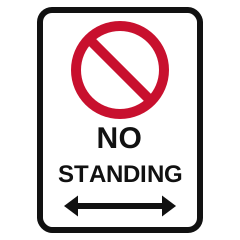
- Only while loading or unloading goods
- Only while loading or unloading passengers
- Never, not even for a moment
- Only for up to fifteen minutes
How many demerit points are given for a careless driving conviction?
- 4
- 3
- 7
- 6
What happens in a zone marked with a school bus loading zone sign?
- All traffic must stop at all times
- Buses must use red lights and stop arm
- Only school buses may park overnight
- Buses load without red lights or stop arm
What colours does a school zone sign use?
- White with red symbols
- Fluorescent orange with black symbols
- Bright yellow with red symbols
- Fluorescent yellow-green and black
Where is the entrance that this sign warns you about?
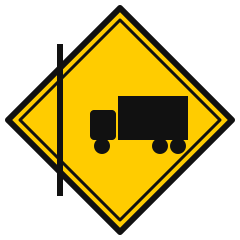
- On the right side of the road
- On both sides of the road
- Straight ahead at a dead end
- On the left side of the road
You approach this sign. What should you be ready to do?
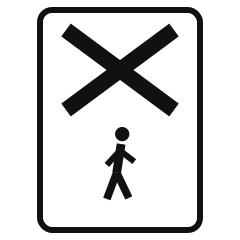
- Stop and yield to pedestrians
- Sound your horn to warn walkers
- Yield only to cyclists
- Speed up to clear the crossing
A police officer demands a breath sample and the driver refuses. What licence penalty takes effect right away?
- A 90-day licence suspension
- A 3-day licence suspension
- A 24-hour licence suspension
- A 30-day licence suspension
Interchange 204 on Highway 401 is 204 kilometres from which city, where the freeway begins?
- London
- Kingston
- Toronto
- Windsor
What is 'velocitization'?
- Speeding up to match freeway traffic
- Losing your sense of how fast you are going
- Skidding when braking at high speed
- Feeling sleepy on a long, straight road
You are ready to pull back into traffic from a stop at the right-hand roadside. Which signal should you use?
- Your horn
- Your left-turn signal
- Your right-turn signal
- Your hazard lights
What does a 'share the road' warning sign ask drivers to do?
- Let cyclists use the full lane only at night
- Drive in the centre of the lane at all times
- Leave safe space for cyclists and other vehicles
- Sound the horn before passing a cyclist
For an ordinary car without an exemption, how many people, including the driver, are normally required in an Ontario provincial-highway HOV lane?
- Four or more
- Two or more
- One or more
- Three or more
What is the minimum length of a ministry-approved beginner driver education course?
- 40 hours
- 60 hours
- 30 hours
- 20 hours
At what time of day are wild animals most active, according to the handbook?
- From noon to mid-afternoon
- Only during early morning
- From dusk to dawn
- Only in the late afternoon
You are stranded in your car during a severe snowstorm. What does the handbook recommend?
- Seal every window completely
- Walk to find help right away
- Stay with the car and run the engine sparingly
- Keep the engine running nonstop with windows shut
Why is it dangerous to drive close behind a large truck?
- The driver can't see you and you can't escape
- The truck's mirrors will dazzle you
- The truck will slow you below the limit
- Trucks are required to brake slowly
After your brakes have dried, the pedal still feels spongy. What should you do?
- Keep driving until your next service
- Drive through more water to clear them
- Have the vehicle repaired right away
- Pump the brakes before every stop
You are following a school bus toward a railway crossing that has gates and signal lights. What should you expect the bus to do?
- Stop with its upper red lights flashing
- Stop at the crossing, without its red lights
- Cross without stopping, since it has gates
- Stop only if the signal lights are flashing
There is a solid line along the left side of your lane. What does it mean?
- It is unsafe to pass
- You may pass if it is clear
- You must turn left soon
- Your lane is ending ahead
Under Ontario’s current policy, how long can a temporary Accessible Parking Permit be valid?
- Up to five years without recertification
- Up to twelve months, with medical recertification required to renew
- Only two weeks, with no possibility of another permit
- Indefinitely while it is displayed
Defensive driving is built on three main ideas. What are they?
- Visibility, space and communication
- Speed, signals and mirrors
- Patience, courtesy and concentration
- Distance, timing and braking
A driver with no alcohol-related history is convicted of dangerous driving under the Criminal Code. Which remedial measure applies?
- A warn-range education course
- A driver-improvement interview
- An ignition interlock only
- The Back on Track program
The signals are out because of a power outage. You and a car on your right stop at the same moment. Who should go first?
- Whichever car is going straight
- The car on your right
- Whichever car is larger
- You, as the car on the left
You are stopped at a red light where a stop line is painted on the pavement. Where should the front of your vehicle be?
- At the edge of the intersection
- At the stop line
- On the far side of the crosswalk
- Wherever you can see cross traffic
A G1 driver is convicted for the first time of breaking a graduated-licensing condition. How long is the escalating novice-driver suspension?
- 7 days
- 30 days
- 60 days
- 90 days
You are stopping for a red light. There is no stop line, but there is an unmarked crosswalk. Where should you stop?
- At the edge of the intersection
- At the crosswalk
- Three car lengths back
- In the middle of the crosswalk
What should you do when approaching an intersection with a flashing yellow light?
- Drive through with caution
- Wait for a steady green light
- Come to a complete stop
- Stop and yield to the right
You notice two chevrons painted above a bicycle symbol in your lane. What does this marking tell you?
- Bikes and vehicles share this lane
- The lane is for bicycles only
- A bike lane starts at the next block
- Vehicles may not enter the lane
You see this sign at an intersection. What does it tell you?
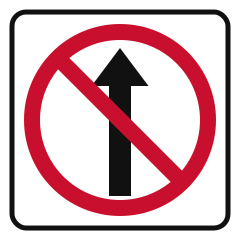
- Straight ahead only
- One-way road ahead
- Road ends ahead
- Do not go straight
Near an interchange, you see continuity lines on the left side of your lane. What does this generally mean?
- Your lane is ending or exiting
- You may pass on the right only
- Your lane continues unaffected
- A bus lane begins just ahead
What should you do when you see this sign?

- Stop right at this sign
- Slow down; a stop sign is ahead
- Speed up before the light changes
- Yield to traffic on your left
Keep practising
- Ontario G1 Mock Exam 1 – 40 QuestionsUntimed practice · answers explained
- Ontario G1 Mock Exam 2 – 40 QuestionsUntimed practice · answers explained
- Ontario G1 Mock Exam 3 – 40 QuestionsUntimed practice · answers explained
- Ontario G1 Mock Exam 5 – 40 QuestionsUntimed practice · answers explained
- Ontario G1 Practice Test 140 questions with explanations
- Ontario G1 Practice Test 240 questions with explanations
- Ontario G1 Practice Test 340 questions with explanations
- Ontario G1 Practice Test 440 questions with explanations