You are about to turn right at an intersection with no special signs or lane markings. Where should your vehicle be as you start and finish the turn?
Ontario G1 overview
Ontario G1 Mock Exam 2
Same format as the real test. Answers stay hidden until you submit. The official time limit is not published; the timer is a practice setting.
- No sign-up
- Every answer explained
- Independent · not a government site
- 40 questions
- untimed
- Pass mark 32/40
0/40
All 40 questions in this test
Every question and its answer choices. The correct answers and explanations appear when you take the test above.
You are about to turn right at an intersection with no special signs or lane markings. Where should your vehicle be as you start and finish the turn?
- Close to the right side of the road
- In whichever lane is least busy
- Close to the centre line
- In the centre of the road
What is the maximum sentence for impaired driving that causes a death?
- Life imprisonment
- 14 years in prison
- 25 years in prison
- 10 years in prison
What does this sign warn you about?

- A lift bridge ahead
- The pavement narrows ahead
- A divided highway begins ahead
- A narrow bridge ahead
What does the number on the small plate under this sign tell you?

- The maximum safe speed for the curve
- The minimum speed for the curve
- The distance to the curve in metres
- The new speed limit for the road
Before a long trip you check the oil and coolant. When should you look under the hood?
- With the engine running
- While the engine is hot
- Right after a long drive
- When the engine is cold
Where is the greatest risk of a collision for most drivers?
- Behind your vehicle
- On your right side
- In front of you
- On your left side
What does this sign tell you?

- A traffic island ahead; keep left
- A divided highway begins; keep right
- A divided highway ends; keep right
- The road splits; pick either side
How are all railway crossings on public roads in Ontario marked?
- With flashing lights and gates
- With green guide signs
- With large red and white X signs
- With yellow diamond signs only
While driving, about how often should you check your mirrors?
- Only when changing lanes
- About once a minute
- About every 30 seconds
- About every five seconds
Which left turn on a red light is allowed in Ontario, after a full stop and when the way is clear?
- From a two-way road onto a one-way road
- From any road when no traffic is coming
- From a one-way road onto a two-way road
- From a one-way road onto a one-way road
How often must Ontario drivers aged 80 or older renew a full Class G licence?
- Every year
- Every five years
- Every two years
- Every three years
What does this sign warn you about?

- Deer regularly cross this road
- Hunting is allowed nearby
- A farm entrance is ahead
- A wildlife park is ahead
How is a marked crosswalk shown on the road?
- One white line across the road
- Two parallel white lines across the road
- Two parallel yellow lines across the road
- A white X in each lane
You are stopped at a red light. Can you text on your hand-held phone?
- Yes, because the car is not moving
- Yes, if the light is long
- Yes, if you keep one hand on the wheel
- No, the law applies at red lights too
A warning sign shows a bridge that lifts or swings. What is it telling you?
- The bridge is closed for repairs
- The bridge opens to let boats pass
- The bridge has a weight limit
- The bridge freezes before the road
You bring a photocopy of your passport to apply for a licence. Will it be accepted?
- Only for a G1 licence
- No, only valid originals
- Yes, if a parent signs it
- Yes, if it is a clear copy
You see this sign at the entrance to a road. What does it mean?

- Do not enter this road
- Emergency vehicles only
- Road closed for winter
- No parking at any time
What approximate annual death figure from distracted driving is quoted in the MTO handbook?
- About 100
- About 500
- About 10
- About 1,000
Why is a flashing green light called an advance green?
- It warns that a red light is coming next
- Pedestrians are given time to cross first
- It lets only buses go through first
- Oncoming traffic still faces a red light
You are about to enter a roundabout. Which traffic has the right-of-way?
- Vehicles entering from your right
- Vehicles already in the roundabout
- The vehicle that is going fastest
- You, because you are entering
What does this sign mean for you as a driver?
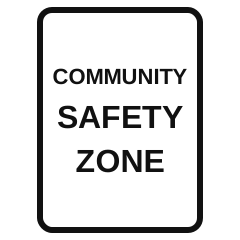
- Pedestrians must use crosswalks here
- Only local residents may drive here
- Traffic offences here carry higher fines
- Speed cameras operate here at all times
How many years of driving experience must a G1 driver's accompanying driver have?
- At least five years
- At least four years
- At least two years
- At least three years
At what time of day are wild animals most active, according to the handbook?
- From noon to mid-afternoon
- Only during early morning
- From dusk to dawn
- Only in the late afternoon
In the study summarized in the MTO handbook, how much farther did drivers texting or changing music travel before reacting to a hazard?
- 28 metres
- 50 metres
- 8 metres
- 15 metres
You see a warning sign for a hidden school bus stop. What should you do?
- Slow down and watch for children and the bus
- Keep your speed; the stop is hidden
- Stop and wait until a bus arrives
- Honk to warn children you are coming
Two solid lines on the pavement curve around a concrete island ahead. What are they for?
- Marking a parking area
- Guiding traffic away from the object
- Showing a passing zone
- Marking a pedestrian crossing at the island
How many parts does a typical freeway entrance have, and what are they?
- Three: a ramp, a merge lane and a stop sign
- Two: an entrance ramp and an acceleration lane
- Two: a deceleration lane and an exit ramp
- One: a single merging ramp
What does the word 'VIA' mean on a direction sign?
- The road has a speed camera
- The road is a toll route
- The roads to follow to reach a destination
- The destination is a railway station
You are stopped in an intersection waiting for oncoming traffic to clear before turning left. How should your front wheels be?
- Turned slightly left, halfway into the turn
- Turned left, ready to go
- Pointed straight ahead until you can turn
- Turned right, toward the curb
An orange sign warns that a survey crew is ahead. Where are they working?
- In a field beside the road
- On the next exit ramp
- On the road ahead
- On the road behind you
A vehicle ahead shows this sign on its back. What does it tell you?

- It travels at 50 km/h or less
- It travels at 30 km/h or less
- It travels at 40 km/h or less
- It travels at 60 km/h or less
On a rural road, a stop sign has no stop line, no crosswalk and no sidewalk. Where must you stop?
- Ten metres before the intersection
- Right beside the stop sign post
- At the edge of the intersection
- Wherever you can first see traffic
The signals are out because of a power outage. You and a car on your right stop at the same moment. Who should go first?
- Whichever car is going straight
- The car on your right
- Whichever car is larger
- You, as the car on the left
Under the handbook’s basic rules, how far must you keep from the public entrance of an open hotel, theatre or public hall when parking?
- At least 6 metres
- At least 9 metres
- At least 15 metres
- At least 3 metres
What does this sign warn you about?

- A steep hill ahead
- A slippery road ahead
- A winding road ahead
- A sharp left turn ahead
Your vehicle has a problem on a freeway. Where should you stop?
- On the nearest shoulder
- In the right driving lane
- In the centre lane
- On the median strip
In winter, the road ahead looks black and shiny. What might this mean?
- It may be covered in black ice
- The road was just repaved
- Salt has fully melted the ice
- The road is dry and safe
Which of these roads is a G1 driver with a regular (non-instructor) accompanying driver NOT allowed to use?
- A city street posted at 50 km/h
- The Gardiner Expressway
- A residential street posted at 40 km/h
- A two-lane rural highway posted at 80 km/h
An underpass warning sign shows a measurement. Who needs to pay most attention to it?
- Motorcycle riders
- Drivers of tall vehicles
- Drivers of small cars
- Drivers towing a short trailer
You want to turn right at a red light and no sign forbids it. What must you do first?
- Wait for the light to turn green
- Signal and turn without slowing
- Stop fully and wait until the way is clear
- Slow down and turn if no one is coming
Keep practising
- Ontario G1 Mock Exam 1 – 40 QuestionsUntimed practice · answers explained
- Ontario G1 Mock Exam 3 – 40 QuestionsUntimed practice · answers explained
- Ontario G1 Mock Exam 4 – 40 QuestionsUntimed practice · answers explained
- Ontario G1 Mock Exam 5 – 40 QuestionsUntimed practice · answers explained
- Ontario G1 Practice Test 140 questions with explanations
- Ontario G1 Practice Test 240 questions with explanations
- Ontario G1 Practice Test 340 questions with explanations
- Ontario G1 Practice Test 440 questions with explanations