Where must you never place a rear-facing child car seat?
Ontario G1 overview
Ontario G1 Practice Test 4
40 questions on getting ready to drive, graduated licensing: g1, g2 and g, emergencies and collisions, pavement markings, traffic lights and pedestrian signals and more.
- No sign-up
- Every answer explained
- Independent · not a government site
- Set 4 of 15
- 40 questions
- Instant feedback
0/40
All 40 questions in this test
Every question and its answer choices. The correct answers and explanations appear when you take the test above.
Where must you never place a rear-facing child car seat?
- In the back seat
- In front of an active airbag
- Behind the driver's seat
- In the middle of the back seat
A G1 driver wants to use a 400-series highway posted at 100 km/h. When is this allowed?
- When the accompanying driver has 10 years of experience
- Never, under any circumstances at Level One
- When the accompanying driver is a driving instructor
- When traffic is light and visibility is good
Your car is towed after a collision. What information should you get?
- The tow truck's fuel level
- The tow driver's home phone number
- The tow driver's insurance card and policy number
- The tow operator's name and licence number
Near an interchange, you see continuity lines on the left side of your lane. What does this generally mean?
- Your lane is ending or exiting
- You may pass on the right only
- Your lane continues unaffected
- A bus lane begins just ahead
At a fully protected left-turn intersection, the left-turn lane gets a green arrow. What will traffic going straight usually see?
- A flashing yellow light
- A yellow arrow
- A green light
- A red light
Before a long trip you check the oil and coolant. When should you look under the hood?
- With the engine running
- While the engine is hot
- Right after a long drive
- When the engine is cold
How many demerit points within two years will get a Level One or Level Two driver's licence suspended?
- 9 or more
- 12 or more
- 15 or more
- 6 or more
Your full G car licence expired eight months ago. With no suspension or other testing requirement, what does the expiry alone require you to do?
- Retake the G1 and G2 road tests
- Retake the written knowledge test
- Start graduated licensing again
- Renew it without taking any tests
You are driving beside a large commercial truck. Why should you avoid staying alongside it?
- It cannot use its turn signals
- It has large blind spots
- It must stop at every intersection
- It is not allowed to change lanes
An ambulance with its siren on is coming toward you from behind on a two-lane road. What must you do?
- Move left to let it pass on the right
- Pull to the right edge and stop
- Stop immediately in your lane
- Speed up to stay ahead of it
At an all-way stop, you and a car on your left come to a stop at the same moment. Who goes first?
- You, since you are on the right
- Whoever is going straight
- Whoever signals their turn first
- The car on your left
Your vehicle gets stuck on a railway crossing. What should you do first?
- Turn on your hazard lights and wait
- Try to restart the engine and drive off
- Call for a tow truck from inside the car
- Get everyone out and away from the vehicle
How closely may you follow a fire truck responding to an alarm?
- Not within 300 metres
- Not within 150 metres
- Not within 100 metres
- Not within 50 metres
You have driven past the street you wanted. According to the handbook, what is the simplest and safest way to turn around?
- Drive around the block
- Make a U-turn at the next curve
- Reverse back to the street
- Make a three-point turn right away
According to the handbook’s fuel-saving advice, about how long is the usual initial engine warm-up before driving gently in cold weather?
- About 30 seconds
- About 10 minutes
- About 15 minutes
- About 5 minutes
At an intersection with traffic lights but no pedestrian signals, when may a pedestrian cross?
- When facing a left-turn green arrow
- When facing a flashing green light
- When facing a steady green light
- When facing a yellow light
You see this sign. What does it tell you?
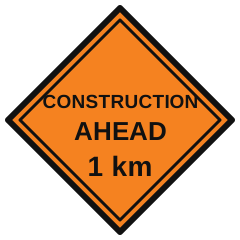
- A construction zone ends in one kilometre
- A detour runs for the next kilometre
- A lower speed limit for one kilometre
- Construction work is one kilometre ahead
How far must you be able to see in both directions before making a U-turn?
- At least 50 metres
- At least 250 metres
- At least 150 metres
- At least 100 metres
In winter, the road ahead looks black and shiny. What might this mean?
- It may be covered in black ice
- The road was just repaved
- Salt has fully melted the ice
- The road is dry and safe
Which levels of government make traffic laws that police can enforce?
- Federal and provincial only
- Municipal only
- Federal, provincial and municipal
- Provincial only
You have just passed a bus on the highway. When is it acceptable to move back in front of it?
- As soon as your rear bumper clears it
- Once the bus driver flashes the lights
- Only when you have left plenty of room
- Right away, so you don't block the left lane
An entrance ramp joins the freeway on the left side. How does this change how you merge?
- You may merge at a slower speed
- You must speed up more quickly to merge
- You must first move to the right lane
- You should stop at the end of the ramp
A cyclist ahead swings wide in the lane to cross streetcar tracks. At what angle should they cross the tracks?
- 45 degrees
- 30 degrees
- 90 degrees
- 15 degrees
When travelling at freeway speeds, how far ahead should you be looking?
- About one minute ahead
- About 5 to 8 seconds ahead
- About 15 to 20 seconds ahead
- About 2 to 4 seconds ahead
Which of these may normally use a provincial-highway HOV lane?
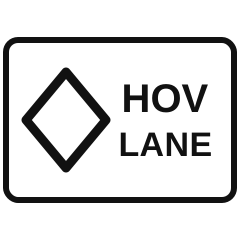
- Any heavy truck, regardless of length or occupants
- Any car whose driver holds a full G licence
- A bus or an ordinary car meeting the occupancy requirement
- Any vehicle at rush hour
A witness reports your car for passing a stopped school bus, but nobody knows who was driving. As the registered owner, what can you receive?
- The fine, but no demerit points or jail
- Nothing, since you weren't identified as driver
- The fine plus six demerit points
- Demerit points, but no fine
You are in the right lane and see this sign. What must you do?

- Speed up and pass on the shoulder
- Stop and wait for a gap
- Merge safely into the lane on your left
- Stay in your lane; others must merge
A pedestrian at the curb is looking at their phone and stepping toward the road in front of you. What should you use to get their attention?
- Your turn signal
- Your high beams
- Your hazard lights
- Your horn
A 19-year-old driver has detectable alcohol in their blood and violates the zero-alcohol rule for the first time. What immediate licence suspension applies?
- A 3-day licence suspension
- A 7-day licence suspension
- A written warning only
- A 90-day licence suspension
A minor collision on a busy road leaves both cars drivable and no one hurt. What should you do?
- Drive away and phone the police later
- Leave them in place for the police
- Leave the cars and walk to safety
- Move the cars as far off the road as possible
What does the word 'VIA' mean on a direction sign?
- The road has a speed camera
- The road is a toll route
- The roads to follow to reach a destination
- The destination is a railway station
How long does Level One (G1) normally last if you do not take an approved driver-education course?
- 12 months
- 20 months
- 8 months
- 6 months
You brake hard in a car with ABS and the pedal pulses under your foot. What should you do?
- Shift into park
- Keep pressing the pedal firmly
- Release the pedal right away
- Pump the pedal quickly
What tire setup is recommended for the best winter traction?
- Four winter tires, same tread pattern
- Mixed tires on each axle
- Two winter tires on the rear
- Two winter tires on the front drive wheels
The line on the left of your lane is broken. When may you pass?
- Only after sounding your horn
- At any time, even on a hill
- When the way ahead is clear
- Only once the line turns solid
No-stopping, no-standing and no-parking signs are used in pairs or groups. Where does the rule apply?
- Only within 9 metres of each sign
- In the area between the signs
- Only right beside each sign
- On the whole street, both sides
Fog keeps you from clearly seeing vehicles 120 metres ahead in daytime. What must you do?
- Use your parking lights
- Turn on your headlights
- Use your hazard lights only
- Rely on daytime running lights
A driver is caught with a BAC of .08 or more. How long will the vehicle they were driving be impounded?
- Thirty days
- Forty-five days
- Seven days
- Three days
What does the number on the small plate under this sign tell you?

- The maximum safe speed for the curve
- The minimum speed for the curve
- The distance to the curve in metres
- The new speed limit for the road
You are driving in the lane next to a bus bay. A bus in the bay turns on its left signals to pull out. What must you do?
- Keep going, since you are in the lane
- Speed up to pass before it moves
- Change lanes into the bus bay
- Let the bus re-enter traffic
All Ontario G1 practice tests
- Ontario G1 Mock Exam 1 – 40 QuestionsUntimed practice · answers explained
- Ontario G1 Mock Exam 2 – 40 QuestionsUntimed practice · answers explained
- Ontario G1 Mock Exam 3 – 40 QuestionsUntimed practice · answers explained
- Ontario G1 Mock Exam 4 – 40 QuestionsUntimed practice · answers explained
- Ontario G1 Mock Exam 5 – 40 QuestionsUntimed practice · answers explained
- Regulatory signsStop, yield, school zone and railway crossbuck shapes, permissive and prohibitive signs, no stopping, standing and parking, community safety zones, school bus and HOV lane signs.
- Warning signsYellow diamond warning signs for curves, hills, merges, lane endings, crossings, animals and hazards, plus the slow-moving vehicle and long commercial vehicle placards.
- Construction, information and direction signsOrange temporary condition signs in work zones, doubled construction-zone fines, green guide signs, freeway exit numbering, emergency detour routes and bilingual signs.
- Traffic lights and pedestrian signalsGreen, yellow and red lights, turns on red, advance green and left-turn arrows, flashing lights, transit priority signals, dark signals during power failures and pedestrian signals.
- Pavement markingsYellow and white lines, solid and broken lines, continuity lines, stop lines, crosswalks, lane arrows, pedestrian crossovers and markings around obstacles.
About this practice test
How many questions are in Ontario G1 practice test 4?
40 original multiple-choice practice questions covering getting ready to drive, graduated licensing: g1, g2 and g, emergencies and collisions, pavement markings, traffic lights and pedestrian signals, your vehicle: maintenance, insurance and registration, demerit points and keeping your licence, driving along and intersections, special situations on the road, stopping and parking, turning, signalling and changing lanes, safe, responsible and efficient driving, construction, information and direction signs, night driving and bad weather, sharing the road, freeway driving, regulatory signs, warning signs, impaired driving and other suspensions. Each answer includes an explanation. This mixed practice set does not reproduce the official exam format or predict an official score.
Are the questions the same every time?
Yes. Practice test 4 always has the same 40 questions, so you can repeat it until you get them all right. The other 14 sets use different questions.
Are these real test questions?
No. The official question bank is not published. These are original questions written from the official handbook, which is what the real Ontario G1 test is based on.