On a road posted at 60 km/h or less, how much greater is the risk of death or serious injury in a crash at 50 km/h or more over the limit?
Ontario G1 overview
Ontario G1 Mock Exam 5
Same format as the real test. Answers stay hidden until you submit. The official time limit is not published; the timer is a practice setting.
- No sign-up
- Every answer explained
- Independent · not a government site
- 40 questions
- untimed
- Pass mark 32/40
0/40
All 40 questions in this test
Every question and its answer choices. The correct answers and explanations appear when you take the test above.
On a road posted at 60 km/h or less, how much greater is the risk of death or serious injury in a crash at 50 km/h or more over the limit?
- Almost two times
- Almost ten times
- Almost eight times
- Almost five times
Between two of these signs, when may you stop your vehicle?
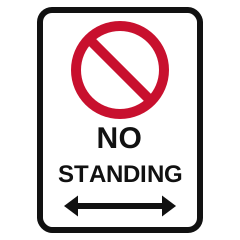
- Only while loading or unloading goods
- Only while loading or unloading passengers
- Never, not even for a moment
- Only for up to fifteen minutes
You are getting ready to pass an LCV on the highway. What should you plan for?
- Its extra length and limited speed
- Its sudden bursts of speed
- Its tendency to drive on the shoulder
- Its short stopping distance
Escalating sanctions for novice drivers count repeat violations that happen within what time period?
- Two years
- Ten years
- One year
- Five years
Under full emergency braking, how far can it take a train to stop?
- Up to two kilometres
- Up to 500 metres
- Up to 200 metres
- Up to one kilometre
On a work zone board like this, what do the flashing lights show?

- How far away the work is
- The lane that is open to trucks
- The direction to follow
- The speed limit in the zone
Which Ontario professionals have mandatory reporting duties for patients aged 16 or over with specified high-risk medical or visual conditions?
- The person’s employer
- Police officers only
- Physicians, optometrists and nurse practitioners
- The person’s insurance company
At which times of day does every driver have extra trouble adjusting to the light?
- Dusk and dawn
- Noon and midnight
- Only late at night
- Mid-morning and mid-afternoon
What does this sign warn you about?
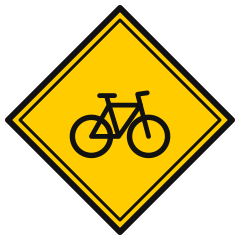
- A bicycle lane ending
- No bicycles allowed
- An official bicycle route
- A bicycle crossing ahead
You are making an unprotected left turn at an intersection. Whom must you yield to before turning?
- Oncoming traffic and pedestrians
- Only traffic behind you
- No one, once you have signalled your turn
- Only vehicles turning right
A sign at an intersection says you may not turn right on a red light. What does it forbid?
- Turning right at any time
- Turning right while facing a red light
- Turning left while facing a red light
- Turning right on a green light
What does this sign warn you about?

- A school crossing guard ahead
- A pedestrian crossing ahead
- Road work ahead
- A survey crew on the shoulder only
At a fully protected left-turn intersection, the left-turn lane gets a green arrow. What will traffic going straight usually see?
- A flashing yellow light
- A yellow arrow
- A green light
- A red light
A driver under a Criminal Code driving prohibition order is convicted of driving for the second time. What suspension applies?
- Six months
- Five years
- Two years
- One year
What does the number on the small plate under this sign tell you?

- The maximum safe speed for the curve
- The minimum speed for the curve
- The distance to the curve in metres
- The new speed limit for the road
How long can a long commercial vehicle (LCV) be?
- Up to 30 metres
- Up to 25 metres
- Up to 40 metres
- Up to 50 metres
What does this X-shaped sign tell you?

- Do not enter this road
- The road is closed ahead
- Two roads cross at a four-way stop
- Railway tracks cross the road here
A 7-year-old weighs 30 kg and is 146 cm tall. May he use a seatbelt instead of a booster?
- Yes, he meets the height criterion
- No, he must meet all three criteria
- No, he must be eight years old
- No, he must weigh 36 kg
A police officer pulls you over to inspect your vehicle and finds it unsafe. What can happen?
- You get only a warning
- Only commercial vehicles are affected
- It can be taken off the road
- You may drive it for 30 days
What does this sign mean?
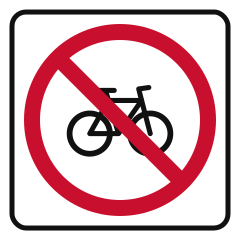
- Bicycle route ahead
- Bicycle crossing ahead
- Bicycles must use the sidewalk
- No bicycles allowed on this road
A warning sign shows a bus entrance on the right ahead. What should you be prepared to do?
- Yield to buses entering the road
- Stop until a bus appears
- Speed up to get past the bus entrance
- Pull into the bus lane
You want to turn right at a red light and no sign forbids it. What must you do first?
- Wait for the light to turn green
- Signal and turn without slowing
- Stop fully and wait until the way is clear
- Slow down and turn if no one is coming
A driver is caught not wearing a seatbelt. Besides a fine, how many demerit points will the driver receive?
- 3
- 6
- 4
- 2
A toddler weighs 15 kg and rides in a forward-facing car seat. Besides the seatbelt or UAS strap, what must be attached?
- A locking lap belt
- Nothing else is needed
- The seat's tether strap
- A second seatbelt
You are parking on the right side of the road, facing downhill beside a curb. Which way should your front wheels point?
- Toward the curb
- Toward the road
- It does not matter
- Straight ahead
You face this sign at an intersection. What must you do?

- Yield only to pedestrians
- Always come to a complete stop
- Keep going at your current speed
- Slow down or stop if needed and yield
You have moved into the intersection on a green light to turn left, and the light turns red before oncoming traffic clears. What should you do?
- Complete your turn when it is safe
- Back up behind the stop line
- Go straight through instead
- Stay in place until the next green
At an intersection with no signs or lights, a car on your left got there clearly before you. Who should go first?
- Whichever vehicle is larger
- You, because you are on the right
- Whichever driver signals first
- The car that arrived first
A temporary sign warns that the pavement has been milled or grooved. What may be affected?
- Your fuel economy on long trips
- Your headlight aim
- Your radio reception
- Your vehicle's ability to stop
There is no stop line or crosswalk at a stop sign, but there is a sidewalk. Where do you stop?
- At the edge of the sidewalk
- At the edge of the intersection
- One car length before the sign
- Halfway across the sidewalk
On an Ontario rural road outside a city, town or village, no local rule or sign specifies another limit. What is the default maximum?
- 50 km/h
- 80 km/h
- 90 km/h
- 100 km/h
You see this sign ahead. What might you need to do?

- Turn on your hazard lights
- Shift to a lower gear
- Move to the left lane
- Switch to high beams
After the left-turn green arrow, a yellow arrow appears just before you start your turn. What should you do?
- Turn, but yield to oncoming traffic
- Start the turn; yellow arrows are protected
- Don't start the turn; stop if safe
- Speed up and finish the turn quickly
What should you do when you see this sign?

- Stop right at this sign
- Slow down; a stop sign is ahead
- Speed up before the light changes
- Yield to traffic on your left
How far to the right can a snow plow's wing extend?
- Up to one metre
- Up to six metres
- Up to half a metre
- Up to three metres
How close to a pedestrian crossover is passing another vehicle not permitted?
- Within 50 metres
- Within 30 metres
- Within 15 metres
- Within 10 metres
Which accompanying driver is NOT allowed to supervise a G1 driver?
- A driver who has some demerit points
- A driver with a valid Class A licence
- A driver whose licence is currently suspended
- A driver who spent two of their four years at G2
Continuity lines run along the right side of your lane near an off-ramp. What does that tell you?
- You must change lanes right away
- Your lane will continue unaffected
- Your lane is about to exit
- You must slow to the ramp speed
Your car's tire tread is worn to 1 mm. What should you do?
- Rotate it to the rear
- Add more air pressure
- Keep it until it reaches 0.5 mm
- Replace the tire
On a two-way road with no median, you meet a school bus stopped with its upper red lights flashing, coming toward you. What must you do?
- Stop only if children are on your side
- Continue, since only traffic behind stops
- Slow down and pass carefully
- Stop at a safe distance for children to cross
Keep practising
- Ontario G1 Mock Exam 1 – 40 QuestionsUntimed practice · answers explained
- Ontario G1 Mock Exam 2 – 40 QuestionsUntimed practice · answers explained
- Ontario G1 Mock Exam 3 – 40 QuestionsUntimed practice · answers explained
- Ontario G1 Mock Exam 4 – 40 QuestionsUntimed practice · answers explained
- Ontario G1 Practice Test 140 questions with explanations
- Ontario G1 Practice Test 240 questions with explanations
- Ontario G1 Practice Test 340 questions with explanations
- Ontario G1 Practice Test 440 questions with explanations