A temporary sign tells you that you are entering a construction zone. What should you be prepared for?
Ontario G1 overview
Ontario G1 Practice Test 2
40 questions on construction, information and direction signs, sharing the road, impaired driving and other suspensions, emergencies and collisions, special situations on the road and more.
- No sign-up
- Every answer explained
- Independent · not a government site
- Set 2 of 15
- 40 questions
- Instant feedback
0/40
All 40 questions in this test
Every question and its answer choices. The correct answers and explanations appear when you take the test above.
A temporary sign tells you that you are entering a construction zone. What should you be prepared for?
- A lower speed limit
- A toll booth
- A higher speed limit
- A ferry crossing
You are behind a school bus that stops with its red lights flashing and stop arm out. How far back must you stop?
- At least 30 metres
- At least 20 metres
- At least 10 metres
- At least 5 metres
A police officer demands a breath sample and the driver refuses. What licence penalty takes effect right away?
- A 90-day licence suspension
- A 3-day licence suspension
- A 24-hour licence suspension
- A 30-day licence suspension
You are not trained in first aid. A collision victim seems to be in shock. What can you do?
- Cover them with a jacket or blanket
- Lay them down in a cold, shaded spot
- Make them walk around
- Give them a drink of water
You are eating a burger while driving and weave across a lane. What could happen?
- You can only receive a warning
- Nothing, since eating is not illegal
- You could be charged with careless driving
- You get an automatic licence suspension
In Ontario, what minimum licence suspension follows a first criminal conviction for impaired driving?
- Three years
- Six months
- Ninety days
- One year
You are charged with following too closely. How many demerit points can you receive?
- 2
- 3
- 4
- 6
Under the handbook’s basic rules, how far must you keep from the public entrance of an open hotel, theatre or public hall when parking?
- At least 6 metres
- At least 9 metres
- At least 15 metres
- At least 3 metres
Which item belongs in your winter emergency kit?
- A spare licence plate
- Booster cables
- A tire pressure sticker
- A roof rack
When should you not use cruise control?
- On long straight roads
- On dry highways
- In light daytime traffic
- In snow and other bad weather
Why is a flashing green light called an advance green?
- It warns that a red light is coming next
- Pedestrians are given time to cross first
- It lets only buses go through first
- Oncoming traffic still faces a red light
You are turning left from a two-way road onto another two-way road. Which lane should you turn into?
- The right curb lane directly
- Whichever lane has the most space
- The lane just right of the centre line
- The lane just left of the centre line
An 18-year-old G2 driver (licensed 2 months) carries four teen friends at 2 a.m. What makes this legal?
- Staying off 400-series highways
- Every passenger wearing a seatbelt
- Driving below the posted speed limit
- A qualified accompanying driver with a full G licence and at least four years of experience in the front passenger seat
What is the most common cause of skids?
- Worn or streaky windshield wipers
- Driving with the radio on
- Using low beams at night
- Driving too fast for conditions
A driver is convicted of wilfully evading police during a pursuit, with no death or bodily harm. What licence suspension does HTA section 216 require?
- Two years
- One year
- Five years
- Ninety days
You face this sign at an intersection. What must you do?

- Yield only to pedestrians
- Always come to a complete stop
- Keep going at your current speed
- Slow down or stop if needed and yield
How long do demerit points stay on your driving record?
- Three years from the offence date
- Two years from the offence date
- One year from the offence date
- Five years from the offence date
A driver is caught not wearing a seatbelt. Besides a fine, how many demerit points will the driver receive?
- 3
- 6
- 4
- 2
What is 'velocitization'?
- Speeding up to match freeway traffic
- Losing your sense of how fast you are going
- Skidding when braking at high speed
- Feeling sleepy on a long, straight road
Your passenger puts the shoulder strap behind her back because it rubs her neck. What should she do?
- Tuck it under her arm
- Unbuckle it on short trips
- Leave it behind her back
- Wear it over her shoulder
Your full G licence expired four years ago. Which renewal route applies?
- Reapply, pass vision and knowledge tests and both road tests, with the usual graduated waiting periods waived
- Renew within six days at ServiceOntario
- Pass a vision test only
- Pay a late fee and renew online
Your light has just turned green, but a car that entered on the previous light is still crossing in front of you. What should you do?
- Drive around the car carefully
- Wait until the intersection is clear
- Sound your horn, then go ahead
- Go, since green gives you right-of-way
You have stopped behind a school bus loading children. Which condition must be met before you may drive on?
- The driver waves you past the bus
- Thirty seconds have gone by
- The bus moves, its red lights stop and its stop arm retracts
- The children step onto the sidewalk
Your foot can't free a stuck gas pedal. What should you do next?
- Pump the gas pedal until it frees
- Shift into park while still moving
- Keep driving until the fuel runs out
- Hazards on, shift to neutral and stop safely
What does this sign mean?
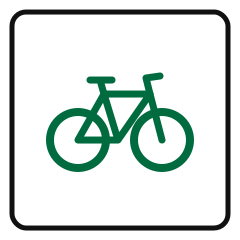
- Bicycles are not allowed on this road
- This area is for bicycle parking
- A bicycle crossing is just ahead
- This road is an official bicycle route
What do the numbers on this green sign show?
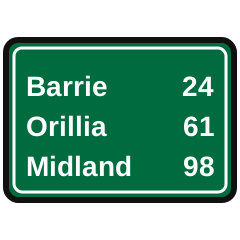
- Distances in kilometres to each place
- Speed limits in each place
- Travel time in minutes to each place
- Highway numbers for each place
How long can a long commercial vehicle (LCV) be?
- Up to 30 metres
- Up to 25 metres
- Up to 40 metres
- Up to 50 metres
Continuity lines run along the right side of your lane near an off-ramp. What does that tell you?
- You must change lanes right away
- Your lane will continue unaffected
- Your lane is about to exit
- You must slow to the ramp speed
What does this sign mean?

- Slow traffic keep right
- Two lanes merge ahead
- Do not pass on this road
- Passing lane ahead
While scanning the road as you drive, about how often should you check your mirrors?
- Every five seconds or so
- Every 15 seconds or so
- Only before you change lanes
- Every 30 seconds or so
You are stopping for a red light. There is no stop line, but there is an unmarked crosswalk. Where should you stop?
- At the edge of the intersection
- At the crosswalk
- Three car lengths back
- In the middle of the crosswalk
Besides lines on the pavement, how are fixed objects like bridge piers marked as a warning?
- With yellow and black markings
- With red and white markings
- With green reflective paint
- With orange and white stripes
Your tires have plenty of tread but are 12 years old. Why is this a problem?
- Aged tires may fail unexpectedly
- Only tread depth matters
- They are fine if never used
- Old tires grip better in winter
A police officer stops you for using an HOV lane improperly. Besides a ticket, what will you be required to do?
- Leave the freeway at the next exit
- Cross the buffer right away to the general lane
- Stay in the HOV lane until the next exit
- Rejoin the general lanes at the next entry/exit zone
Under the ordinary Class G towing rule, excluding special house-trailer exemptions, what maximum gross weight may the towed vehicle have?
- 14,000 kilograms
- 4,600 kilograms
- 11,000 kilograms
- 2,000 kilograms
You are about to enter a roundabout. Which traffic has the right-of-way?
- Vehicles entering from your right
- Vehicles already in the roundabout
- The vehicle that is going fastest
- You, because you are entering
Your turn signals have stopped working and you need to turn left. Which hand signal do you use?
- Left arm bent downward
- Left arm bent upward
- Right arm straight out
- Left arm straight out
What should you do when you see this sign?
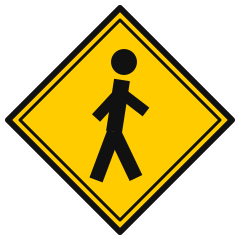
- Watch for pedestrians and share the road
- Expect a pedestrian-only street
- Stop until a crossing guard waves you on
- Sound your horn as you pass
When you refuel, why shouldn't you keep topping off the tank after the pump clicks off?
- Spilled fuel gives off harmful vapours
- It makes the fuel gauge stop working
- The pump will charge a penalty fee
- It voids your vehicle warranty
A private car behind you shows a flashing green light. What does this mean?
- A firefighter or medic is responding
- A funeral procession is passing
- A tow truck is about to stop
- An unmarked police car wants you to pull over
All Ontario G1 practice tests
- Ontario G1 Mock Exam 1 – 40 QuestionsUntimed practice · answers explained
- Ontario G1 Mock Exam 2 – 40 QuestionsUntimed practice · answers explained
- Ontario G1 Mock Exam 3 – 40 QuestionsUntimed practice · answers explained
- Ontario G1 Mock Exam 4 – 40 QuestionsUntimed practice · answers explained
- Ontario G1 Mock Exam 5 – 40 QuestionsUntimed practice · answers explained
- Regulatory signsStop, yield, school zone and railway crossbuck shapes, permissive and prohibitive signs, no stopping, standing and parking, community safety zones, school bus and HOV lane signs.
- Warning signsYellow diamond warning signs for curves, hills, merges, lane endings, crossings, animals and hazards, plus the slow-moving vehicle and long commercial vehicle placards.
- Construction, information and direction signsOrange temporary condition signs in work zones, doubled construction-zone fines, green guide signs, freeway exit numbering, emergency detour routes and bilingual signs.
- Traffic lights and pedestrian signalsGreen, yellow and red lights, turns on red, advance green and left-turn arrows, flashing lights, transit priority signals, dark signals during power failures and pedestrian signals.
- Pavement markingsYellow and white lines, solid and broken lines, continuity lines, stop lines, crosswalks, lane arrows, pedestrian crossovers and markings around obstacles.
About this practice test
How many questions are in Ontario G1 practice test 2?
40 original multiple-choice practice questions covering construction, information and direction signs, sharing the road, impaired driving and other suspensions, emergencies and collisions, special situations on the road, demerit points and keeping your licence, stopping and parking, your vehicle: maintenance, insurance and registration, night driving and bad weather, traffic lights and pedestrian signals, turning, signalling and changing lanes, graduated licensing: g1, g2 and g, driving along and intersections, getting ready to drive, freeway driving, regulatory signs, warning signs, pavement markings, safe, responsible and efficient driving. Each answer includes an explanation. This mixed practice set does not reproduce the official exam format or predict an official score.
Are the questions the same every time?
Yes. Practice test 2 always has the same 40 questions, so you can repeat it until you get them all right. The other 14 sets use different questions.
Are these real test questions?
No. The official question bank is not published. These are original questions written from the official handbook, which is what the real Ontario G1 test is based on.