How long will a Criminal Code driving conviction remain on your driver's record?
Ontario G1 overview
Ontario G1 Practice Test 5
40 questions on impaired driving and other suspensions, warning signs, sharing the road, night driving and bad weather, getting ready to drive and more.
- No sign-up
- Every answer explained
- Independent · not a government site
- Set 5 of 15
- 40 questions
- Instant feedback
0/40
All 40 questions in this test
Every question and its answer choices. The correct answers and explanations appear when you take the test above.
How long will a Criminal Code driving conviction remain on your driver's record?
- At least 2 years
- At least 5 years
- At least 10 years
- At least 3 years
What does this sign warn you about?

- A narrow bridge ahead
- A railway crossing ahead
- A bump or uneven road
- A steep hill ahead
You drive an electric car. Why should you take extra care when slowing near intersections where pedestrians are waiting?
- Pedestrians must yield to quiet cars
- Electric cars take longer to stop
- Electric cars have weaker headlights
- Blind pedestrians may not hear you coming
You are following another car at night. Within what distance must you use low beams?
- Within 30 metres
- Within 150 metres
- Within 60 metres
- Within 100 metres
A toddler weighs 15 kg and rides in a forward-facing car seat. Besides the seatbelt or UAS strap, what must be attached?
- A locking lap belt
- Nothing else is needed
- The seat's tether strap
- A second seatbelt
You are in the second lane from the left on a road with three lanes each way, and a large truck behind wants to pass. What should you do?
- Speed up to stay ahead of the truck
- Move into the far left lane
- Move into the right-hand lane when you can
- Hold your lane and let it pass on the right
Your headlights suddenly go out at night. What should you check first?
- The engine oil level
- The tire pressure
- The brake fluid
- The headlight switch
Which pavement pattern marks the traditional overhead-lit pedestrian crossover illustrated in the handbook?
- Two yellow lines with a diamond
- One white stop line with lane arrows
- Double white lines with an X in each lane
- Yellow zigzag lines along the curb
You must stop at an intersection with no stop line and no crosswalk, but there is a sidewalk. Where do you stop?
- At the edge of the intersection
- In the middle of the sidewalk
- Three metres past the sidewalk
- At the edge of the sidewalk
You enter a tunnel on a bright, sunny day. What should you do?
- Keep sunglasses on and switch on your high beams
- Slow down, take off sunglasses, use headlights
- Speed up to get through quickly
- Turn on hazard lights and stop inside the tunnel
After a no-injury collision causing $2,000 damage, which duty remains even if a police report is not required?
- Report it to police within 24 hours
- Report it to the Ministry of Transportation
- Exchange information with the other driver
- Nothing, since damage is under $5,000
Which hand does the Dutch reach method use to open the driver's door?
- Whichever hand is closer
- Your right hand
- Your left hand
- Both hands together
You pull over to wait for a friend. To save fuel and cut emissions, after how long should you turn off the engine?
- More than 1 minute
- More than 3 minutes
- More than 5 minutes
- More than 10 seconds
What should you do when approaching an intersection with a flashing yellow light?
- Drive through with caution
- Wait for a steady green light
- Come to a complete stop
- Stop and yield to the right
You do not pay a court-ordered fine for a moving traffic offence, rather than a parking offence. What can happen to your licence?
- It gets 2 demerit points
- It will be suspended
- It is downgraded to a G1
- Nothing happens to it
A slower vehicle cuts in front of a faster vehicle on the freeway. How does the handbook describe this?
- Allowed if the driver signals
- Allowed in heavy traffic only
- Dangerous and illegal
- Legal but impolite
This sign hangs over a centre lane. What is that lane for?
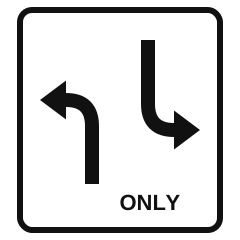
- Left turns by traffic from both directions
- Right turns by traffic from both directions
- Buses and taxis only
- Passing slower traffic in either direction
You are in the left-turn lane and see a left-turn green arrow along with a red light. What may you do?
- Wait until the light turns green
- Turn left only after a full stop
- Turn left from the left-turn lane
- Go straight through the intersection
What can happen if you are caught driving with a radar detector in Ontario?
- You get a warning with no penalty
- You are fined but get no demerits
- You are fined and get demerit points
- Nothing, since they are legal
Interchange 204 on Highway 401 is 204 kilometres from which city, where the freeway begins?
- London
- Kingston
- Toronto
- Windsor
A fully licensed G driver reaches 6 demerit points. What is the result?
- A 30-day suspension
- A licence cancellation
- A warning letter
- A 60-day suspension
You are driving on a one-way street with three lanes and a fire truck approaches with siren on. Where should you stop?
- Wherever you are in your lane
- In the centre lane
- Always at the right-hand curb
- At the closest curb or edge
What approximate annual death figure from distracted driving is quoted in the MTO handbook?
- About 100
- About 500
- About 10
- About 1,000
What is the minimum age to apply for a driver's licence in Ontario?
- 18 years old
- 15 years old
- 16 years old
- 17 years old
You sell your car. What happens to its licence plates?
- The buyer returns them
- They stay with the car
- You remove them and keep them
- They are destroyed by police
You move from a province with a licence-exchange agreement and have one year of experience. Where do you start?
- At Level One, as a new driver
- With a full Class G licence
- With a learner's permit only
- At Level Two of graduated licensing
In a bilingual area, English and French messages are on separate signs. How are they placed?
- They are on opposite sides of the road
- They face opposite directions of travel
- The English sign comes just before the French one
- The French sign comes just before the English one
A sign at an intersection says you may not turn right on a red light. What does it forbid?
- Turning right at any time
- Turning right while facing a red light
- Turning left while facing a red light
- Turning right on a green light
Why can a bus be more efficient in carbon dioxide emissions per passenger than many separate cars?
- Every bus has zero exhaust emissions
- One vehicle can carry many passengers
- A bus never needs fuel
- Cars cannot carry more than one person
After installation, what is the maximum movement allowed at a child seat’s belt or UAS path?
- No more than 2.5 cm
- No more than 1 cm
- No more than 10 cm
- No more than 5 cm
A novice driver receives their first suspension for accumulating 9 or more demerit points. How long does that suspension last?
- 30 days
- 6 months
- 90 days
- 60 days
How many parts does a typical freeway entrance have, and what are they?
- Three: a ramp, a merge lane and a stop sign
- Two: an entrance ramp and an acceleration lane
- Two: a deceleration lane and an exit ramp
- One: a single merging ramp
On which road is it illegal to drive in reverse, including on the shoulder?
- Any road with a limit over 50 km/h
- Any road with a limit of 80 km/h or more
- A divided road with a limit over 80 km/h
- A two-lane road with a limit over 60 km/h
You are parking on the right side of the road, facing downhill beside a curb. Which way should your front wheels point?
- Toward the curb
- Toward the road
- It does not matter
- Straight ahead
Why is a faulty exhaust system especially dangerous in winter?
- Snow blocks the tailpipe every time
- Windows and vents are usually closed
- Exhaust freezes the brake lines
- Cold air makes exhaust explode
When turning right, what should you check your blind spot for, besides pedestrians?
- Vehicles parked across the road
- Oncoming buses
- Cyclists coming up on your right
- Cars waiting to turn left
A no-left-turn sign has times shown on it. What does it mean?
- Left turns are allowed after a full stop
- Left turns are banned all day
- Left turns are banned during those times
- Left turns are allowed only at those times
A conventional painted bike lane is on your right. Signs and markings allow you to enter it for a right turn into a driveway. What should you do?
- Use your hazard lights and turn quickly
- Turn from your lane across the bike lane
- Enter the bike lane when safe, then turn
- Wait in your lane until the bike lane ends
A warning sign shows a bus entrance on the right ahead. What should you be prepared to do?
- Yield to buses entering the road
- Stop until a bus appears
- Speed up to get past the bus entrance
- Pull into the bus lane
You are parking on the right side of the road, facing uphill with no curb. How should you set your wheels?
- Turned sharply to the left
- Pointing straight ahead
- Turned sharply to the right
- Turned slightly to the left
All Ontario G1 practice tests
- Ontario G1 Mock Exam 1 – 40 QuestionsUntimed practice · answers explained
- Ontario G1 Mock Exam 2 – 40 QuestionsUntimed practice · answers explained
- Ontario G1 Mock Exam 3 – 40 QuestionsUntimed practice · answers explained
- Ontario G1 Mock Exam 4 – 40 QuestionsUntimed practice · answers explained
- Ontario G1 Mock Exam 5 – 40 QuestionsUntimed practice · answers explained
- Regulatory signsStop, yield, school zone and railway crossbuck shapes, permissive and prohibitive signs, no stopping, standing and parking, community safety zones, school bus and HOV lane signs.
- Warning signsYellow diamond warning signs for curves, hills, merges, lane endings, crossings, animals and hazards, plus the slow-moving vehicle and long commercial vehicle placards.
- Construction, information and direction signsOrange temporary condition signs in work zones, doubled construction-zone fines, green guide signs, freeway exit numbering, emergency detour routes and bilingual signs.
- Traffic lights and pedestrian signalsGreen, yellow and red lights, turns on red, advance green and left-turn arrows, flashing lights, transit priority signals, dark signals during power failures and pedestrian signals.
- Pavement markingsYellow and white lines, solid and broken lines, continuity lines, stop lines, crosswalks, lane arrows, pedestrian crossovers and markings around obstacles.
About this practice test
How many questions are in Ontario G1 practice test 5?
40 original multiple-choice practice questions covering impaired driving and other suspensions, warning signs, sharing the road, night driving and bad weather, getting ready to drive, turning, signalling and changing lanes, emergencies and collisions, pavement markings, stopping and parking, safe, responsible and efficient driving, traffic lights and pedestrian signals, freeway driving, regulatory signs, driving along and intersections, construction, information and direction signs, demerit points and keeping your licence, special situations on the road, graduated licensing: g1, g2 and g, your vehicle: maintenance, insurance and registration. Each answer includes an explanation. This mixed practice set does not reproduce the official exam format or predict an official score.
Are the questions the same every time?
Yes. Practice test 5 always has the same 40 questions, so you can repeat it until you get them all right. The other 14 sets use different questions.
Are these real test questions?
No. The official question bank is not published. These are original questions written from the official handbook, which is what the real Ontario G1 test is based on.