You are caught going 52 km/h over the posted limit on a 100 km/h highway. How many demerit points apply?
Ontario G1 overview
Ontario G1 Practice Test 6
40 questions on demerit points and keeping your licence, traffic lights and pedestrian signals, graduated licensing: g1, g2 and g, warning signs, getting ready to drive and more.
- No sign-up
- Every answer explained
- Independent · not a government site
- Set 6 of 15
- 40 questions
- Instant feedback
0/40
All 40 questions in this test
Every question and its answer choices. The correct answers and explanations appear when you take the test above.
You are caught going 52 km/h over the posted limit on a 100 km/h highway. How many demerit points apply?
- 4
- 6
- 3
- 7
You face a red light at an intersection that has no stop line, no crosswalk and no sidewalk. Where must you stop?
- Beside the traffic light pole
- Two car lengths before the corner
- At the edge of the intersection
- Three metres before the intersection
You hold a G1 licence and had one beer at dinner. What blood-alcohol level does the law allow when you drive?
- Less than .08%
- Less than .05%
- Zero
- Less than .02%
A warning sign shows a bridge that lifts or swings. What is it telling you?
- The bridge is closed for repairs
- The bridge opens to let boats pass
- The bridge has a weight limit
- The bridge freezes before the road
In most vehicles, where are the blind spots?
- Beside the front wheels only
- Directly ahead of the hood
- Directly behind the rear bumper
- Back left and back right
A driver squeezes past a cyclist with only a few centimetres to spare and is convicted. Besides a fine, what else goes on their record?
- 6 demerit points
- 4 demerit points
- 3 demerit points
- 2 demerit points
You notice a bulge on the sidewall of a tire. What should you do?
- Drive slower until it wears
- Replace the tire
- Move it to a front wheel
- Lower the air pressure
After stopping you, a police officer asks for your licence, vehicle permit and insurance. When must you hand them over?
- Immediately when asked
- Within 24 hours
- At the police station
- Within 7 days
How far of a clear view in both directions must you have before parking on a road?
- At least 100 metres
- At least 150 metres
- At least 125 metres
- At least 50 metres
Why is it dangerous to drive close behind a large truck?
- The driver can't see you and you can't escape
- The truck's mirrors will dazzle you
- The truck will slow you below the limit
- Trucks are required to brake slowly
You approach this sign. What should you be ready to do?
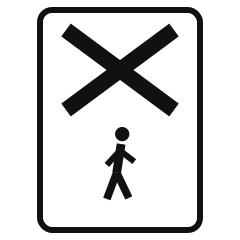
- Stop and yield to pedestrians
- Sound your horn to warn walkers
- Yield only to cyclists
- Speed up to clear the crossing
How many demerit points are given for a careless driving conviction?
- 4
- 3
- 7
- 6
Escalating sanctions for novice drivers count repeat violations that happen within what time period?
- Two years
- Ten years
- One year
- Five years
Why is a road marked as a community safety zone?
- The community found a special risk to pedestrians
- The road is next to a police station
- The road has a high number of truck crashes
- The road is closed to through traffic
At night you see shining eyes at the side of the road. What should you do?
- Switch off your headlights
- Swerve toward the centre line
- Speed up to pass quickly
- Slow down and be ready to stop
Under which law are speeding fines doubled in a designated construction zone?
- The Motor Vehicle Safety Act
- A municipal bylaw
- The Criminal Code
- The Highway Traffic Act
The traffic light at an intersection is flashing red in your direction. What must you do?
- Slow down and proceed with caution
- Stop completely, then go when safe
- Treat it the same as a green light
- Stop only if cross traffic is present
Which of these is an example of courteous driving?
- Speeding up when someone signals
- Driving close so no one cuts in
- Using the horn to hurry slow drivers
- Leaving room for others to change lanes
The train has passed but the crossing gate is still rising. What should you do?
- Cross as soon as the train is gone
- Drive under it once it is halfway up
- Go around it if no other train is visible
- Wait until the gate is fully up
How may you program your GPS while driving?
- By typing at a red light
- By typing at low speed
- Only with one hand
- Only by voice commands
When should you finish braking when making a turn?
- Before you start to steer
- Halfway through the turn
- After the turn is complete
- While you turn the steering wheel
The fog becomes too dense to keep driving. What should you do?
- Pull fully off the road and turn on flashers
- Keep driving at the same speed
- Switch to high beams to see better
- Stop in your lane with your flashers turned on
Why should you stay clear of large vehicles on a freeway?
- They are not allowed to brake suddenly
- They always travel faster
- They block more of your view
- They use the HOV lane
You need to remove your seatbelt to turn properly and see behind you while reversing. Is this allowed?
- No, seatbelts must be worn at all times
- Yes, and you can leave it off afterward
- Only if a passenger guides you
- Yes, but buckle up before moving forward
A driver is convicted of driving while their licence was suspended for an HTA offence. Besides a large fine, what is added?
- Six demerit points to the record
- Thirty days to the suspension
- One year to the suspension
- Six months to the suspension
A police officer directing traffic signals you to stop, but your traffic light is green. What do you do?
- Go, because the light is green
- Stop only if pedestrians cross
- Sound your horn and go ahead
- Stop and follow the officer
What does a transit priority signal show?
- A green diamond on a white background
- A white vertical bar on a dark background
- A white horizontal bar on a dark background
- A flashing blue light under the signal
What does this sign warn you about?
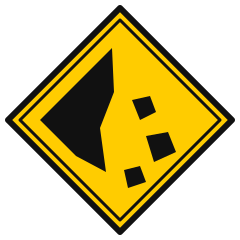
- A steep drop beside the road
- A quarry entrance ahead
- Rocks may have fallen on the road
- A gravel road ahead
From how far away can a snow plow's flashing blue lights be seen?
- 60 metres
- 30 metres
- 500 metres
- 150 metres
What does this sign warn you about?

- A school crossing guard ahead
- A pedestrian crossing ahead
- Road work ahead
- A survey crew on the shoulder only
Your 35-year-old aunt is a qualified accompanying driver supervising your G1 practice. What blood-alcohol limit must she stay below?
- Less than .05%
- Less than .08%
- Less than .10%
- Zero
On a hot day at highway speed, which is usually more fuel efficient?
- Opening all the windows
- Opening the sunroof fully
- Turning off the vents
- Using the air conditioning
When may you use a hand-held phone to make a call while driving?
- To call your employer
- When traffic is moving slowly
- To call 911 in an emergency
- When you are in the right lane
What do yellow lines painted on the road separate?
- Traffic moving in the same direction
- Traffic moving in opposite directions
- Parking spaces from travel lanes
- Bicycles from motor vehicles
On a freeway with three or more lanes each way, why might a large truck be passing in the second lane from the left?
- The far left lane is for buses only
- Trucks may pass only on the right
- Trucks are often barred from the far left lane
- Trucks must always use the centre lane
You press the brake pedal and nothing happens. What should you try first?
- Turn off the ignition
- Pump the brake pedal
- Pull the parking brake hard
- Shift into reverse
Which habit helps your tires last longer?
- Mixing tire types
- Braking hard often
- Driving with low pressure
- Rotating them regularly
You are thinking of passing on a broken line, but the line becomes solid a short way ahead. What must you judge?
- Whether the car ahead waves you on
- Whether oncoming drivers flash their lights
- Whether you can finish before it turns solid
- Whether you can pass faster than the limit
Your vehicle has a problem on a freeway. Where should you stop?
- On the nearest shoulder
- In the right driving lane
- In the centre lane
- On the median strip
Where is the safest place for a child under 13 to ride?
- In the back seat
- In any seat with an airbag
- In the front passenger seat
- In the cargo area
All Ontario G1 practice tests
- Ontario G1 Mock Exam 1 – 40 QuestionsUntimed practice · answers explained
- Ontario G1 Mock Exam 2 – 40 QuestionsUntimed practice · answers explained
- Ontario G1 Mock Exam 3 – 40 QuestionsUntimed practice · answers explained
- Ontario G1 Mock Exam 4 – 40 QuestionsUntimed practice · answers explained
- Ontario G1 Mock Exam 5 – 40 QuestionsUntimed practice · answers explained
- Regulatory signsStop, yield, school zone and railway crossbuck shapes, permissive and prohibitive signs, no stopping, standing and parking, community safety zones, school bus and HOV lane signs.
- Warning signsYellow diamond warning signs for curves, hills, merges, lane endings, crossings, animals and hazards, plus the slow-moving vehicle and long commercial vehicle placards.
- Construction, information and direction signsOrange temporary condition signs in work zones, doubled construction-zone fines, green guide signs, freeway exit numbering, emergency detour routes and bilingual signs.
- Traffic lights and pedestrian signalsGreen, yellow and red lights, turns on red, advance green and left-turn arrows, flashing lights, transit priority signals, dark signals during power failures and pedestrian signals.
- Pavement markingsYellow and white lines, solid and broken lines, continuity lines, stop lines, crosswalks, lane arrows, pedestrian crossovers and markings around obstacles.
About this practice test
How many questions are in Ontario G1 practice test 6?
40 original multiple-choice practice questions covering demerit points and keeping your licence, traffic lights and pedestrian signals, graduated licensing: g1, g2 and g, warning signs, getting ready to drive, sharing the road, your vehicle: maintenance, insurance and registration, driving along and intersections, stopping and parking, regulatory signs, impaired driving and other suspensions, special situations on the road, construction, information and direction signs, safe, responsible and efficient driving, turning, signalling and changing lanes, night driving and bad weather, freeway driving, pavement markings, emergencies and collisions. Each answer includes an explanation. This mixed practice set does not reproduce the official exam format or predict an official score.
Are the questions the same every time?
Yes. Practice test 6 always has the same 40 questions, so you can repeat it until you get them all right. The other 14 sets use different questions.
Are these real test questions?
No. The official question bank is not published. These are original questions written from the official handbook, which is what the real Ontario G1 test is based on.