At a stop sign there is no stop line, but there is a marked crosswalk. Where should you stop?
Ontario G1 overview
Ontario G1 Practice Test 14
40 questions on regulatory signs, warning signs, graduated licensing: g1, g2 and g, special situations on the road, sharing the road and more.
- No sign-up
- Every answer explained
- Independent · not a government site
- Set 14 of 15
- 40 questions
- Instant feedback
0/40
All 40 questions in this test
Every question and its answer choices. The correct answers and explanations appear when you take the test above.
At a stop sign there is no stop line, but there is a marked crosswalk. Where should you stop?
- Three metres before the crosswalk
- In the middle of the crosswalk
- Past the crosswalk, at the intersection
- At the crosswalk
You see a school crossing sign. Whose directions should you follow there?
- The driver of the car ahead
- Any adult standing at the corner
- The school principal or a teacher on duty
- A crossing guard or safety patroller
How early should you arrive for a road test appointment?
- At least 15 minutes early
- At least 10 minutes early
- At least 1 hour early
- At least 30 minutes early
A transit bus at a dedicated bus stop signals to pull back into your lane. A sign on its back reminds you of the law. What must you do?
- Pass the bus before it moves
- Change lanes without slowing
- Sound your horn and continue
- Yield and let the bus re-enter
You see this sign ahead. What might you need to do?

- Turn on your hazard lights
- Shift to a lower gear
- Move to the left lane
- Switch to high beams
Which of these must display a slow-moving vehicle sign when it is on a road?
- A farm tractor
- A motorcycle
- A loaded dump truck
- A school bus
Besides the knowledge test, what other test must you pass before you get a G1 licence?
- A first-aid test
- A road test
- A vision test
- A hearing test
What increased crash risk does the research summarized in the MTO handbook associate with texting or browsing on a phone?
- 10 times
- 20 times
- 5 times
- 2 times
As you approach from behind, a cyclist moves out toward the middle of the lane. Which of these is a legitimate safety reason for doing so?
- To avoid potholes or a sewer grate
- To signal that they will stop
- To ride beside a parked car door
- To make you pass more quickly
You notice you can't remember the last few kilometres you drove. What should you do?
- Pull off and rest in a safe place
- Turn the radio up louder
- Drink a coffee and keep driving
- Open the window and keep going
What does this sign warn you about?

- Deer regularly cross this road
- Hunting is allowed nearby
- A farm entrance is ahead
- A wildlife park is ahead
You want to turn left, and an oncoming motorcycle has its turn signal flashing. What should you keep in mind?
- The rider may have forgotten to cancel it
- Motorcycles signal only when stopping
- The rider must turn as the signal shows
- The signal gives you the right-of-way
From July 1, 2026, what is the most foreign driving experience a driver from a non-exchange country can be credited?
- 36 months
- 6 months
- 12 months
- 24 months
What does this sign mean?

- Two-way traffic ahead
- Turn around at the next exit
- Winding road ahead
- No U-turns allowed
You are 19 and have had your G2 for eight months. Between midnight and 5 a.m., how many passengers aged 19 or under may you carry?
- Up to two
- Up to three
- Only one
- Up to four
Which age group is most likely to drive distracted, according to the handbook?
- Drivers over 65
- Drivers aged 26 to 35
- Drivers aged 36 to 50
- Drivers aged 16 to 25
For an ordinary car without an exemption, how many people, including the driver, are normally required in an Ontario provincial-highway HOV lane?
- Four or more
- Two or more
- One or more
- Three or more
You are facing a red light and want to turn right. There is no sign prohibiting the turn. What must you do?
- Turn only if a pedestrian signal is showing
- Stop completely, then turn when the way is clear
- Wait for the light to turn green
- Slow down and turn without stopping
What does a 'share the road' warning sign ask drivers to do?
- Let cyclists use the full lane only at night
- Drive in the centre of the lane at all times
- Leave safe space for cyclists and other vehicles
- Sound the horn before passing a cyclist
What should you do when you see this sign?

- Slow down; slippery when wet
- Steer onto the shoulder
- Turn on your high beams to see better
- Speed up to keep traction
You see this sign at an intersection. What does it tell you?
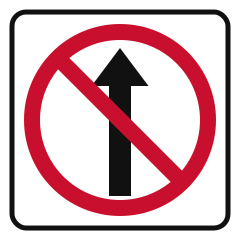
- Straight ahead only
- One-way road ahead
- Road ends ahead
- Do not go straight
This marker is on an obstacle near the edge of the road. On which side may you safely pass it?

- Either side
- Neither side; stop first
- The right side
- The left side
A school crossing guard is helping children across the street in front of you. When may you continue?
- As soon as your lane is clear
- When the guard turns to face you
- When the children pass the centre line
- When everyone is safely on the sidewalk
At a crossing with a pedestrian push-button, how does a pedestrian get the walk signal?
- By stepping onto the crosswalk
- By waiting for the next green
- By waving at approaching drivers
- By pressing the push-button
What is the minimum total time needed to complete Ontario's two-step graduated licensing system?
- 16 months
- 20 months
- 12 months
- 24 months
Signs like this are posted in groups along a road. What are they for?
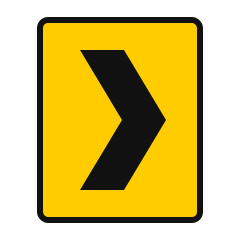
- Marking a truck entrance
- Showing that a lane is ending ahead
- Marking a passing zone
- Guiding you around a sharp curve
On an Ontario rural road outside a city, town or village, no local rule or sign specifies another limit. What is the default maximum?
- 50 km/h
- 80 km/h
- 90 km/h
- 100 km/h
When may you use the right shoulder to pass?
- Any time the shoulder is wide enough
- Whenever traffic in your lane is slow
- Only to pass a left-turning vehicle, if paved
- Only to pass a stopped bus, if gravel
What colours does a school zone sign use?
- White with red symbols
- Fluorescent orange with black symbols
- Bright yellow with red symbols
- Fluorescent yellow-green and black
You are getting ready to pass an LCV on the highway. What should you plan for?
- Its extra length and limited speed
- Its sudden bursts of speed
- Its tendency to drive on the shoulder
- Its short stopping distance
You are 18 and got your G2 three months ago. Between midnight and 5 a.m., how many passengers aged 19 or under may you carry?
- Two
- One
- Three
- None
On a rural road, a horse-drawn buggy is coming toward you in the opposite lane. What should you do?
- Move toward the centre line
- Move to the far right of your lane
- Flash your headlights to warn it
- Sound your horn as you approach
A G2 driver's record reaches 6 demerit points. What does the ministry do?
- Suspends the licence for 30 days
- Suspends the licence for 60 days
- Sends a second warning letter
- Cancels the licence permanently
How close to a pedestrian crossover is passing another vehicle not permitted?
- Within 50 metres
- Within 30 metres
- Within 15 metres
- Within 10 metres
You are on a highway divided by a raised median. A school bus on the other side is stopped with its red lights flashing. What must you do?
- Stop until the stop arm folds away
- Slow to 40 km/h until past the bus
- Continue with care; you need not stop
- Stop at least 20 metres from the bus
You see this sign at an intersection. What does it mean?
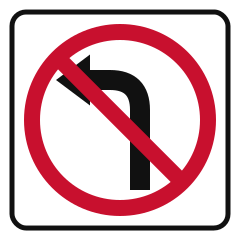
- Left lane ends ahead
- Sharp curve to the left
- Left turn only
- Do not turn left
You see this sign in front of a traffic island. What should you do?

- Keep to the left of the island
- Turn right at the island
- Merge into the right lane ahead
- Keep to the right of the island
Which of these signs is the strictest, banning you from stopping even for a moment?
- No parking
- No stopping
- No standing
- Do not enter
A cyclist ahead of you holds their right arm straight out to the side. What are they signalling?
- That you may pass
- That they are stopping
- A left turn
- A right turn
You are 20 and hold a full Class G licence. What blood-alcohol level is allowed when you drive?
- Less than .05%
- Zero
- Less than .08%
- Less than .02%
All Ontario G1 practice tests
- Ontario G1 Mock Exam 1 – 40 QuestionsUntimed practice · answers explained
- Ontario G1 Mock Exam 2 – 40 QuestionsUntimed practice · answers explained
- Ontario G1 Mock Exam 3 – 40 QuestionsUntimed practice · answers explained
- Ontario G1 Mock Exam 4 – 40 QuestionsUntimed practice · answers explained
- Ontario G1 Mock Exam 5 – 40 QuestionsUntimed practice · answers explained
- Regulatory signsStop, yield, school zone and railway crossbuck shapes, permissive and prohibitive signs, no stopping, standing and parking, community safety zones, school bus and HOV lane signs.
- Warning signsYellow diamond warning signs for curves, hills, merges, lane endings, crossings, animals and hazards, plus the slow-moving vehicle and long commercial vehicle placards.
- Construction, information and direction signsOrange temporary condition signs in work zones, doubled construction-zone fines, green guide signs, freeway exit numbering, emergency detour routes and bilingual signs.
- Traffic lights and pedestrian signalsGreen, yellow and red lights, turns on red, advance green and left-turn arrows, flashing lights, transit priority signals, dark signals during power failures and pedestrian signals.
- Pavement markingsYellow and white lines, solid and broken lines, continuity lines, stop lines, crosswalks, lane arrows, pedestrian crossovers and markings around obstacles.
About this practice test
How many questions are in Ontario G1 practice test 14?
40 original multiple-choice practice questions covering regulatory signs, warning signs, graduated licensing: g1, g2 and g, special situations on the road, sharing the road, turning, signalling and changing lanes, traffic lights and pedestrian signals, driving along and intersections, demerit points and keeping your licence, stopping and parking. Each answer includes an explanation. This mixed practice set does not reproduce the official exam format or predict an official score.
Are the questions the same every time?
Yes. Practice test 14 always has the same 40 questions, so you can repeat it until you get them all right. The other 14 sets use different questions.
Are these real test questions?
No. The official question bank is not published. These are original questions written from the official handbook, which is what the real Ontario G1 test is based on.