You are a G1 driver going to your first road test. Who must come with you to the test centre?
Ontario G1 overview
Ontario G1 Practice Test 13
40 questions on graduated licensing: g1, g2 and g, regulatory signs, special situations on the road, traffic lights and pedestrian signals, warning signs and more.
- No sign-up
- Every answer explained
- Independent · not a government site
- Set 13 of 15
- 40 questions
- Instant feedback
0/40
All 40 questions in this test
Every question and its answer choices. The correct answers and explanations appear when you take the test above.
You are a G1 driver going to your first road test. Who must come with you to the test centre?
- A driving instructor
- No one; you may drive alone
- An accompanying driver
- A parent or guardian
What is the purpose of a regulatory sign?
- To show distances to towns
- To mark a construction zone
- To give a direction you must obey
- To warn of a hazard ahead
In a construction zone, with no instruction to merge or change lanes, which action should you avoid?
- Obeying lower speed limits
- Changing lanes
- Watching for workers
- Being ready for sudden stops
Where can you find lane-use signs that tell drivers the direction each lane must travel?
- Only on poles at the right curb
- Only on the far side of the intersection
- Above the road or on the pavement
- Only on the traffic light itself
You are approaching an intersection when the light changes from green to yellow. You have plenty of room to stop safely. What should you do?
- Keep going at the same speed
- Sound your horn and go through
- Speed up to clear it before red
- Stop before the intersection
You are 23 and hold a G2 licence. What blood-alcohol level must you have when you drive?
- Zero
- Less than .08%
- Zero only after midnight
- Less than .05%
What should you do when you see this sign?
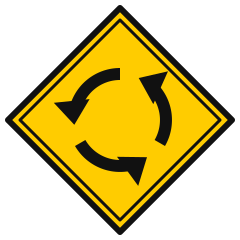
- Prepare for a detour route
- Reduce speed for a roundabout ahead
- Watch for a merge from the right
- Get ready to make a U-turn
You are parking on the right side of the road, facing uphill beside a curb. Which way should you turn the steering wheel?
- To the left, so the wheels point to the road
- Straight, with the wheels centred
- To the right, so the wheels point to the curb
- To the right, then back to centre
A school bus ahead of you has its overhead amber lights flashing. What does this mean for you?
- Slow down and get ready to stop
- Stop at least 20 metres away now
- Carry on, since only red lights matter
- Pass quickly before it stops
Another driver cuts you off and you feel your anger rising. What is the best response?
- Pass them and slow down in front of them
- Honk repeatedly until they acknowledge you
- Follow closely so they know they made a mistake
- Let it go and keep your distance from that driver
What does this sign mean?
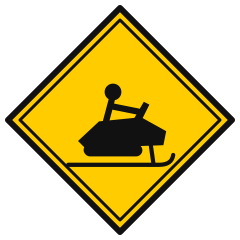
- Snowmobiles cross this road
- Snowmobiles may use this road
- Snowmobiles are banned here
- Snowmobile rental ahead
You plan a roadside stop, but a car is waiting to pull out of a driveway between you and your stopping spot. When should you signal?
- You need not signal for a roadside stop
- Well before reaching the driveway
- After you have passed that driveway
- Only once you have fully stopped
The signals are out because of a power outage. You and a car on your right stop at the same moment. Who should go first?
- Whichever car is going straight
- The car on your right
- Whichever car is larger
- You, as the car on the left
Your signal lights are not working. How do you show other drivers you are turning right?
- Left arm waving up and down
- Left arm out, bent up at a right angle
- Left arm held straight out to the side
- Left arm out, bent down at a right angle
What does this sign tell you?

- A traffic island ahead; keep left
- A divided highway begins; keep right
- A divided highway ends; keep right
- The road splits; pick either side
For repeat offences of failing to respond to an emergency vehicle, what is the maximum jail time?
- Up to one year
- Up to six months
- Up to two years
- Up to 30 days
You stop at a light behind a large truck. Why should you leave plenty of space in front of you?
- Trucks must stop a full lane back
- The truck may roll back when it starts
- Exhaust from the truck may stall you
- The truck may need to reverse to turn
In which condition should you avoid using cruise control?
- On wet, icy or slippery roads
- When driving in daylight
- On a dry, quiet highway
- When at the speed limit
You want to turn right at a red light and no sign forbids it. What must you do first?
- Wait for the light to turn green
- Signal and turn without slowing
- Stop fully and wait until the way is clear
- Slow down and turn if no one is coming
At an intersection with no signs or lights, a car on your left got there clearly before you. Who should go first?
- Whichever vehicle is larger
- You, because you are on the right
- Whichever driver signals first
- The car that arrived first
Which Ontario professionals have mandatory reporting duties for patients aged 16 or over with specified high-risk medical or visual conditions?
- The person’s employer
- Police officers only
- Physicians, optometrists and nurse practitioners
- The person’s insurance company
A G1 driver with no previous demerit points is convicted of an offence worth 2 points. What demerit-point action follows?
- Your licence is suspended 30 days
- You must attend a road test
- Nothing happens until 6 points
- You get a warning letter
You are in the middle lane under this overhead sign. What may you do?
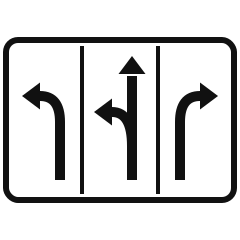
- Turn right or go straight
- Turn left only
- Go straight only
- Turn left or go straight
You are on a road divided by a median strip. A school bus on the other side of the median, facing you, stops with its red lights flashing. What must you do?
- You are not required to stop
- Stop at least 20 metres away
- Stop until its stop arm is folded
- Slow to 40 km/h and pass carefully
Under ideal conditions, what is the minimum safe following distance?
- One car length
- Half a second
- One second
- Two seconds
A streetcar is stopped and passengers are getting off, with no passenger area set aside. Where must you stop?
- Beside the rear doors
- At least 2 metres behind its rear doors
- At least 2 metres behind its front doors
- At least 5 metres behind its rear doors
A cyclist is riding slower than the cars around them on a street with a curb. Roughly where are they expected to ride?
- About two metres from the curb
- About one metre from the curb
- In the centre of the lane
- Right against the curb
You are driving behind a school bus that stops with its upper red lights flashing. How far back must you stop?
- At least 20 metres
- At least 5 metres
- At least 30 metres
- At least 10 metres
What does the checkerboard border on this sign warn you about?
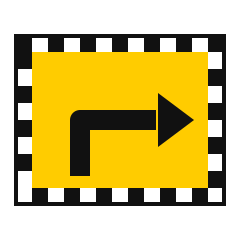
- A railway crossing ahead
- A dangerous sharp turn; slow down
- A race track entrance ahead
- A construction zone ahead
When parallel parking, about how long should the space be?
- About the same as your vehicle's length
- About three times your vehicle's length
- About twice your vehicle's length
- About 1.5 times your vehicle's length
You are following a snow plow that is clearing the road. When may you pass it?
- When it is going under 40 km/h
- On a straight road with clear visibility
- When it pulls slightly to the right
- Never, while it is moving
When may you turn left on a red light in Ontario?
- Never; left turns on red are illegal
- From a one-way road onto a one-way road
- From a two-way road onto a one-way road
- From any road, if no traffic is coming
How many demerit points does speeding by 16 to 29 km/h over the limit carry?
- 6
- 2
- 4
- 3
At a fully protected left-turn signal, the green arrow changes to a yellow light. Which drivers does that yellow apply to?
- Only vehicles turning left
- Only vehicles turning right
- All traffic approaching the intersection
- Only vehicles going straight through
What does this sign tell you?
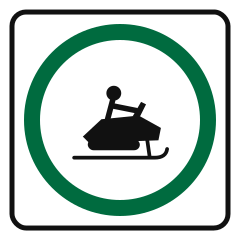
- A snowmobile trail crosses here
- Snowmobiles are banned on this road
- Snowmobiles may use this road
- Snowmobile parking area ahead
You are signalling a right turn and a cyclist is riding up beside you on your right. What should you do?
- Let the cyclist go through before you turn
- Speed up so you turn ahead of the cyclist
- Sound your horn and complete the turn
- Turn first, since you signalled first
Before taking the G2 exit test, what must you complete about your driving experience?
- A logbook signed by a driving instructor
- A record of 50 hours of night driving
- A Declaration of Highway Driving Experience
- A letter from your insurance company
Which of these is permitted under Ontario's distracted-driving law?
- Watching a video on a mounted tablet
- Playing a hand-held game at a stop
- Talking on a Bluetooth hands-free device
- Typing a text while stopped in traffic
How often must Ontario drivers aged 80 or older renew a full Class G licence?
- Every year
- Every five years
- Every two years
- Every three years
What shape and colour are most temporary condition signs?
- Rectangular and white
- Rectangular and green
- Diamond-shaped and orange
- Diamond-shaped and yellow
All Ontario G1 practice tests
- Ontario G1 Mock Exam 1 – 40 QuestionsUntimed practice · answers explained
- Ontario G1 Mock Exam 2 – 40 QuestionsUntimed practice · answers explained
- Ontario G1 Mock Exam 3 – 40 QuestionsUntimed practice · answers explained
- Ontario G1 Mock Exam 4 – 40 QuestionsUntimed practice · answers explained
- Ontario G1 Mock Exam 5 – 40 QuestionsUntimed practice · answers explained
- Regulatory signsStop, yield, school zone and railway crossbuck shapes, permissive and prohibitive signs, no stopping, standing and parking, community safety zones, school bus and HOV lane signs.
- Warning signsYellow diamond warning signs for curves, hills, merges, lane endings, crossings, animals and hazards, plus the slow-moving vehicle and long commercial vehicle placards.
- Construction, information and direction signsOrange temporary condition signs in work zones, doubled construction-zone fines, green guide signs, freeway exit numbering, emergency detour routes and bilingual signs.
- Traffic lights and pedestrian signalsGreen, yellow and red lights, turns on red, advance green and left-turn arrows, flashing lights, transit priority signals, dark signals during power failures and pedestrian signals.
- Pavement markingsYellow and white lines, solid and broken lines, continuity lines, stop lines, crosswalks, lane arrows, pedestrian crossovers and markings around obstacles.
About this practice test
How many questions are in Ontario G1 practice test 13?
40 original multiple-choice practice questions covering graduated licensing: g1, g2 and g, regulatory signs, special situations on the road, traffic lights and pedestrian signals, warning signs, stopping and parking, sharing the road, driving along and intersections, demerit points and keeping your licence, turning, signalling and changing lanes, construction, information and direction signs. Each answer includes an explanation. This mixed practice set does not reproduce the official exam format or predict an official score.
Are the questions the same every time?
Yes. Practice test 13 always has the same 40 questions, so you can repeat it until you get them all right. The other 14 sets use different questions.
Are these real test questions?
No. The official question bank is not published. These are original questions written from the official handbook, which is what the real Ontario G1 test is based on.