Which road users does the handbook single out as possibly losing traction on milled or grooved pavement?
Ontario G1 overview
Ontario G1 Practice Test 1
40 questions on construction, information and direction signs, freeway driving, turning, signalling and changing lanes, sharing the road, impaired driving and other suspensions and more.
- No sign-up
- Every answer explained
- Independent · not a government site
- Set 1 of 15
- 40 questions
- Instant feedback
0/40
All 40 questions in this test
Every question and its answer choices. The correct answers and explanations appear when you take the test above.
Which road users does the handbook single out as possibly losing traction on milled or grooved pavement?
- Cyclists
- Bus drivers
- Truck drivers
- Motorcyclists
The HOV lane is separated from the general lanes by striped buffer markings. May you cross them to enter the lane?
- Yes, if traffic is light
- Yes, if you signal first
- No, crossing the buffer is illegal
- Yes, at speeds under 80 km/h
You missed your turn and are thinking of making a U-turn. Where is it illegal to do so?
- On a road with a clear view both ways
- On a straight, flat road
- Near a hilltop
- On a quiet residential street
You are about to turn right at an intersection and a cyclist could be coming up on your right. What should you do?
- Sound your horn and turn before the cyclist
- Speed up so the cyclist can't reach you
- Signal and check mirrors and your right blind spot
- Swing into the left lane before turning
What blood-alcohol range does Ontario call the warn range?
- .08 to .10
- .02 to .05
- .01 to .03
- .05 to .079
Why should you avoid starting your engine when you don't need to?
- It drains the windshield washer fluid
- A cold start releases a burst of pollutants
- Starting wears out the headlights
- It resets the vehicle's odometer
What does this sign warn you about?
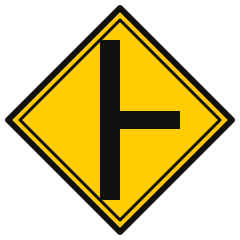
- A road branches off ahead
- The right lane ends ahead
- A detour to the right ahead
- A truck entrance ahead
Which three parts does a typical freeway exit include?
- Entrance ramp, deceleration lane, toll booth
- Exit ramp, collector lane, acceleration lane
- Deceleration lane, exit ramp, controlled intersection
- Acceleration lane, exit ramp, merge lane
Under full emergency braking, how far can it take a train to stop?
- Up to two kilometres
- Up to 500 metres
- Up to 200 metres
- Up to one kilometre
Who does the 'share the road' sign warn to take extra care on the section ahead?
- Only cyclists
- Only motorists
- Both motorists and cyclists
- Only drivers of trucks and buses
Under the handbook’s basic parking rules, what minimum distance must you keep from a bridge when parking?
- 50 metres
- 100 metres
- 30 metres
- 15 metres
What does it mean to 'overdrive' your headlights?
- Your high beams are aimed too high above the road
- You can't stop within the range you can see
- You use high beams near other cars
- Your headlights are left on in daylight
A police officer pulls you over to inspect your vehicle and finds it unsafe. What can happen?
- You get only a warning
- Only commercial vehicles are affected
- It can be taken off the road
- You may drive it for 30 days
Picturing the steering wheel as a clock, where should your hands be?
- At nine and three o'clock
- Both at twelve o'clock
- At ten and two o'clock
- At eight and four o'clock
You are on a multi-lane road and the lanes beside you are divided by white lines. What does that tell you?
- Those lanes are reserved for buses
- Traffic in those lanes moves opposite ways
- Traffic in those lanes moves the same way
- You may never change lanes there
You see this sign in a work zone. What should you do?
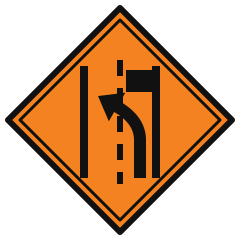
- Stop and wait for a flag person
- Drive on the shoulder past the closure
- Obey the speed limit and merge into the open lane
- Stay in your lane until you reach the workers
You move to a new apartment. Within how many days must you tell the Ministry of Transportation?
- Ten days
- Sixty days
- Thirty days
- Six days
Your headlights fail at night and won't come back on. Can you keep driving?
- Yes, if you drive slowly
- Yes, with hazard lights flashing
- Yes, on well-lit city streets
- No, it is dangerous and illegal
Which program is mandatory for all drivers convicted of impaired, driving-related Criminal Code offences?
- Novice requalification
- Driver-improvement interview
- Back on Track
- Collision avoidance course
What is the only way to make sure no one is in your blind spot?
- Use your turn signal
- Turn your head to shoulder check
- Check both side mirrors very carefully
- Check the interior mirror
How long does a new G1 driver have to finish the graduated licensing process before the licence expires?
- Three years
- Ten years
- Two years
- Five years
You pass a ministry-approved driver-education course while holding a G1. How soon can you finish Level One?
- After 6 months
- After 8 months
- After 4 months
- After 10 months
After a collision, a tow truck operator offers you cash to use his body shop. What should you do?
- Contact your insurance company
- Pay him to tow you quickly
- Accept and sign his forms
- Choose the shop he names
When do the late-night passenger limits for young G2 drivers stop applying?
- After 12 months at G2 with a clean record
- When you get a full G or turn 20
- When you turn 21
- When you turn 18
You are changing lanes on a multi-lane road. What should you do with your speed as you move over?
- Slow down before moving over
- Keep it steady or increase it gently
- Brake as you enter the new lane
- Speed up sharply to get ahead
Your gas pedal sticks while driving. What should you try first?
- Lift it by slipping your foot under it
- Turn the ignition off immediately
- Brake hard and steer to the ditch
- Reach down and pull it up by hand
What does this sign mean?
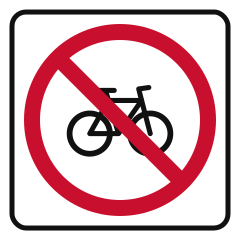
- Bicycle route ahead
- Bicycle crossing ahead
- Bicycles must use the sidewalk
- No bicycles allowed on this road
The handbook illustrates a crossover with double white lines and Xs on the road. Which equipment accompanies that layout?
- Full traffic lights and a painted stop line
- Specific signs and overhead yellow lights
- Flashing red beacons and a gate
- A crossing guard at all times
You want to stop and watch a moose near the highway. Where should you park?
- Completely off the road in a safe spot
- On the gravel shoulder near the moose
- In your lane with hazard lights
- On the paved shoulder with flashers on
You want to drop off a friend between two of these signs. What are you allowed to do?
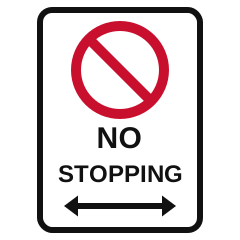
- Stop briefly to unload groceries
- Stop briefly to let a passenger out
- Nothing; you may not stop here at all
- Stop for up to five minutes
Where is the greatest risk of a collision for most drivers?
- Behind your vehicle
- On your right side
- In front of you
- On your left side
Your lane is blocked by road work and nobody is directing traffic. What should you do?
- Drive onto the shoulder to get by
- Go first because your lane is blocked
- Sound your horn and proceed
- Yield to traffic coming the other way
You have moved into the intersection on a green light to turn left, and the light turns red before oncoming traffic clears. What should you do?
- Complete your turn when it is safe
- Back up behind the stop line
- Go straight through instead
- Stay in place until the next green
When is a road most slippery during rain?
- Only once puddles form
- As the first drops fall
- After an hour of heavy rain
- When the rain stops
When must your headlights be on, regardless of weather?
- One hour before sunset to one hour after sunrise
- Half an hour before sunset to half an hour after sunrise
- Fifteen minutes after sunset to sunrise
- From sunset until sunrise only
You are on a main road with a green light, going straight, but traffic is backed up into the intersection. What should you do?
- Go around the stopped traffic
- Enter and wait inside the intersection
- Stop before the intersection and wait
- Sound your horn and creep ahead
At a pedestrian signal, what does the white walking-person symbol mean?
- Pedestrians must wait at the curb
- Drivers may turn across the crosswalk
- Only cyclists may cross now
- Pedestrians may cross in that direction
Why should you avoid following closely behind a bicycle?
- Bicycles throw up loose gravel
- Bicycles cannot stop quickly
- Bicycles must stop at every corner
- Many bicycles have no brake lights
Under Ontario’s studded-tire rules, which ordinary Ontario resident is eligible to use compliant studded tires during the permitted season?
- Any resident anywhere in Ontario
- No Ontario residents
- A resident of Northern Ontario
- Only a driver using a 400-series highway
What is hydroplaning?
- Wipers lifting off the glass
- Tires riding on top of water
- Brakes overheating in the rain
- Water entering the engine
All Ontario G1 practice tests
- Ontario G1 Mock Exam 1 – 40 QuestionsUntimed practice · answers explained
- Ontario G1 Mock Exam 2 – 40 QuestionsUntimed practice · answers explained
- Ontario G1 Mock Exam 3 – 40 QuestionsUntimed practice · answers explained
- Ontario G1 Mock Exam 4 – 40 QuestionsUntimed practice · answers explained
- Ontario G1 Mock Exam 5 – 40 QuestionsUntimed practice · answers explained
- Regulatory signsStop, yield, school zone and railway crossbuck shapes, permissive and prohibitive signs, no stopping, standing and parking, community safety zones, school bus and HOV lane signs.
- Warning signsYellow diamond warning signs for curves, hills, merges, lane endings, crossings, animals and hazards, plus the slow-moving vehicle and long commercial vehicle placards.
- Construction, information and direction signsOrange temporary condition signs in work zones, doubled construction-zone fines, green guide signs, freeway exit numbering, emergency detour routes and bilingual signs.
- Traffic lights and pedestrian signalsGreen, yellow and red lights, turns on red, advance green and left-turn arrows, flashing lights, transit priority signals, dark signals during power failures and pedestrian signals.
- Pavement markingsYellow and white lines, solid and broken lines, continuity lines, stop lines, crosswalks, lane arrows, pedestrian crossovers and markings around obstacles.
About this practice test
How many questions are in Ontario G1 practice test 1?
40 original multiple-choice practice questions covering construction, information and direction signs, freeway driving, turning, signalling and changing lanes, sharing the road, impaired driving and other suspensions, safe, responsible and efficient driving, warning signs, stopping and parking, night driving and bad weather, your vehicle: maintenance, insurance and registration, driving along and intersections, pavement markings, demerit points and keeping your licence, emergencies and collisions, getting ready to drive, graduated licensing: g1, g2 and g, regulatory signs, special situations on the road, traffic lights and pedestrian signals. Each answer includes an explanation. This mixed practice set does not reproduce the official exam format or predict an official score.
Are the questions the same every time?
Yes. Practice test 1 always has the same 40 questions, so you can repeat it until you get them all right. The other 14 sets use different questions.
Are these real test questions?
No. The official question bank is not published. These are original questions written from the official handbook, which is what the real Ontario G1 test is based on.