There is a solid line along the left side of your lane. What does it mean?
Ontario G1 overview
Ontario G1 Practice Test 8
40 questions on pavement markings, graduated licensing: g1, g2 and g, your vehicle: maintenance, insurance and registration, getting ready to drive, demerit points and keeping your licence and more.
- No sign-up
- Every answer explained
- Independent · not a government site
- Set 8 of 15
- 40 questions
- Instant feedback
0/40
All 40 questions in this test
Every question and its answer choices. The correct answers and explanations appear when you take the test above.
There is a solid line along the left side of your lane. What does it mean?
- It is unsafe to pass
- You may pass if it is clear
- You must turn left soon
- Your lane is ending ahead
What class of licence do you need to drive a car, van or small truck in Ontario?
- Class D
- Class G
- Class F
- Class C
Your car's tire tread is worn to 1 mm. What should you do?
- Rotate it to the rear
- Add more air pressure
- Keep it until it reaches 0.5 mm
- Replace the tire
How can you check that your seat is the right distance from the pedals?
- Press the gas pedal to the floor
- Put your feet flat under the brake pedal
- Touch the dashboard with your knees
- Fully straighten your arms on the wheel
After a novice driver finishes a demerit-point suspension, how many points remain on their record?
- 4
- 7
- 0
- 2
On a two-way street, on which side should you pass a streetcar?
- On the left
- On either side
- On the right
- Only on the side with a stop
A 6-year-old weighs 25 kg, is 120 cm tall and has outgrown her forward-facing seat. What must she use?
- A rear-facing car seat
- A booster seat
- The adult seatbelt alone
- A lap belt only
Ontario’s mandatory medical-reporting rules cover patients with certain prescribed high-risk conditions. What is the minimum patient age?
- 18 years or older
- 65 years or older
- 21 years or older
- 16 years or older
You are approaching a green light that has been green for a while. What should you be ready to do?
- Stop when it turns yellow
- Turn on your hazard lights
- Yield to cars on your right
- Speed up before it turns red
What do most information and direction signs look like?
- Diamond-shaped, yellow with black letters
- Diamond-shaped, orange with black letters
- Rectangular, white with black letters
- Rectangular, green with white letters
A white arrow pointing straight ahead is painted in your lane. What does it mean?
- The lane is one-way for buses
- You may go straight or turn right
- You may only go straight ahead
- Going straight is only suggested
You are waiting to turn left and an oncoming cyclist is approaching the intersection. What must you do?
- Sound your horn and complete the turn
- Wait for the cyclist to pass, then turn
- Wave the cyclist through to stop
- Turn quickly before the cyclist arrives
You have turned on your signal to change lanes. What must you still do before moving over?
- Wait exactly three seconds
- Sound your horn as a warning
- Check that the way is clear
- Nothing; the signal is enough
A tractor-trailer ahead of you swings left before making a right turn, leaving an open gap in the right lane. What should you do?
- Sound your horn so the driver sees you
- Stay well back until it has cleared the turn
- Move up into the gap on the right
- Pass it on the right while it swings
You are in slow, stop-and-go city traffic on a warm day. What does the handbook suggest for staying cool efficiently?
- Keep the engine idling faster
- Turn on the rear defroster
- Run the A/C on maximum
- Use the windows and vents
A warning sign says drivers on the sideroad ahead don't have a clear view of traffic. What does this tell you?
- The sideroad is closed to traffic
- You must stop at the sideroad
- You must yield to the sideroad
- Sideroad drivers may not see you coming
You are driving in the right lane of a freeway and a vehicle is merging from an entrance ramp. What should you do?
- Speed up to block the vehicle
- Move over a lane if it is safe
- Stop to let the vehicle in
- Sound your horn as a warning
On a multi-lane freeway, which lane should you normally drive in?
- The centre lane only
- The right-hand lane
- Any lane you prefer
- The far left lane
A train is approaching a railway crossing ahead of you. How far from the nearest rail or gate must you stop?
- At least 2 metres
- At least 15 metres
- At least 5 metres
- At least 30 metres
You come to this sign. What must you do?

- Slow down and go if nobody is coming
- Stop only if cross traffic is present
- Yield only to vehicles on your right
- Stop fully, then go when it is clear
You are following detour markers around a closed road. How long should you keep following them?
- Until you have gone one kilometre
- Until you reach a freeway
- Until the next traffic light
- Until you are back on your regular route
Acid rain forms when exhaust gases combine with water vapour. Which gases are responsible?
- Carbon dioxide and methane
- Carbon monoxide and ozone
- Sulphur and nitrogen oxides
- Hydrocarbons and soot
Under the handbook’s basic parking rules, what minimum distance must you keep from the nearest rail of a level railway crossing?
- 15 metres
- 5 metres
- 9 metres
- 30 metres
You are involved in a collision. What is your legal duty?
- Leave if you are not at fault
- Stay and give all possible help
- Leave once you call your insurer
- Stay only if someone is injured or killed
On a freeway, several snow plows are staggered across the lanes. What should you do?
- Pass on the shoulder
- Flash your lights so they move over
- Pass between them in a clear gap
- Stay back and don't pass between them
What does this sign warn you about?

- A steep hill ahead
- A slippery road ahead
- A winding road ahead
- A sharp left turn ahead
You are passing a car on a two-lane road when it suddenly speeds up. What should you do?
- Sound your horn and keep passing
- Stay beside it until it slows
- Speed up and finish passing quickly
- Drop back and return to your original lane
During which late-night period do drowsiness-related collisions tend to happen most?
- Between 2 a.m. and 6 a.m.
- Between 10 p.m. and midnight
- Between 6 a.m. and 9 a.m.
- Between midnight and 2 a.m.
On a two-lane, two-way road, in which situation may you pass another vehicle on the right?
- When it is a large truck
- When it signals a right turn
- When it is going below the limit
- When it is turning left
What is the standard demerit value for failing to stop at a designated pedestrian crossover (distinct from an ordinary crosswalk)?
- 6
- 2
- 3
- 4
At an intersection pedestrian signal on a busy main road, how is traffic on the smaller crossroad controlled?
- By a crossing guard
- By stop signs
- By yield signs
- By traffic lights
You must drive in fog. Which headlights should you use?
- Parking lights only
- High-beam headlights
- Low-beam headlights
- No headlights at all
Two solid lines on the pavement curve around a concrete island ahead. What are they for?
- Marking a parking area
- Guiding traffic away from the object
- Showing a passing zone
- Marking a pedestrian crossing at the island
Your wheels went off the pavement and you have slowed down. When should you steer back?
- Only after a complete stop
- Immediately, at full speed
- Once the vehicle is under control
- Never; drive on the shoulder
A Class G driver wants to drive a 13,000 kg recreational vehicle. What does the driver need?
- An air brake ("Z") endorsement
- A Class M licence
- Nothing; Class G covers all RVs
- An RV ("T") endorsement
A driver with no alcohol-related history is convicted of dangerous driving under the Criminal Code. Which remedial measure applies?
- A warn-range education course
- A driver-improvement interview
- An ignition interlock only
- The Back on Track program
Between two of these signs, which kind of stop is allowed?
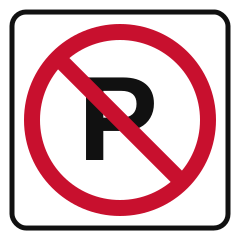
- Waiting with your hazard lights on
- Parking while you run into a store
- Loading or unloading passengers or goods
- No stop of any kind is allowed
An emergency vehicle approaches with siren on. Why should you avoid stopping on the shoulder?
- Shoulders are always closed to traffic
- Your car may get stuck in gravel
- It earns you an automatic fine
- Emergency vehicles may use the shoulder
Pumping the brakes did not work. How should you use the parking brake?
- Yank it on as hard as possible
- Gently but firmly, button held in
- In quick on-and-off pulls to avoid a skid
- Only after turning off the engine
During a power failure, the traffic lights at an intersection are completely dark. How should you treat the intersection?
- As if it had no rules at all
- As a yield sign for you only
- As if the light were green
- As an all-way stop
All Ontario G1 practice tests
- Ontario G1 Mock Exam 1 – 40 QuestionsUntimed practice · answers explained
- Ontario G1 Mock Exam 2 – 40 QuestionsUntimed practice · answers explained
- Ontario G1 Mock Exam 3 – 40 QuestionsUntimed practice · answers explained
- Ontario G1 Mock Exam 4 – 40 QuestionsUntimed practice · answers explained
- Ontario G1 Mock Exam 5 – 40 QuestionsUntimed practice · answers explained
- Regulatory signsStop, yield, school zone and railway crossbuck shapes, permissive and prohibitive signs, no stopping, standing and parking, community safety zones, school bus and HOV lane signs.
- Warning signsYellow diamond warning signs for curves, hills, merges, lane endings, crossings, animals and hazards, plus the slow-moving vehicle and long commercial vehicle placards.
- Construction, information and direction signsOrange temporary condition signs in work zones, doubled construction-zone fines, green guide signs, freeway exit numbering, emergency detour routes and bilingual signs.
- Traffic lights and pedestrian signalsGreen, yellow and red lights, turns on red, advance green and left-turn arrows, flashing lights, transit priority signals, dark signals during power failures and pedestrian signals.
- Pavement markingsYellow and white lines, solid and broken lines, continuity lines, stop lines, crosswalks, lane arrows, pedestrian crossovers and markings around obstacles.
About this practice test
How many questions are in Ontario G1 practice test 8?
40 original multiple-choice practice questions covering pavement markings, graduated licensing: g1, g2 and g, your vehicle: maintenance, insurance and registration, getting ready to drive, demerit points and keeping your licence, turning, signalling and changing lanes, impaired driving and other suspensions, driving along and intersections, construction, information and direction signs, sharing the road, safe, responsible and efficient driving, warning signs, freeway driving, stopping and parking, regulatory signs, emergencies and collisions, night driving and bad weather, special situations on the road, traffic lights and pedestrian signals. Each answer includes an explanation. This mixed practice set does not reproduce the official exam format or predict an official score.
Are the questions the same every time?
Yes. Practice test 8 always has the same 40 questions, so you can repeat it until you get them all right. The other 14 sets use different questions.
Are these real test questions?
No. The official question bank is not published. These are original questions written from the official handbook, which is what the real Ontario G1 test is based on.