Some work zone signs give notice of fines. What offence do these signs warn about?
BC Class 7 overview
BC Class 7: Construction, guide and railway signs
Orange construction and work zone signs, information and destination signs, and railway crossing signs.
- No sign-up
- Every answer explained
- Independent · not a government site
- 19 questions
- Topic drill
0/19
Study reference: Learn to Drive Smart (ICBC, March 2026 edition), Ch. 3 Signs, signals and road markings — Construction signs, information and destination signs, railway signs, pp. 35–36
All 19 questions in this test
Every question and its answer choices. The correct answers and explanations appear when you take the test above.
Some work zone signs give notice of fines. What offence do these signs warn about?
- Driving without headlights
- Speeding in a work zone
- Using a phone in a work zone
- Parking on the shoulder
How may public railway crossings be marked?
- With signs or pavement markings, and sometimes warning devices
- Only with a stop sign at every crossing
- Only with a flag person during the day
- Only with gates, bells and flashing lights at every public crossing
What does this X-shaped sign mark?

- A crossroad ahead
- A railway crossing
- A road closed to traffic
- A four-way stop
What should you do when you see this lighted sign in a work zone?

- Stop and wait until the arrow stops flashing
- Pass on the right side of the board
- Turn on your hazard lights and stop
- Follow the direction of the lighted arrow
A sign warns of a railway crossing on a side road ahead. What should you be ready to do?
- Change to the left lane
- Speed up past the side road
- Stop at that crossing
- Sound your horn twice
What should you do when you see this sign?
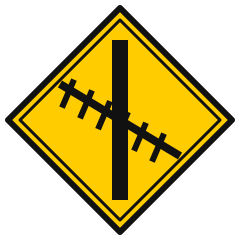
- Be prepared to stop; a railway crossing is ahead
- Turn off; the road ends at the tracks
- Speed up to cross before any train
- Stop at once; a train is crossing the road right now
What unit are the distances on a green destination sign like this one?
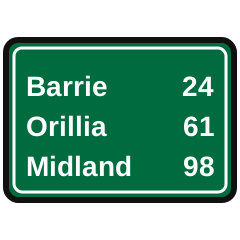
- Miles
- Metres
- Minutes of travel
- Kilometres
What does this sign warn you about?

- A school crossing guard ahead
- Pedestrians crossing ahead
- A traffic-control person ahead
- A survey crew ahead
What must you do when you see this sign?

- Move to the left lane right away
- Obey the posted speed; a crew is working
- Stop and wait for a flag person's signal
- Slow to 30 km/h only if you see workers
What does an end of construction zone speed limit sign tell you?
- Workers are present for the next 1 km
- The work zone speed limit starts at this sign
- You must stop at the end of the zone
- The work zone speed limit no longer applies
Which type of sign tells you about destinations, route numbers and facilities such as gas or a hospital?
- Warning signs and object markers
- Regulatory and turn control signs
- Construction and maintenance signs
- Information and destination signs
A train has passed and the crossing gate is starting to rise. When may you go?
- When the last car clears the crossing
- Only once the gate is fully raised
- When the bells stop ringing
- As soon as the gate starts to rise
A work zone sign says blasting ahead. What must you do?
- Speed up to clear the area quickly
- Honk to warn the blasting crew
- Stop and wait for the blast to end
- Follow the instructions on the sign
At a public railway crossing, who must yield?
- Whoever reaches the crossing first
- You must always yield to trains
- Trains yield when gates are up
- Trains yield to vehicles on the tracks
A construction sign warns of a soft shoulder ahead. What should you do?
- Stay off the shoulder
- Use the shoulder only if dry
- Slow to 30 km/h on the shoulder
- Use the shoulder to pass
What does this sign tell you?

- The road is closed ahead
- A detour is ahead
- A lane is closed ahead
- The construction zone ends
What does this sign tell you?
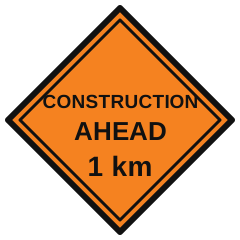
- A detour around the work
- Construction is ahead
- A construction zone ends
- The road is closed to traffic
You are approaching road work. Which is a rule for driving through a construction zone?
- Follow the car ahead closely to save time
- Obey traffic-control persons and the posted speed
- Pass close to equipment to keep traffic moving
- Drive at the normal limit if no workers are visible
A railway crossing sign tells you to stop. What must you do?
- Stop, then go when it is safe
- Slow and go if no train is visible
- Stop only if a train is in sight
- Stop only when the lights flash
Construction, guide and railway signs: key rules to remember
Our summary of what the official handbook says on this topic, in our own words. Read it before or after the practice questions above, then check the original chapter. Read the official chapter ↗
Construction signs
- Warn of construction and maintenance work; you must heed the warnings and obey the instructions.
- In work zones: obey traffic-control persons, travel within the posted speed, stay well back from all equipment, pass only when safe.
- End of construction zone speed limit.
- Detour ahead. Soft shoulder ahead: stay off the shoulder. Construction ahead.
- Traffic-control person ahead.
- Crew working: obey the posted speed limit. Survey crew: obey the posted speed limit.
- Lighted arrow board: follow the lighted arrow.
- Fine notice for speeding in a work zone.
- Blasting ahead: follow the instructions on the sign.
Information and destination signs
- Give information on destinations, route numbers and facilities.
- Destination sign distances are in kilometres. Directional sign. Trans-Canada Highway route marker. Primary highway marker.
- Facility signs: hospital nearby, gas ahead, accommodation ahead, travel information ahead.
Railway signs
- Public railway crossings are shown by signs or pavement markings and may also have mechanical or electrical warning devices.
- You must always yield to trains.
- Railway crossing ahead: be prepared to stop.
- Railway crossing on a side road ahead: be prepared to stop.
- Railway crossing (with stop): stop, then proceed when it is safe.
- Crossing with a gate: stay stopped until the gate is fully raised.
Study the Construction, guide and railway signs rules as flashcards →
Other topics
- Regulatory signsStop, yield and speed signs, school and playground zone signs, crosswalk signs, lane use and turn control signs, parking signs and reserved lane signs.
- Warning signs and object markersYellow diamond warning signs for curves, hills, merges, lane endings, crossings, wildlife and road hazards, plus object markers on obstructions.
- Traffic lights and lane control signalsSteady and flashing lights, green and yellow arrows, transit priority signals and overhead lane control signals.
- Road markingsYellow and white lines, passing rules by line type, crosswalk and stop lines, reserved lane and bicycle lane markings, and painted islands.
- Your vehicle and safety equipmentSeat and head restraint adjustment, seatbelts, child car seat stages, airbags, mirrors, controls, lights, anti-lock brakes, pre-trip checks, tires and winter preparation.
- Intersections and right-of-waySignalling, controlled and uncontrolled intersections, where to stop, right-of-way at lights, stop signs and yield signs, traffic circles, roundabouts and entering a roadway.
- Lanes, turns and passingChoosing a lane, turning right and left, multiple and two-way left-turn lanes, U-turns, HOV, bus and bicycle lanes, passing, merging, freeway entrances and exits, and turning around.
- Parking rulesWhere parking is illegal, required distances from hydrants, crosswalks, stop signs and railway crossings, curb distance and hill parking.
- Observation and hazard perceptionScanning ahead, behind and at intersections, mirror and shoulder checks, blind spots, hazard perception, assessing risk and choosing a solution.
- Speed, space and communicationSpeed limits and appropriate speeds, curves, steering, stopping distance, the two-second rule, space behind and beside, safe gaps, signals, lights and the horn.
- Pedestrians, cyclists and motorcyclesYielding to pedestrians, passing distance and rules for cyclists, and sharing the road with motorcycle riders and other passenger vehicles.
- Large vehicles, buses, emergency vehicles and trainsLarge vehicle blind spots, school buses, transit buses, emergency vehicles, stopped vehicles with flashing lights, construction zones, railway crossings and horses.
- Fitness to drive, distraction and attitudeVision, health and fatigue, cellphones and other devices, dangerous emotions, risk taking, peer pressure, unsafe passengers and aggression on the road.
- Alcohol, drugs and impairmentHow alcohol and drugs affect driving, blood alcohol facts, medications, illegal drugs, cannabis and combining drugs with alcohol.
- Emergency driving strategiesEmergency braking, anti-lock brakes, skid recovery, tire blowouts, brake failure and other breakdowns, animals on the road, collision avoidance and what to do at a crash.
- Weather, visibility and night drivingLoss of visibility, glare, rain, hydroplaning, deep water, ice and snow, being stranded, wind and turbulence, headlight use and overdriving your headlights.
- Graduated licensing and penaltiesLearner (L) and novice (N) stage restrictions, supervisor and passenger rules, GLP penalties, fines and penalty points, impaired driving penalties and vehicle impoundment.