It's raining hard and the road is slippery. What following distance should you leave?
BC Class 7 overview
BC Class 7 Practice Test 7
50 questions on speed, space and communication, weather, visibility and night driving, intersections and right-of-way, construction, guide and railway signs, observation and hazard perception and more.
- No sign-up
- Every answer explained
- Independent · not a government site
- Set 7 of 11
- 50 questions
- Instant feedback
0/50
All 50 questions in this test
Every question and its answer choices. The correct answers and explanations appear when you take the test above.
It's raining hard and the road is slippery. What following distance should you leave?
- Three seconds
- Six seconds
- Four seconds
- Two seconds
A strong crosswind gusts as a tractor-trailer passes you. What should you do?
- Brake hard and stop in your own lane
- Steer hard away from the side of the truck
- Speed up to get past the truck quickly
- Slow down; grip the wheel with both hands
You need to pass a person walking on the shoulder of an 80 km/h highway. What minimum gap does the law require?
- 1.5 metres
- 3.0 metres
- 0.5 metre
- 1.0 metre
What must you do at a flashing red light?
- Stop only if traffic is coming
- Wait until it turns green
- Slow down, then keep going if the way looks clear
- Stop completely, then go when safe
A work zone sign says blasting ahead. What must you do?
- Speed up to clear the area quickly
- Honk to warn the blasting crew
- Stop and wait for the blast to end
- Follow the instructions on the sign
As you approach an intersection, in what order should you scan the road you're about to cross?
- Right, centre, left, then right again
- Left, centre, right, then left again
- Centre, then left, then right only
- Left, then right, then straight ahead
What does a double solid yellow line mean?
- No passing is allowed
- Passing allowed with caution
- Passing allowed for slow vehicles
- The lane is reversible
You're driving a manual-transmission car toward a railway crossing. When should you change to a lower gear?
- While you're on the tracks
- As the front wheels hit the rail
- Before you begin to cross
- Halfway across the crossing
A study quoted in the guide found that a driver who combines alcohol and drugs is how much more likely to crash than a sober driver?
- Nine times
- Twenty times
- Two times
- Four times
What does a broken white line between two lanes going your way allow?
- Passing on the shoulder
- Making a U-turn whenever it is clear
- Changing lanes when it is safe
- No lane changes at all
On wet roads, how much braking distance should you allow?
- At least twice the normal distance
- The same as on dry pavement
- At least ten times the normal distance
- About one and a half times normal
Below what speed does ICBC suggest rolling down the windows instead of using air conditioning?
- 80 km/h
- 30 km/h
- 50 km/h
- 70 km/h
A crash can't be avoided. What should you try to steer toward?
- A row of parked cars
- Bushes or a high snowbank
- A large, solid tree
- A concrete highway wall
You're on a rural B.C. road outside any town and see no speed sign. What is the limit?
- 70 km/h
- 90 km/h
- 80 km/h
- 100 km/h
After a crash, which of these must you give the other driver?
- The registered owner's name and address
- Your date of birth and age
- Your employer's name and phone number
- Your driving school's details
Which effect of cannabis on drivers is described in the guide?
- Slower responses, especially in emergencies
- Quicker reactions to brake lights ahead of you
- Sharper vision when driving at night
- Better focus on long highway trips
What does this sign tell you?
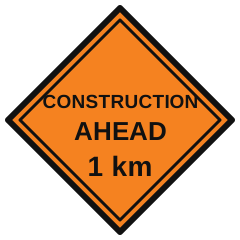
- A detour around the work
- Construction is ahead
- A construction zone ends
- The road is closed to traffic
How do you know you've reached the end of a 30 km/h school zone?
- You pass the school's parking lot
- You pass the last marked crosswalk
- You reach the back of the school zone sign
- You pass the school's front driveway
Outside a school zone, you're caught 10 km/h over the speed limit. What does the table show?
- $138 and 3 points
- $196 and 3 points
- $109 and 2 points
- $167 and 3 points
You fail to yield to a pedestrian in a crosswalk. What fine and points does the table list?
- $167 and 3 points
- $167 and 2 points
- $196 and 3 points
- $109 and 3 points
A cyclist ahead holds their right arm straight out to the side. What are they signalling?
- A left turn
- A lane drift
- A stop
- A right turn
What does this sign warn you about?
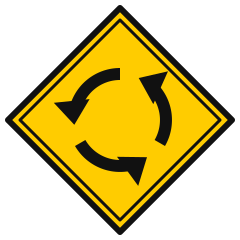
- A detour ahead
- A roundabout ahead
- Two-way traffic ahead
- U-turns are allowed ahead
Smoke and flames are coming from under your hood. What should you do?
- Open the hood to check the fire
- Get everyone out and move well away
- Keep driving to a service station
- Stay inside with all the windows rolled up
On which two kinds of warning signs are you told to slow to the advisory speed shown?
- Steep hill signs and rough road signs
- Narrow bridge signs and tunnel signs
- School zone signs and playground signs
- Sharp curve signs and highway exit signs
Why does your vehicle need a longer distance to stop when you're going downhill?
- Tires grip better going downhill
- Brakes cool down too fast on hills
- Gravity keeps pulling it forward
- Inertia is weaker on a downgrade
A cyclist moves toward the middle of a narrow lane to avoid broken glass and potholes. What does the guide say?
- The cyclist has the right to do that
- The cyclist must ride on the sidewalk
- You may honk to move them over
- The cyclist must stay at the far right
Why should you check the exhaust system before winter?
- Leaks can let carbon monoxide build up inside
- Exhaust leaks drain the battery
- Snow can freeze the tailpipe shut
- Cold air makes the muffler louder
What do yellow lines on the road separate?
- Traffic moving in the same direction
- Traffic moving in opposite directions
- Parking areas from travel lanes
- Bicycle lanes from the lanes used by cars
What colour is the school crosswalk ahead sign?
- Fluorescent yellow-green
- Orange with black symbols
- White with black lettering
- Yellow with black symbols
Visibility behind you is limited as you prepare to back up. What can you do to warn others?
- Give a quick tap on the horn
- Roll down your window and shout
- Turn on your left signal
- Flash your high beams twice
At a steady red light, which left turn may you make after stopping and checking that it is clear?
- A left turn from any lane
- A left turn onto a one-way street
- A left turn onto any two-way street
- No left turn is ever allowed
You have your L licence. Who must sit beside you whenever you drive?
- A supervisor 21+ with any class of licence
- A supervisor 25+ with a Class 1–5 licence
- Any licensed driver aged 19 or older
- Any adult who holds a Class 7 N licence
Your car has been sitting in the driveway for several hours and you need to back out. What does the guide suggest first?
- Walk around the back to check the path
- Tap the horn twice, then reverse
- Rely on the back-up camera alone to back out
- Turn on your hazard lights first
You stop to eat during a long drive. What eating advice does the guide give to help you stay alert?
- Eat a large meal once
- Eat only sweets and snacks
- Skip food until you arrive
- Avoid heavy meals
You are turning left from a one-way street onto a two-way street. What is the correct lane tracking?
- From the right lane into the centre lane
- From the left lane into the centre lane
- From the left lane into the curb lane
- From the centre lane into the left lane
Your wheels lock as you brake on an icy road. What should you do?
- Turn the steering wheel sharply to one side
- Ease off the brakes, then re-apply them
- Shift into neutral and coast to a stop
- Press down even harder on the brakes
Are you allowed to exceed the speed limit while passing?
- Yes, by up to 10 km/h
- No, you must stay within the limit
- Yes, if you pass quickly
- Only on a divided highway
One new driver is overconfident and another lacks confidence. What does the guide say both need?
- More learning and more practice time
- A higher class of licence first
- Only more highway driving time
- A stricter limit on passengers
Daytime running lights are standard on vehicles made after which year?
- 1985
- 2001
- 1995
- 1991
How often should you complete the whole observation cycle of looking ahead, scanning side to side and checking your mirrors?
- Every 12 to 15 seconds
- Every 20 to 30 seconds
- Every one to two seconds
- Every five to eight seconds
You're on the second day of a long road trip. Why should you be especially careful today?
- Traffic is always heaviest on day two
- Your licence rules change after day one
- Fatigue is most likely to hit you today
- Tires wear fastest on the second day
A truck ahead begins slowing well before a red light, leaving a big gap in front of it. What should you do?
- Pass the truck on its right side
- Honk so the driver moves ahead
- Stay out of that space
- Move into the gap to save time
On a 100 km/h highway, you approach a tow truck stopped on the shoulder with flashing lights. What is the fastest you may go as you pass?
- 70 km/h
- 40 km/h
- 60 km/h
- 90 km/h
What is the speed limit in a B.C. playground zone, and when does it apply?
- 30 km/h 8 a.m. to 5 p.m. on school days
- 30 km/h every day from dawn to dusk
- 20 km/h only when children are present
- 40 km/h every day from dawn to dusk
You want to turn left at a two-lane roundabout. Which lane should you enter from?
- Either lane
- The right lane
- The left lane
- The truck apron
The green left-turn arrow on a separate signal turns yellow before you can turn. What should you do?
- Move into the through lane instead
- Stop and wait for the next green arrow
- Turn quickly before it goes red
- Turn after yielding to oncoming traffic
What does this sign mean?

- Stop sign ahead
- Road closed to trucks
- No stopping at any time
- Do not enter
Feeling sleepy on a long drive, you pull into a rest stop for a nap. What does the guide remind you to do?
- Leave the engine running
- Roll all the windows down
- Turn on your hazard lights
- Lock your doors
When may a driver cross a bicycle lane?
- Where the line is broken, or to use a driveway
- Never, under any circumstances
- Anytime there is no cyclist in sight in either direction
- Only when parking for a short time
You are in a lane signed for left turns only and have already entered the intersection when you realize you meant to go straight. What must you do?
- Move into the through lane quickly
- Complete the left turn
- Go straight if no one is beside you
- Stop and wait for a gap to change lanes
All BC Class 7 practice tests
- BC Class 7 Mock Exam 1 – 50 QuestionsTimed practice · 45 minutes · answers explained
- BC Class 7 Mock Exam 2 – 50 QuestionsTimed practice · 45 minutes · answers explained
- BC Class 7 Mock Exam 3 – 50 QuestionsTimed practice · 45 minutes · answers explained
- BC Class 7 Mock Exam 4 – 50 QuestionsTimed practice · 45 minutes · answers explained
- BC Class 7 Mock Exam 5 – 50 QuestionsTimed practice · 45 minutes · answers explained
- Regulatory signsStop, yield and speed signs, school and playground zone signs, crosswalk signs, lane use and turn control signs, parking signs and reserved lane signs.
- Warning signs and object markersYellow diamond warning signs for curves, hills, merges, lane endings, crossings, wildlife and road hazards, plus object markers on obstructions.
- Construction, guide and railway signsOrange construction and work zone signs, information and destination signs, and railway crossing signs.
- Traffic lights and lane control signalsSteady and flashing lights, green and yellow arrows, transit priority signals and overhead lane control signals.
- Road markingsYellow and white lines, passing rules by line type, crosswalk and stop lines, reserved lane and bicycle lane markings, and painted islands.
About this practice test
How many questions are in BC Class 7 practice test 7?
50 original multiple-choice practice questions covering speed, space and communication, weather, visibility and night driving, intersections and right-of-way, construction, guide and railway signs, observation and hazard perception, road markings, large vehicles, buses, emergency vehicles and trains, alcohol, drugs and impairment, your vehicle and safety equipment, emergency driving strategies, pedestrians, cyclists and motorcycles, graduated licensing and penalties, warning signs and object markers, fitness to drive, distraction and attitude, lanes, turns and passing, regulatory signs. Each answer includes an explanation. This mixed practice set does not reproduce the official exam format or predict an official score.
Are the questions the same every time?
Yes. Practice test 7 always has the same 50 questions, so you can repeat it until you get them all right. The other 10 sets use different questions.
Are these real test questions?
No. The official question bank is not published. These are original questions written from the official handbook, which is what the real BC Class 7 test is based on.