
BC Class 7 overview

BC Class 7 Practice Test 11

50 questions on regulatory signs, emergency driving strategies, speed, space and communication, road markings, large vehicles, buses, emergency vehicles and trains and more.

  • Set 11 of 11
  • 50 questions
  • Instant feedback
0/50
Practice test 11 · Question 1Score 0/0
White square with a black oval at the bottom and a curved black arrow passing it on the right

What does this sign tell you to do?

All 50 questions in this test

Every question and its answer choices. The correct answers and explanations appear when you take the test above.

  1. What does this sign tell you to do?

    White square with a black oval at the bottom and a curved black arrow passing it on the right
    1. Merge right because the left lane ends
    2. Keep to the right of the divider
    3. Keep left of the island ahead
    4. Turn right at the next intersection
  2. At what times are animals most likely to be on the move and hardest to see?

    1. Around midday
    2. At dusk and dawn
    3. Around midnight
    4. In late afternoon
  3. When judging a gap in traffic, what mistake does the guide warn about with motorcycles and bicycles?

    1. Overestimating how fast they are coming
    2. Assuming they will always stay right
    3. Underestimating how fast they are coming
    4. Thinking they must yield to cars
  4. What colour are school zone signs in B.C.?

    1. White with red letters
    2. Orange with black symbols
    3. Yellow with a black border
    4. Fluorescent yellow-green
  5. You are on a road with a single solid yellow centre line. What does the B.C. guide say about passing?

    1. Passing is never allowed
    2. Passing is allowed with extra caution
    3. Passing is allowed only on the right
    4. Passing is allowed only in daylight
  6. This sign has a tab underneath listing hours of the day. What does it mean?
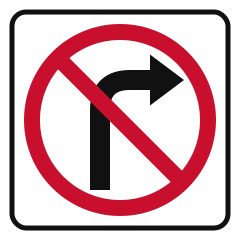
    White square with a black right-turn arrow inside a red circle with a red diagonal slash
    1. No right turns during the posted times
    2. No right turn on a red light at any time
    3. Only buses may turn right at those times
    4. Right turns allowed only during the posted times
  7. Which of these warns you that a large vehicle is about to back up?

    1. A beeper, four-way flashers or backup lights
    2. A flashing left turn signal
    3. Its engine noise getting quieter
    4. A puff of smoke from the exhaust
  8. You've stopped for a school bus with flashing red lights. When can you start moving again?

    1. When a child waves you through
    2. When the last child reaches the curb safely
    3. After waiting about 30 seconds
    4. When it moves on or its lights go off
  9. Traffic is heavy and a motorcycle is riding on one side of its lane. Can you move up beside it in the same lane?

    1. Yes, on multi-lane highways only
    2. No, it needs the whole lane
    3. Only when traffic is stopped
    4. Yes, if you stay on the far side
  10. Is it legal to coast down a hill in neutral or with the clutch pushed in?

    1. No, you must stay in gear
    2. Yes, to save fuel on long hills
    3. Only with an automatic transmission
    4. Yes, if the hill isn't steep
  11. A truck ahead of you slows down, but its brake lights never come on. What's a likely reason?

    1. It is coasting downhill in neutral
    2. Its brake lights must be burnt out
    3. It is about to begin backing up
    4. It's slowing with an engine retarder or gears
  12. A school zone sign has a tab showing 30 km/h. In the standard B.C. example, when does that 30 km/h limit apply?

    1. Dawn to dusk every day
    2. 8 a.m. to 4 p.m. on school days
    3. 7 a.m. to 6 p.m. every day
    4. 8 a.m. to 5 p.m. on school days
  13. You've stopped and want to let another driver go ahead of you. Why is waving them on generally a bad idea?

    1. They may face hazards you can't see
    2. It counts as a distracted driving offence
    3. It cancels your right-of-way later
    4. Hand gestures are illegal in B.C.
  14. Where does the guide say you should practise emergency braking and skid control?

    1. On the highway during light traffic
    2. In any parking lot, by yourself
    3. On a quiet residential street at night
    4. In a safe place with an expert driver
  15. What happens to traffic fines in construction zones?

    1. They are doubled
    2. They are cut in half
    3. They are tripled
    4. They stay the same
  16. Which action is most likely to cause a skid?

    1. Slowing down before a curve
    2. Steering smoothly through a turn
    3. Slamming on the brakes while steering
    4. Easing off the gas pedal gently on ice
  17. Without ABS, when might you deliberately lock the brakes?

    1. Whenever another car is close behind you
    2. When stopping matters more than steering
    3. Whenever you are going downhill
    4. Whenever the road is wet or icy
  18. What should you do when you see this sign?
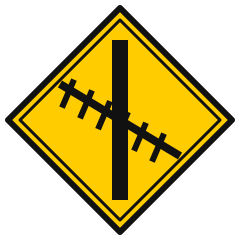
    Yellow diamond with a vertical black road crossed at an angle by a black railway track
    1. Be prepared to stop; a railway crossing is ahead
    2. Turn off; the road ends at the tracks
    3. Speed up to cross before any train
    4. Stop at once; a train is crossing the road right now
  19. You're stopped at a red light and your car is blocking the path of an approaching fire truck. What may you have to do?

    1. Stay put; never move on a red
    2. Back up into the car behind you
    3. Turn the corner to get out of its way
    4. Drive into the middle of the intersection
  20. You hit black ice and the rear of your car slides to the right. What should you do?

    1. Brake firmly and hold the wheel straight
    2. Brake hard and steer left
    3. Ease off the gas and steer right
    4. Accelerate and steer left
  21. How fast can passenger trains travel in Canada?

    1. Up to 200 km/h
    2. Up to 100 km/h
    3. Up to 160 km/h
    4. Up to 120 km/h
  22. You took an over-the-counter allergy pill before driving. Which effects does the guide warn it can cause?

    1. Sharper focus and faster reactions
    2. No effects, since it's non-prescription
    3. Effects only if mixed with alcohol
    4. Drowsiness and inattentiveness
  23. In which direction do you travel around a traffic circle?

    1. Counter-clockwise, keeping to the right
    2. Clockwise, keeping to the left
    3. Clockwise, keeping to the right
    4. Either direction, whichever way is shorter to your exit
  24. A sign shows the passing lane is ending. What must drivers in both lanes do?

    1. Keep side by side to the end
    2. Merge before the passing lane ends
    3. Move to the shoulder to merge
    4. Stop and let others go first
  25. Who may use a parking space marked with the disabled parking sign?

    1. A vehicle displaying the permit and carrying a person with disabilities
    2. Any vehicle carrying a person with disabilities, permit or not
    3. Any driver stopping for less than 15 minutes
    4. Any vehicle displaying the permit, even if the permit holder is not with it
  26. Your new car has blind spot detectors and a back-up camera. How does that change your shoulder checks?

    1. You can skip them on highways and freeways
    2. You only need them when backing
    3. It doesn't; you still turn and look
    4. You only need them after dark
  27. You are driving slowly on a two-lane highway with 5 vehicles lined up behind you. A sign says slow traffic delaying 5 vehicles must use the pullout. What must you do?

    1. Use it only if 10 vehicles are behind
    2. Pull into the pullout and let them pass
    3. Carry on; the pullout rule applies to large trucks only
    4. Speed up to the posted limit instead
  28. Where is a "do not go this way" sign usually mounted?

    1. On exit ramps
    2. At railway crossings
    3. At the start of passing lanes
    4. At school crosswalks
  29. The rule requiring drivers to let a signalling transit bus pull out applies on roads with what speed limits?

    1. 80 km/h or lower
    2. 60 km/h or lower
    3. 70 km/h or lower
    4. 50 km/h or lower
  30. An N driver wants to drive four friends to a game. Which situation would allow it?

    1. The trip is shorter than 20 km
    2. All the friends also hold N licences
    3. The whole drive is during daylight hours
    4. A qualified supervisor 25+ sits beside them
  31. A truck is backing into a loading bay across the road. What should you never do?

    1. Wait for it to finish backing
    2. Stop well back from the truck
    3. Drive behind it to get past
    4. Watch for its backup lights
  32. You're driving a pickup with a tall load. What is the main extra risk on a curve taken at higher speed?

    1. Its brakes are likely to fade
    2. Its steering will lock up
    3. It is more likely to tip over
    4. It is more likely to stall
  33. When do posted construction zone speed limits apply?

    1. Only when workers are present
    2. 24 hours a day
    3. Only during daylight hours
    4. Only from 7 a.m. to 7 p.m.
  34. You're in the left lane of a one-way street when a fire truck approaches with lights and siren. Which way should you pull over?

    1. To the left
    2. Nowhere; just slow down
    3. Into the intersection
    4. To the right
  35. You have just driven slowly through deep water on the road. What should you do next?

    1. Lightly apply the brakes to dry them
    2. Pump the brakes as hard as you can
    3. Speed up to shake the water off
    4. Stop and turn off the engine to cool it
  36. You're driving on a back-road logging route in B.C. and meet a loaded logging truck. Who yields?

    1. You always yield to it
    2. The truck must yield to you
    3. The vehicle going uphill
    4. Whoever reaches the spot first
  37. When is it appropriate to use your horn?

    1. When greeting a friend on the sidewalk
    2. When the driver ahead is going too slowly
    3. When the light turns green for you
    4. When it gives a useful warning to prevent a crash
  38. You're turning left on a green light and an oncoming motorcycle is going straight through. By law, what must you do?

    1. Turn first; the rider must yield to you
    2. Turn quickly before the light changes
    3. Yield to the motorcycle before turning
    4. Flash your headlights, then turn
  39. What is the fee to have your licence reinstated after a prohibition?

    1. $150
    2. $100
    3. $500
    4. $250
  40. Your car is stuck on the railway tracks. After getting everyone out, how far from the track should you go?

    1. At least 5 metres
    2. At least 30 metres
    3. At least 15 metres
    4. At least 100 metres
  41. You approach a pedestrian-activated crosswalk and its light is flashing. What should you do?

    1. Prepare to stop for a pedestrian
    2. Speed up to clear the crosswalk
    3. Continue; flashing means caution only
    4. Stop only if a crossing guard signals
  42. You don't hear a train whistle as you approach a railway crossing. Does that mean no train is coming?

    1. Yes; trains always whistle first
    2. Yes, unless it is nighttime
    3. Only if there are no gates
    4. No; trains don't whistle at every crossing
  43. On a road with this sign, which lane should you use?
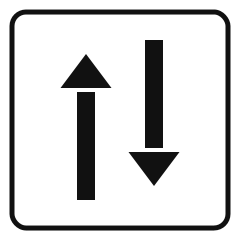
    White square with a black arrow pointing up on the left and a black arrow pointing down on the right
    1. Stay left except when turning right
    2. Keep right unless you are passing
    3. Use either lane as you choose
    4. Drive near the centre line
  44. A warning sign says there is a narrow structure ahead. What is that structure most often?

    1. A toll booth
    2. A tunnel
    3. A snow shed
    4. A bridge
  45. Your traffic light is flashing red and no other vehicles are in sight. What must you do?

    1. Yield to traffic on your right only
    2. Slow down and proceed with caution
    3. Stop, then go only when it is safe
    4. Stop only if traffic is coming
  46. A slow vehicle pullout sign shows a number of metres. What does the number tell you?

    1. How far ahead the pullout is
    2. How far you must stay back
    3. How far the no-passing zone runs
    4. How long the passing lane is
  47. A school bus ahead turns on alternating flashing amber lights. What does this usually mean?

    1. It's about to pull away
    2. It's preparing to stop
    3. You may pass at any speed
    4. Children are crossing now
  48. A sign tells you to stay off a road during major disasters. Why?

    1. It is reserved for local residents and deliveries
    2. It is closed every winter for snow
    3. It floods during heavy rain storms
    4. It may be used only by emergency vehicles
  49. On a two-lane road, where in your lane should you generally position your vehicle?

    1. Fairly close to the centre line
    2. On the paved shoulder when possible
    3. Straddling the centre line slightly
    4. As close to the right edge as you can
  50. Where should you look up the correct air pressure for your tires?

    1. The tire shop's general chart
    2. The owner's manual or the driver's door sticker
    3. The pressure numbers printed on the side of the tire
    4. The fuel cap label on every car

About this practice test

How many questions are in BC Class 7 practice test 11?

50 original multiple-choice practice questions covering regulatory signs, emergency driving strategies, speed, space and communication, road markings, large vehicles, buses, emergency vehicles and trains, pedestrians, cyclists and motorcycles, construction, guide and railway signs, alcohol, drugs and impairment, intersections and right-of-way, lanes, turns and passing, observation and hazard perception, graduated licensing and penalties, weather, visibility and night driving, warning signs and object markers, traffic lights and lane control signals, your vehicle and safety equipment. Each answer includes an explanation. This mixed practice set does not reproduce the official exam format or predict an official score.

Are the questions the same every time?

Yes. Practice test 11 always has the same 50 questions, so you can repeat it until you get them all right. The other 10 sets use different questions.

Are these real test questions?

No. The official question bank is not published. These are original questions written from the official handbook, which is what the real BC Class 7 test is based on.