The light turns steady yellow as you approach. What should you do?
BC Class 7 overview
BC Class 7 Mock Exam 4
Same format as the real test. Answers stay hidden until you submit.
- No sign-up
- Every answer explained
- Independent · not a government site
- 50 questions
- 45 min
- Pass mark 40/50
0/50
All 50 questions in this test
Every question and its answer choices. The correct answers and explanations appear when you take the test above.
The light turns steady yellow as you approach. What should you do?
- Stop only if a pedestrian is waiting to cross
- Stop unless you are too close to stop safely
- Speed up to get through before it turns red
- Keep your speed, since yellow means go with care
On wet roads, how much braking distance should you allow?
- At least twice the normal distance
- The same as on dry pavement
- At least ten times the normal distance
- About one and a half times normal
The 5 m no-parking distance from a fire hydrant is measured from where?
- Your vehicle's front wheels
- The point on the curb beside the hydrant
- The hydrant's farthest outlet
- The centre of the nearest lane
Two drivers facing each other arrive at a four-way stop at about the same time. One is turning left. Who must yield?
- The driver on the right
- The left-turning driver
- The driver going straight
- The driver who arrived second
For a repeat offender, how long can a vehicle impoundment escalate to?
- 30 or 60 days
- 10 or 14 days
- 90 or 120 days
- 14 or 21 days
You have your L licence. Who must sit beside you whenever you drive?
- A supervisor 21+ with any class of licence
- A supervisor 25+ with a Class 1–5 licence
- Any licensed driver aged 19 or older
- Any adult who holds a Class 7 N licence
Who uses a two-way left-turn lane in the middle of the road?
- Only buses and emergency vehicles
- Left-turning drivers from both directions
- Drivers who want to pass slow traffic in the right lane
- Only drivers going your direction
On the highway, looking at least 12 seconds ahead means watching roughly how far down the road?
- About 100 metres
- Half a kilometre
- About 50 metres
- About two kilometres
You hold an N licence. When may you use a hands-free phone while driving?
- Only for calls shorter than one minute
- Whenever the phone is mounted on the dash
- Only to call 9-1-1 to report an emergency
- Only while stopped in heavy traffic
A slow vehicle pullout sign shows a number of metres. What does the number tell you?
- How far ahead the pullout is
- How far you must stay back
- How far the no-passing zone runs
- How long the passing lane is
You are in a lane signed for left turns only and have already entered the intersection when you realize you meant to go straight. What must you do?
- Move into the through lane quickly
- Complete the left turn
- Go straight if no one is beside you
- Stop and wait for a gap to change lanes
How far over the posted limit counts as excessive speeding that can lead to impoundment?
- 20 km/h or more
- 40 km/h or more
- 60 km/h or more
- 30 km/h or more
What should you do when you see this sign?

- Slow down; a steep hill is ahead
- Watch for heavy trucks entering the road ahead
- Speed up to keep your momentum
- Shift to neutral to save fuel
The yellow centre line is broken. May you pass?
- Only in daylight hours
- No, never
- Yes, when it is safe
- Only to pass a cyclist
You are taking two different medications. What does the guide recommend before you drive?
- Wait 30 minutes after taking them
- Ask a pharmacist about their combined effects
- Take only half of each dose that day
- Take both of them at exactly the same time
How much longer can it take to stop on ice compared with a normal stop?
- About 10 times as far
- About three times as far
- About five times as far
- About twice as far
Which of these is correct when using a roundabout?
- Change lanes to reach your exit
- Signal right before you exit
- Drive beside large trucks
- Signal left before you exit
About how much distance do most trains need to stop?
- About 200 metres
- About two kilometres
- About 500 metres
- About five kilometres
An intersection has no stop line, no crosswalk and no sidewalk. Where should you stop?
- Three metres back from the corner
- Just before you enter the intersection
- Where you can see the cross street
- One car length into the intersection
After a vehicle is impounded, who pays the towing and storage fees?
- ICBC
- The police department
- The towing company
- The vehicle's owner
Your wheels lock as you brake on an icy road. What should you do?
- Turn the steering wheel sharply to one side
- Ease off the brakes, then re-apply them
- Shift into neutral and coast to a stop
- Press down even harder on the brakes
At a stop sign, a car approaching from your left has its right signal on, but it isn't slowing or moving right. What should you do?
- Flash your headlights, then go across
- Wait to see what the driver actually does
- Honk and pull out in front of it
- Cross now, since the car is turning
While practising hard braking with ABS, you hear noise and feel the pedal shudder. What does this mean?
- The wheels have locked
- It is normal for ABS
- The brakes are failing
- You should pump the pedal
What does this sign mean?
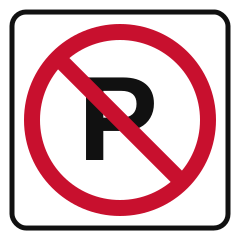
- Pick-up and drop-off only
- Do not park here
- No stopping at any time
- Parking for permit holders only
Why is the parking brake sometimes called an emergency brake?
- It must be used for every quick stop
- It locks all four wheels instantly
- It can slow the car if the foot brake fails
- It turns on the hazard lights
In good weather and road conditions, what is the minimum following distance?
- Three seconds
- Two seconds
- One second
- Four seconds
About what share of the information you use while driving reaches you through your eyes?
- About 80 per cent
- About 95 per cent
- About 50 per cent
- About 60 per cent
You lost your L sign. Where can you get a free replacement?
- Only by mail from ICBC in Victoria
- Only from a police station
- Only from a driving school
- At any driver licensing office
You are approaching a stale green light and pass your point of no return just as it turns yellow. What should you do?
- Keep going through the intersection
- Back up behind the stop line
- Stop in the middle of the intersection
- Brake hard to stop at the line
A no-stopping sign shows a range of hours. When does the restriction apply?
- Only from 8 a.m. to 5 p.m.
- Only on weekends and holidays
- Only during the posted times
- At all hours, every day
Right after a tire blowout, what should you do?
- Brake hard right away to stop fast
- Ease off the gas and slow down gradually
- Shift to neutral and switch off the engine
- Accelerate firmly to keep control
Where does the guide say you should practise emergency braking and skid control?
- On the highway during light traffic
- In any parking lot, by yourself
- On a quiet residential street at night
- In a safe place with an expert driver
The green left-turn arrow on a separate signal turns yellow before you can turn. What should you do?
- Move into the through lane instead
- Stop and wait for the next green arrow
- Turn quickly before it goes red
- Turn after yielding to oncoming traffic
You're driving a pickup with a tall load. What is the main extra risk on a curve taken at higher speed?
- Its brakes are likely to fade
- Its steering will lock up
- It is more likely to tip over
- It is more likely to stall
What must you do at a flashing red light?
- Stop only if traffic is coming
- Wait until it turns green
- Slow down, then keep going if the way looks clear
- Stop completely, then go when safe
Why should you avoid pumping the brakes in a vehicle with ABS?
- Pumping makes the steering lock
- Pumping overheats the brake fluid
- Pumping sets off the airbags
- Pumping turns the ABS system off
One new driver is overconfident and another lacks confidence. What does the guide say both need?
- More learning and more practice time
- A higher class of licence first
- Only more highway driving time
- A stricter limit on passengers
Your car is stuck on the railway tracks. After getting everyone out, how far from the track should you go?
- At least 5 metres
- At least 30 metres
- At least 15 metres
- At least 100 metres
You are in the middle lane under this overhead sign. What may you do at the intersection?
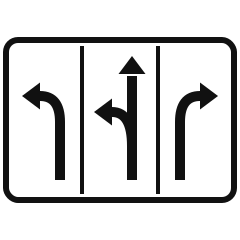
- Turn left only
- Turn right only
- Go straight through or turn left
- Go straight through or turn right
A warning sign shows that your road merges with another road and adds a lane on the right. What does that mean?
- Traffic on the right must stop for you
- The right lane ends ahead and you must merge left
- Another road joins yours as an extra lane on the right
- Your road ends at a T-intersection ahead
Until what age does ICBC recommend children ride in the back seat?
- 12 years
- 7 years
- 9 years
- 16 years
According to the guide, when are hazard lights used?
- When you've stopped for an emergency
- When parked briefly in a no-stop zone
- When driving in heavy rain
- Whenever you're running late
In B.C. in 2014, speed was a factor in about what share of reported fatal collisions?
- About 60 per cent
- About 27 per cent
- About 10 per cent
- About 45 per cent
When should fog lamps be used?
- In fog, in place of brake lights
- In fog, with or instead of headlamps
- Whenever you're driving at night
- Any time there's light rain
You've stopped for a school bus with flashing red lights. When can you start moving again?
- When a child waves you through
- When the last child reaches the curb safely
- After waiting about 30 seconds
- When it moves on or its lights go off
Which of these warns you that a large vehicle is about to back up?
- A beeper, four-way flashers or backup lights
- A flashing left turn signal
- Its engine noise getting quieter
- A puff of smoke from the exhaust
A green arrow points straight up. What does it mean?
- You may turn in any direction
- Go straight or turn right
- No turns; go straight through only
- Through traffic must stop
You are caught driving while prohibited. What could happen?
- Your prohibition is shortened
- Impoundment, plus fines or jail
- Only penalty points are added to it
- Only a warning letter is sent
You're about to pull away from the right-hand curb into traffic. Which mirror shows whether cars are coming up from behind?
- The left side-view mirror
- Only the rear-view mirror
- The right side-view mirror
- Only the back-up camera
There are no speed signs on a street inside a B.C. city. What is the speed limit?
- 60 km/h
- 30 km/h
- 50 km/h
- 40 km/h
Keep practising
- BC Class 7 Mock Exam 1 – 50 QuestionsTimed practice · 45 minutes · answers explained
- BC Class 7 Mock Exam 2 – 50 QuestionsTimed practice · 45 minutes · answers explained
- BC Class 7 Mock Exam 3 – 50 QuestionsTimed practice · 45 minutes · answers explained
- BC Class 7 Mock Exam 5 – 50 QuestionsTimed practice · 45 minutes · answers explained
- BC Class 7 Practice Test 150 questions with explanations
- BC Class 7 Practice Test 250 questions with explanations
- BC Class 7 Practice Test 350 questions with explanations
- BC Class 7 Practice Test 450 questions with explanations