A signal-lights-ahead sign has its own lights, and they are flashing. What should you do?
BC Class 7 overview
BC Class 7 Practice Test 3
50 questions on warning signs and object markers, observation and hazard perception, construction, guide and railway signs, regulatory signs, parking rules and more.
- No sign-up
- Every answer explained
- Independent · not a government site
- Set 3 of 11
- 50 questions
- Instant feedback
0/50
All 50 questions in this test
Every question and its answer choices. The correct answers and explanations appear when you take the test above.
A signal-lights-ahead sign has its own lights, and they are flashing. What should you do?
- Prepare to stop
- Carry on; the signal is off
- Speed up to clear the light
- Stop at once where you are
In the see-think-do strategy, what happens during the 'think' step?
- You pick the most dangerous hazard and a safe solution
- You steer, brake or signal to avoid trouble
- You scan the road around you for hazards
- You check your mirrors and blind spots
What unit are the distances on a green destination sign like this one?
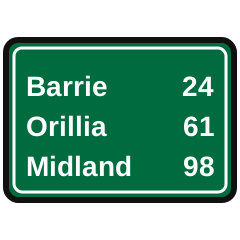
- Miles
- Metres
- Minutes of travel
- Kilometres
A sign on a mountain highway says winter tires or chains are required. When does that rule apply?
- Only for commercial trucks
- Only when snow is actually falling
- Whenever the sign is displayed
- Only from December to February
You park facing uphill on a road with no curb. Which way should your wheels point?
- Straight ahead
- Toward the centre line
- To the right
- To the left
When doing a shoulder check, how far should you look over your shoulder?
- Only as far as the side mirror
- At least 15 degrees
- At least 45 degrees
- At least 90 degrees
What does this sign require you to do?

- Come to a full stop every time at the line
- Give way to pedestrians but not to vehicles
- Merge only after the other traffic has stopped for you
- Give way to other vehicles and crossing pedestrians
You're driving toward a school bus on a two-lane road. It stops and its top red lights start flashing alternately. What must you do?
- Slow down and pass with care
- Stop only if children are visible
- Keep going; only traffic behind stops
- Stop and wait
According to the guide, what share of motorcycle crashes result in injury or death?
- About one quarter
- About one in ten
- More than half
- Nearly all of them
Which drug does the guide specifically name under the zero blood drug concentration rule for GLP drivers?
- Caffeine
- Nicotine
- Antacids
- Cannabis (THC)
You're snowbound on a remote road. What does the guide advise?
- Leave a note and try to hitchhike
- Leave the car as soon as it gets dark
- Always walk to the nearest town
- Stay with your car unless sure of help
There is a solid yellow line on your side and a broken yellow line beside it on the far side. May you pass?
- Yes, whenever it is safe to do so
- Yes, as long as you can get back into your lane within 10 seconds
- No; pass only when the broken line is on your side
- Yes, but only to pass slow trucks
Alcohol makes drivers more impulsive. How does this usually show up on the road?
- Signalling much too early before turns
- Taking bigger risks, such as speeding
- Driving well below the speed limit
- Stopping at every green light
You're about to pass a horse and rider on a rural road. What should you avoid?
- Honking your horn
- Slowing down early
- Passing at a low speed
- Leaving lots of space
You are driving at the speed limit in the left lane of a highway. Why should you move right?
- Drivers in the left lane must always go over the limit
- Staying there may push others to pass on your right
- The left lane is closed to cars at night
- The left lane is only for trucks
Why do intersections ice up quickly?
- Car exhaust and packed snow
- Traffic lights give off cold air
- Signs shade them from the sun
- Drainage grates freeze first
Which is one way the guide suggests to identify your own driving attitude?
- Time how fast you get to school
- Count how often other drivers honk
- Ask someone you trust for feedback
- Compare yourself to drivers in car ads
You notice a parked car with its front wheels turned out toward the road. What might this tell you?
- The car is waiting for a tow
- The driver may be about to pull out
- The driver is about to back up
- The car has broken steering
The traffic lights at an intersection have gone out. How should you treat it?
- As a four-way stop
- As an uncontrolled intersection
- As a yield sign
- As a green light with caution
On a dark rural road with your high beams on, roughly how much road can you see lit up?
- About 50 metres
- About 150 metres
- About 100 metres
- About 30 metres
The lane control signals over all lanes are flashing yellow. What should you do?
- Move to the far right lane and stop there
- Stop; all of the lanes are closed
- Speed up and clear the area
- Slow down and proceed with caution
Which of these is a legal place to park?
- On a boulevard
- At a curb 10 m from a fire hydrant
- In a bicycle lane
- On a bridge
When is it acceptable to adjust your seat or steering wheel?
- Only before the vehicle starts moving
- While cruising slowly on a straight, empty road
- Whenever traffic is light
- At any red light
You are stopped at a two-way stop. What is the cross street without stop signs called, and who has the right-of-way?
- A through street, whose traffic has the right-of-way
- A shared street, where the first car goes
- A side street, whose traffic must yield
- A through street, but you go first
Firefighters have a hose stretched across the road. May you drive over it?
- Yes, if you go slowly
- Yes, once the fire is out
- Yes, if it lies flat
- No, that is illegal
Your 15-year-old passenger refuses to wear a seatbelt. Who gets the $167 fine?
- You, the driver
- No one, as they're under 16
- The passenger's parent
- The passenger
Why is the parking brake sometimes called an emergency brake?
- It must be used for every quick stop
- It locks all four wheels instantly
- It can slow the car if the foot brake fails
- It turns on the hazard lights
Two drivers facing each other arrive at a four-way stop at about the same time. One is turning left. Who must yield?
- The driver on the right
- The left-turning driver
- The driver going straight
- The driver who arrived second
How are HOV lanes marked on the road?
- Double yellow lines with bus symbols
- Thin broken lines with green diamond symbols inside
- Red pavement with white arrows
- Thick solid or broken lines with white diamonds
You're driving out of a driveway onto the street and someone is walking along the sidewalk. Who must yield?
- Neither of you
- Whoever is faster
- You, the driver
- The pedestrian
At a school crosswalk, a crossing guard is on duty. What must you do?
- Stop only when the light is red
- Sound your horn and continue slowly
- Follow the crossing guard's directions
- Go if no children are in your lane
Another driver is passing you. What should you do?
- Move onto the left shoulder
- Slow down and make room
- Keep the same speed and flash lights
- Speed up to stay ahead
You drive through a red light. What penalty does the guide's table show?
- $368 and 4 points
- $167 and 3 points
- $109 and 3 points
- $167 and 2 points
A bus lane sign has a "Vanpool Permitted" tab. What vehicles qualify as a vanpool?
- Vehicles with four or more occupants
- Any van, regardless of occupants
- Vehicles with six or more occupants
- Vehicles with two or more occupants
A warning sign shows that your road merges with another road and adds a lane on the right. What does that mean?
- Traffic on the right must stop for you
- The right lane ends ahead and you must merge left
- Another road joins yours as an extra lane on the right
- Your road ends at a T-intersection ahead
You're about to pull away from the right-hand curb into traffic. Which mirror shows whether cars are coming up from behind?
- The left side-view mirror
- Only the rear-view mirror
- The right side-view mirror
- Only the back-up camera
What does this sign warn you about?

- Merging traffic ahead
- A hidden side road ahead
- The right lane ends ahead
- A divided highway ends ahead
A driver is tailgating you. What does the guide suggest you do?
- Turn on your hazard lights
- Speed up so you can pull well away from them
- Brake sharply to warn the driver
- Slow slightly to add space in front
You are taking two different medications. What does the guide recommend before you drive?
- Wait 30 minutes after taking them
- Ask a pharmacist about their combined effects
- Take only half of each dose that day
- Take both of them at exactly the same time
A railway crossing sign tells you to stop. What must you do?
- Stop, then go when it is safe
- Slow and go if no train is visible
- Stop only if a train is in sight
- Stop only when the lights flash
You're not sure who has the right-of-way at an intersection. What should you do?
- Insist on the right-of-way
- Go first to avoid confusion
- Be ready to give the right-of-way
- Honk and proceed with caution
Your gas pedal sticks at highway speed. What should you never do?
- Apply the brakes firmly and steadily
- Shift the transmission into neutral
- Reach down and free it by hand
- Look for an escape path off the road
At a public railway crossing, who must yield?
- Whoever reaches the crossing first
- You must always yield to trains
- Trains yield when gates are up
- Trains yield to vehicles on the tracks
You took a cold medicine whose label warns it may cause drowsiness. What should you do?
- Have a strong coffee first, then drive
- Drive only on quiet residential streets
- Drive, but keep a window open for air
- Don't drive; take the bus or get a ride
You must cross two lanes straight across from a stop sign. Using the guide's estimate plus its safety margin, about how big a gap do you need?
- About ten seconds
- About two seconds
- About four seconds
- About six seconds
How far back must you stay when following a fire truck?
- At least 150 metres
- At least 50 metres
- At least 100 metres
- At least 300 metres
You approach a flashing green light. What does it mean in B.C.?
- It is a signal fault; treat it as a four-way stop
- It is an advance left turn; oncoming traffic has a red
- It is pedestrian-controlled; go only if the intersection is clear
- It is about to turn yellow, so speed up to clear the intersection
Your friend is speeding badly and you've already tried humour and asking politely. What is the guide's last-resort option?
- Grab the steering wheel
- Pull the parking brake
- Reach over and turn off the key
- Ask to be let out of the car
Alcohol reduces depth perception. What does this mean for a driver?
- They misjudge other cars' distance and speed
- They are easily blinded by glare
- They miss hazards approaching from the side
- They start to see double images
The curb beside an open space is painted red. Can you park there?
- Yes, for up to 15 minutes
- Only after 6 p.m.
- Yes, if you stay in the car
- No, parking is illegal at a red or yellow curb
All BC Class 7 practice tests
- BC Class 7 Mock Exam 1 – 50 QuestionsTimed practice · 45 minutes · answers explained
- BC Class 7 Mock Exam 2 – 50 QuestionsTimed practice · 45 minutes · answers explained
- BC Class 7 Mock Exam 3 – 50 QuestionsTimed practice · 45 minutes · answers explained
- BC Class 7 Mock Exam 4 – 50 QuestionsTimed practice · 45 minutes · answers explained
- BC Class 7 Mock Exam 5 – 50 QuestionsTimed practice · 45 minutes · answers explained
- Regulatory signsStop, yield and speed signs, school and playground zone signs, crosswalk signs, lane use and turn control signs, parking signs and reserved lane signs.
- Warning signs and object markersYellow diamond warning signs for curves, hills, merges, lane endings, crossings, wildlife and road hazards, plus object markers on obstructions.
- Construction, guide and railway signsOrange construction and work zone signs, information and destination signs, and railway crossing signs.
- Traffic lights and lane control signalsSteady and flashing lights, green and yellow arrows, transit priority signals and overhead lane control signals.
- Road markingsYellow and white lines, passing rules by line type, crosswalk and stop lines, reserved lane and bicycle lane markings, and painted islands.
About this practice test
How many questions are in BC Class 7 practice test 3?
50 original multiple-choice practice questions covering warning signs and object markers, observation and hazard perception, construction, guide and railway signs, regulatory signs, parking rules, large vehicles, buses, emergency vehicles and trains, pedestrians, cyclists and motorcycles, graduated licensing and penalties, weather, visibility and night driving, road markings, alcohol, drugs and impairment, emergency driving strategies, lanes, turns and passing, fitness to drive, distraction and attitude, speed, space and communication, intersections and right-of-way, traffic lights and lane control signals, your vehicle and safety equipment. Each answer includes an explanation. This mixed practice set does not reproduce the official exam format or predict an official score.
Are the questions the same every time?
Yes. Practice test 3 always has the same 50 questions, so you can repeat it until you get them all right. The other 10 sets use different questions.
Are these real test questions?
No. The official question bank is not published. These are original questions written from the official handbook, which is what the real BC Class 7 test is based on.