You have a full licence and are stopped at a red light. May you pick up your hand-held phone to read a text?
BC Class 7 overview
BC Class 7 Practice Test 9
50 questions on fitness to drive, distraction and attitude, warning signs and object markers, your vehicle and safety equipment, weather, visibility and night driving, intersections and right-of-way and more.
- No sign-up
- Every answer explained
- Independent · not a government site
- Set 9 of 11
- 50 questions
- Instant feedback
0/50
All 50 questions in this test
Every question and its answer choices. The correct answers and explanations appear when you take the test above.
You have a full licence and are stopped at a red light. May you pick up your hand-held phone to read a text?
- Yes, if you only read and don't reply
- Yes, if the light is a long one
- No, the ban applies even when stopped
- Yes, as long as the car is stopped
Where are object markers mounted, like the one shown?

- At emergency vehicle exits
- On railway crossing gates
- On obstructions
- On construction equipment only
In a standard transmission vehicle, roughly what speed range is first gear used for?
- From about 15 to 30 km/h
- From a stop to about 30–40 km/h
- From a stop to about 10–15 km/h
- From about 30 to 60 km/h
You're on a two-lane highway in heavy snow and a slow truck is ahead. What does the guide say about passing?
- Pass on the right shoulder if it's clear
- Pass quickly to reduce your time beside it
- Don't pass; you can't see far enough
- Pass only with high beams turned on
You are approaching a stale green light and pass your point of no return just as it turns yellow. What should you do?
- Keep going through the intersection
- Back up behind the stop line
- Stop in the middle of the intersection
- Brake hard to stop at the line
Which of these places makes a U-turn illegal?
- A quiet residential intersection with no light
- A road with a clear view of 300 m
- A wide straight road with no traffic
- An intersection controlled by a traffic light
You did not see the light ahead turn green. What should you assume?
- It may be stale, so be ready to stop
- It will stay green for a full minute
- It just changed, so you can speed up
- It is broken, so treat it as a stop sign
An N driver is found to have a small amount of alcohol in their system. Which penalty can apply?
- None, if their BAC is under .08
- None, if their BAC is under .05
- An immediate roadside suspension
- Only a verbal warning the first time
From a stop in ideal conditions, about how long does it take most vehicles to turn left and reach 50 km/h, before any safety margin?
- About five seconds
- About three seconds
- About ten seconds
- About seven seconds
You plan to go straight through an intersection, but an oncoming car is already in it turning left. What must you do?
- Continue, since straight traffic has priority
- Pass the turning car on its right
- Yield to the turning car
- Sound your horn and proceed
A learner wants to follow voice directions from a hands-free GPS. Is this allowed?
- Yes, hands-free devices are allowed
- Yes, if the supervisor sets it up first
- Yes, but only when on the highway
- No, hands-free devices aren't allowed
You're driving and your phone buzzes with a text. What does the guide recommend?
- Read it quickly at the next red light
- Reply using one hand on your lap
- Let it wait or pull over to read it
- Read it while the road is straight
You approach a yield sign and the through road is completely clear. What may you do?
- Enter without stopping
- Stop fully, then enter
- Honk and then enter
- Wait three seconds, then enter
Your car breaks down on an isolated road and a stranger offers you a ride. What does the guide advise?
- Accept if they seem friendly enough
- Ask them to tow your car to town
- Ask them to go on and phone for help
- Accept, but leave a note in your car
What does this sign mean?
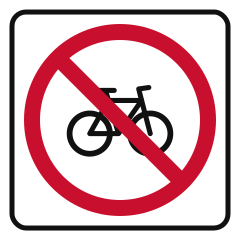
- No bicycle riding beyond this point
- Bicycle parking is not allowed
- Bicycle lane begins ahead
- Cyclists may be on the roadway
A garbage truck with flashing lights is stopped on a 50 km/h street. What is your maximum speed while passing it?
- 40 km/h
- 50 km/h
- 20 km/h
- 30 km/h
Why are temperatures near freezing more dangerous than colder temperatures?
- Ice can form unseen and unexpectedly
- Tires lose air pressure much faster
- Fog is always thicker near freezing
- Snow is much deeper near freezing
You stop behind another car at a red light. About how much space should you leave?
- About one car length
- Just enough to see its plate
- About half a car length
- About three car lengths
A line of vehicles has built up behind you on a two-lane road. What does the guide suggest?
- Tap your brakes to slow them
- Stay put; it's their problem
- Pull over and let them go by
- Speed up beyond the limit
The posted limit is exactly 80 km/h and a paramedic unit is stopped ahead with flashing lights. What is the most you may drive as you pass?
- 80 km/h
- 40 km/h
- 70 km/h
- 60 km/h
You are involved in a crash. What are you legally required to do?
- Leave if no one looks hurt
- Move on once the police arrive
- Remain at the scene
- Drive home and call ICBC
Your front right tire blows out at highway speed. Which way will the car tend to pull?
- To the right
- To the left
- Into a rear skid
- Straight ahead
Near the crest of a hill, a U-turn is illegal if other traffic cannot see you within what distance?
- 100 metres
- 300 metres
- 150 metres
- 50 metres
You are turning right at an intersection. Which lane should you end up in?
- Any lane that is open
- The right lane of the cross street
- The centre lane of the cross street
- The left lane of the cross street
When should you use your high-beam headlights?
- Whenever it is raining or foggy outside
- In busy city traffic during the night
- On any road at all once the sun sets
- On unlit roads with no vehicles ahead or oncoming
What does this sign mean for the stretch of road it covers?
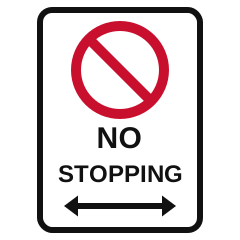
- No parking along here, but brief stops are allowed
- No stopping until the next no-stopping sign
- You may stop only to load passengers
- You may stop for up to 5 minutes
You are in the learner stage and receive a driving prohibition. What happens to your learner stage?
- It's extended; no time counts while prohibited
- Nothing changes; the time keeps counting
- It's cancelled and you start over at the test
- You move up to the N stage early
On a freeway entrance, what separates the acceleration lane from the rest of the roadway?
- A broken white line
- A solid yellow line
- A solid white line
- A double yellow line
You're coming up behind a rider on horseback. How should you pass?
- After a short honk to warn the rider
- Quickly, to limit the time near it
- Slowly, with extra room
- With your high beams on
Who is responsible for making sure every passenger is buckled up or in a child restraint?
- The parent of each child
- Each adult passenger
- The vehicle's owner only
- The driver
You turn into a back lane (alleyway) in a municipality. There is no speed sign. What is the maximum speed?
- 15 km/h
- 50 km/h
- 20 km/h
- 30 km/h
A warning sign shows a fire truck entrance ahead. What should you watch for?
- A water supply for trucks
- A fire lane where you may park
- A fire hall parking lot only
- Fire trucks entering the road
What is the key to emergency braking?
- Pump the brake pedal slowly and gently
- Lock the wheels so you stop sooner
- Shift into neutral, then brake
- Stop fast without locking the wheels
While waiting in your car with the engine running, you start to feel dizzy and drowsy. What could be the cause?
- Carbon monoxide poisoning
- Too much fresh, cold air
- Fumes from the brake fluid
- Low blood sugar from cold
Which of these is an 'I' statement you could use with an unsafe driver?
- Everyone says you're a terrible driver.
- Slow down or I'm never riding again.
- You're driving like a maniac!
- I'm nervous right now; could you slow down?
What does this sign mean?
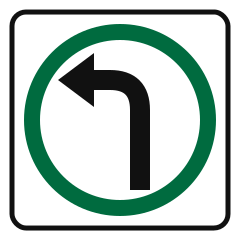
- Sharp curve to the left
- Left lane ends
- No left turn
- Left turn only
Your light turns green, but an elderly pedestrian is still in the crosswalk ahead. What must you do?
- Honk to hurry the person along
- Go, because your light is green
- Wait until the crosswalk is clear
- Drive slowly around the person in the crosswalk
According to the guide, when are hazard lights used?
- When you've stopped for an emergency
- When parked briefly in a no-stop zone
- When driving in heavy rain
- Whenever you're running late
How often does the guide suggest doing a thorough periodic check of your vehicle?
- Once a year
- Every trip
- Every few weeks
- Every two years
How far should you sit from the airbag in the steering wheel?
- At least 25 cm (10 in)
- At least 15 cm (6 in)
- At least 10 cm (4 in)
- At least 50 cm (20 in)
Does B.C. law require cyclists to wear a helmet?
- No, it is only advised
- Only riders under 18
- Yes, an approved helmet
- Only on roads over 50 km/h
A cyclist ahead is wobbling from side to side. How should you respond?
- Give them even more space than usual
- Honk to make them hold steady
- Follow closely so they see you
- Pass them quickly to get by them sooner
It hasn't rained in weeks and a light rain starts to fall. When is the road most slippery?
- After hours of steady rain
- Only once the rain stops
- Only during very heavy rain
- At the start of the rainfall
You're in the lane next to a utility truck stopped with flashing lights on a multi-lane road. Besides slowing down, what must you do?
- Turn on your hazard lights
- Stop until the truck leaves
- Honk to warn the workers
- Change lanes if it's safe
Why should you avoid pumping the brakes in a vehicle with ABS?
- Pumping makes the steering lock
- Pumping overheats the brake fluid
- Pumping sets off the airbags
- Pumping turns the ABS system off
A motorcyclist ahead shoulder checks and the bike starts to lean. What is the rider probably about to do?
- Back up slowly
- Pull onto the shoulder
- Change lanes or turn
- Stop suddenly
As a learner, what is the most passengers you may carry, counting your supervisor?
- Two
- Three
- One
- Four
When does the slow-down rule for stopped vehicles with flashing lights NOT apply?
- On a divided highway, coming the other way
- At night when traffic is light
- When the vehicle is on the shoulder
- When the lights are yellow, not red
What does the guide say about snow tires or chains on B.C. roads?
- Required by law on many roads in winter
- Optional on every road in the province
- Needed only in northern B.C. towns
- Banned on all B.C. highways in winter
Which three features can help you work out the meaning of a sign you have never seen?
- Its colour, its size and its border
- Its size, its height and its location
- Its shape, its colour and its message
- Its shape, its height and its post
All BC Class 7 practice tests
- BC Class 7 Mock Exam 1 – 50 QuestionsTimed practice · 45 minutes · answers explained
- BC Class 7 Mock Exam 2 – 50 QuestionsTimed practice · 45 minutes · answers explained
- BC Class 7 Mock Exam 3 – 50 QuestionsTimed practice · 45 minutes · answers explained
- BC Class 7 Mock Exam 4 – 50 QuestionsTimed practice · 45 minutes · answers explained
- BC Class 7 Mock Exam 5 – 50 QuestionsTimed practice · 45 minutes · answers explained
- Regulatory signsStop, yield and speed signs, school and playground zone signs, crosswalk signs, lane use and turn control signs, parking signs and reserved lane signs.
- Warning signs and object markersYellow diamond warning signs for curves, hills, merges, lane endings, crossings, wildlife and road hazards, plus object markers on obstructions.
- Construction, guide and railway signsOrange construction and work zone signs, information and destination signs, and railway crossing signs.
- Traffic lights and lane control signalsSteady and flashing lights, green and yellow arrows, transit priority signals and overhead lane control signals.
- Road markingsYellow and white lines, passing rules by line type, crosswalk and stop lines, reserved lane and bicycle lane markings, and painted islands.
About this practice test
How many questions are in BC Class 7 practice test 9?
50 original multiple-choice practice questions covering fitness to drive, distraction and attitude, warning signs and object markers, your vehicle and safety equipment, weather, visibility and night driving, intersections and right-of-way, lanes, turns and passing, graduated licensing and penalties, speed, space and communication, emergency driving strategies, regulatory signs, large vehicles, buses, emergency vehicles and trains, pedestrians, cyclists and motorcycles. Each answer includes an explanation. This mixed practice set does not reproduce the official exam format or predict an official score.
Are the questions the same every time?
Yes. Practice test 9 always has the same 50 questions, so you can repeat it until you get them all right. The other 10 sets use different questions.
Are these real test questions?
No. The official question bank is not published. These are original questions written from the official handbook, which is what the real BC Class 7 test is based on.