There is a crosswalk but no stop line at the intersection. Where do you stop?
BC Class 7 overview
BC Class 7 Practice Test 2
50 questions on intersections and right-of-way, parking rules, your vehicle and safety equipment, speed, space and communication, lanes, turns and passing and more.
- No sign-up
- Every answer explained
- Independent · not a government site
- Set 2 of 11
- 50 questions
- Instant feedback
0/50
All 50 questions in this test
Every question and its answer choices. The correct answers and explanations appear when you take the test above.
There is a crosswalk but no stop line at the intersection. Where do you stop?
- In the middle of the crosswalk
- Just past the crosswalk
- Just before the crosswalk
- At the edge of the cross street
Your car is pointed down a steep street, curb on your right. How should the front wheels be set?
- Straight ahead
- Away from the curb
- To the left
- To the right
How close to a fire hydrant may you legally park?
- No closer than 5 m
- No closer than 6 m
- No closer than 3 m
- No closer than 10 m
Until what age does ICBC recommend children ride in the back seat?
- 12 years
- 7 years
- 9 years
- 16 years
Halfway through a curve, you feel your tires start to lose their grip. What should you do?
- Ease off the gas, then re-apply it gently
- Shift into neutral and coast through
- Steer sharply toward the inside edge
- Brake hard until the car slows down
How should a seatbelt be worn?
- Snug over the chest and low over the hips
- Loose over the chest and across the stomach
- With the shoulder strap behind your back
- With the shoulder strap under your arm
You want to turn left into a driveway mid-block across a solid double yellow line. Is this allowed?
- Yes, but only between 9 p.m. and 6 a.m.
- No, a double yellow line never allows it
- Only if there is a two-way left-turn lane
- Yes, if it is safe and no sign prohibits it
A rider ahead is struggling to control their horse. What should you do?
- Pass quickly before it gets worse
- Steer around it on the shoulder
- Stop and wait until it's under control
- Honk to help calm the horse
You see a hockey net set up at the edge of a residential street. What should you think?
- A rink is located nearby
- Parking is not allowed here
- The street is closed to traffic
- Children may be playing nearby
You drive 15 km/h over the limit in a school zone. What fine and points does the table list?
- $196 and 3 points
- $368 and 4 points
- $138 and 3 points
- $167 and 2 points
This sign hangs above the intersection. What does it mean?
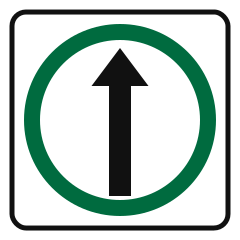
- Go straight or turn right
- Go straight only; no turns
- One-way street ahead
- The through lane ends ahead
You're carrying a load that sticks out past the back of your vehicle. What should you attach to the end of it?
- A white reflector
- An orange cone
- A red flag
- A yellow light
A green arrow points straight up. What does it mean?
- You may turn in any direction
- Go straight or turn right
- No turns; go straight through only
- Through traffic must stop
How does mixing drugs with even a small amount of alcohol affect a driver?
- The effects tend to cancel each other
- It can greatly increase impairment
- It has no extra effect on driving
- It lowers your BAC more quickly
Why are loose gravel, icy patches and large puddles treated as hazards?
- They make sirens harder to hear
- They can reduce traction and steering control
- They make road signs harder to read
- They mostly affect your fuel economy and tire wear
Flashing red lights at a railway crossing tell you to stop. How close to the nearest rail may you stop?
- No closer than 10 m, no further than 30 m
- No closer than 5 m, no further than 15 m
- No closer than 2 m, no further than 10 m
- No closer than 1 m, no further than 5 m
Your car starts to hydroplane. What should you do?
- Brake firmly right away to stop
- Steer sharply toward the shoulder
- Accelerate to regain your grip
- Ease off the gas and keep straight
A cyclist is riding in a protected cycle lane beside your lane. What is the minimum passing distance?
- 1.0 metre
- 1.5 metres
- 0.5 metre
- No minimum applies
After drinking, your eyes lose some of their reflex abilities. Which problem does this cause?
- Braking much too early
- Seeing double images
- Feeling suddenly sleepy
- Being blinded by glare
What are lane control signals used for?
- Showing which lanes are open for driving
- Marking lanes reserved for buses
- Showing the speed limit for each lane
- Timing the traffic lights at the next intersection
The light turns steady yellow as you approach. What should you do?
- Stop only if a pedestrian is waiting to cross
- Stop unless you are too close to stop safely
- Speed up to get through before it turns red
- Keep your speed, since yellow means go with care
You entered a two-lane roundabout from the left lane. Which exit can you not take?
- The exit to the left
- The exit straight ahead
- The first exit to the right
- The exit you came from
You need to report a stalled vehicle at a railway crossing. Where do you find the phone number and location?
- On the signal box door
- On the advance warning sign
- Painted on the road near the X
- On the back of the crossing sign
You have your N. With no supervisor, how many passengers who aren't immediate family may ride with you?
- Two
- One
- None
- Three
Your car only has a lap belt in the back seat. Can you use a booster seat with it?
- Yes, if the child is over 145 cm
- No, a booster needs a lap and shoulder belt
- No, boosters must go in the front seat
- Yes, if the lap belt is pulled very tight
You come to a T-intersection with no signs or signals. How should you treat it?
- As a through road for you
- As an uncontrolled intersection
- As a yield-controlled intersection
- As a four-way stop
What does an end of construction zone speed limit sign tell you?
- Workers are present for the next 1 km
- The work zone speed limit starts at this sign
- You must stop at the end of the zone
- The work zone speed limit no longer applies
According to the study quoted in the guide, drivers talking on a cellphone lose about how much of what is going on around them visually?
- About 50 per cent
- About 80 per cent
- About 25 per cent
- About 10 per cent
Pavement arrows in your lane point left and straight ahead. What must you do?
- Go straight only
- Turn left only
- Turn right or go straight
- Go straight or turn left
On the highway, looking at least 12 seconds ahead means watching roughly how far down the road?
- About 100 metres
- Half a kilometre
- About 50 metres
- About two kilometres
Where are lane use signs mounted?
- Directly above the middle of the intersection itself
- On the far side of the intersection
- Above or beside the lane, before the intersection
- Only on the pavement inside each lane
What should you do when you see this lighted sign in a work zone?

- Stop and wait until the arrow stops flashing
- Pass on the right side of the board
- Turn on your hazard lights and stop
- Follow the direction of the lighted arrow
A lane is marked on both sides with double broken yellow lines. What is it?
- A bus-only lane during rush hours
- A reversible lane; signals show if you may use it
- A two-way left-turn lane shared by both directions
- A painted island you must not drive on
Which of these is every B.C. driver, not just GLP drivers, forbidden to do while driving?
- Adjust the cabin heater
- Manually program the GPS
- Talk with a passenger
- Listen to the car radio
What does 'overdriving your headlights' mean?
- Using high beams when others are near
- Driving with only one headlight working
- Leaving your headlights on after parking
- Going too fast to stop within your lit area
You approach a pedestrian-activated crosswalk with lights flashing in the pavement. What must you do?
- Slow down; the lights are advisory
- Stop for pedestrians in the crosswalk
- Stop only if a child is crossing
- Continue unless a guard signals
Why should you never pass when you are approaching the top of a hill?
- Passing is only legal on downgrades
- You can't see hazards over the crest
- Your engine loses power going uphill
- Oncoming drivers must yield to you
An N driver is prohibited from driving. After the licence is reinstated, what happens to the N time already built up?
- It's all kept if the fine is paid
- It's lost; the clock resets to zero
- It is all kept in full
- Only half of the time is lost
What does this X-shaped sign mark?
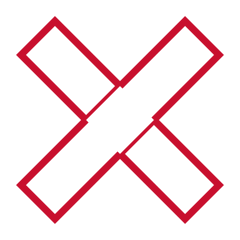
- A crossroad ahead
- A railway crossing
- A road closed to traffic
- A four-way stop
To practise ABS braking in a safe place, the guide suggests reaching what speed before braking hard?
- 30 km/h
- 15 km/h
- 60 km/h
- 50 km/h
A large elk steps into your path and you can't stop in time. What does the guide advise just before impact?
- Press the brake even harder
- Let up on the brake pedal
- Swerve sharply to the left
- Speed up through the impact
An oncoming car's lights are blinding you at night. Where should you look?
- Into your rear-view mirror
- Straight into the oncoming lights
- Toward the right edge of the road
- Toward the centre line of the road
When parallel parking, how close must your vehicle be to the curb?
- Within 15 cm (6 in)
- Within 1 m (3 ft)
- Within 30 cm (one foot)
- Within 50 cm (20 in)
What should you do when you see this sign?

- Slow down; a steep hill is ahead
- Watch for heavy trucks entering the road ahead
- Speed up to keep your momentum
- Shift to neutral to save fuel
On a road with a 60 km/h limit, how much space must you leave when passing someone on a personal mobility device?
- At least 0.5 metre
- At least 2.5 metres
- At least 1.5 metres
- At least 1.0 metre
Your friend says beer is safer to drive on than wine. How does a glass of beer compare with a glass of wine?
- It has about half the alcohol
- It has much less alcohol overall
- It has a quarter of the alcohol
- It has about the same alcohol
A GLP driver gets one ticket for using an electronic device. What can follow?
- Nothing, since a first ticket is a warning
- Loss of the L or N sign for a month
- An automatic retake of the knowledge test
- A record review and a possible prohibition
On a freeway with three lanes in your direction, which lanes should you generally use?
- Only the far-left lane
- Only the far-right lane
- The centre or a right-hand lane
- Any lane you like
A curve ahead sign has no speed tab under it. What should you do?
- Move into the left lane early
- Brake hard once you are in the curve
- Keep your speed; no tab means no advice
- Slow down before the curve
Using the parking brake after your brakes fail, how should you apply it?
- Gently and gradually, holding the release
- All at once, as hard as possible
- In quick, hard jerks every second
- Only once the car has come to a full stop
All BC Class 7 practice tests
- BC Class 7 Mock Exam 1 – 50 QuestionsTimed practice · 45 minutes · answers explained
- BC Class 7 Mock Exam 2 – 50 QuestionsTimed practice · 45 minutes · answers explained
- BC Class 7 Mock Exam 3 – 50 QuestionsTimed practice · 45 minutes · answers explained
- BC Class 7 Mock Exam 4 – 50 QuestionsTimed practice · 45 minutes · answers explained
- BC Class 7 Mock Exam 5 – 50 QuestionsTimed practice · 45 minutes · answers explained
- Regulatory signsStop, yield and speed signs, school and playground zone signs, crosswalk signs, lane use and turn control signs, parking signs and reserved lane signs.
- Warning signs and object markersYellow diamond warning signs for curves, hills, merges, lane endings, crossings, wildlife and road hazards, plus object markers on obstructions.
- Construction, guide and railway signsOrange construction and work zone signs, information and destination signs, and railway crossing signs.
- Traffic lights and lane control signalsSteady and flashing lights, green and yellow arrows, transit priority signals and overhead lane control signals.
- Road markingsYellow and white lines, passing rules by line type, crosswalk and stop lines, reserved lane and bicycle lane markings, and painted islands.
About this practice test
How many questions are in BC Class 7 practice test 2?
50 original multiple-choice practice questions covering intersections and right-of-way, parking rules, your vehicle and safety equipment, speed, space and communication, lanes, turns and passing, large vehicles, buses, emergency vehicles and trains, pedestrians, cyclists and motorcycles, graduated licensing and penalties, regulatory signs, traffic lights and lane control signals, alcohol, drugs and impairment, observation and hazard perception, weather, visibility and night driving, construction, guide and railway signs, fitness to drive, distraction and attitude, road markings, emergency driving strategies, warning signs and object markers. Each answer includes an explanation. This mixed practice set does not reproduce the official exam format or predict an official score.
Are the questions the same every time?
Yes. Practice test 2 always has the same 50 questions, so you can repeat it until you get them all right. The other 10 sets use different questions.
Are these real test questions?
No. The official question bank is not published. These are original questions written from the official handbook, which is what the real BC Class 7 test is based on.