You're stranded in snow and want to run the engine for heat. How often should it run?
BC Class 7 overview
BC Class 7 Practice Test 10
50 questions on weather, visibility and night driving, large vehicles, buses, emergency vehicles and trains, regulatory signs, lanes, turns and passing, graduated licensing and penalties and more.
- No sign-up
- Every answer explained
- Independent · not a government site
- Set 10 of 11
- 50 questions
- Instant feedback
0/50
All 50 questions in this test
Every question and its answer choices. The correct answers and explanations appear when you take the test above.
You're stranded in snow and want to run the engine for heat. How often should it run?
- About 15 minutes every hour
- About five minutes every hour
- About five minutes in every 10
- All the time with the windows shut
On a 50 km/h street, a transit bus is signalling to leave a stop and shows a yield-to-bus sign. What must you do?
- Let the bus pull out
- Speed past it on the left
- Keep going; buses must yield
- Honk to warn the bus driver
What must you do when you reach this sign?

- Yield only to vehicles on your right
- Slow down and go if no one is coming either way
- Stop only if other vehicles are present
- Stop completely, then go when it is safe
About how much distance do most trains need to stop?
- About 200 metres
- About two kilometres
- About 500 metres
- About five kilometres
On a multi-lane highway, which lane should you normally travel in?
- The far-left lane
- One of the right-hand lanes
- Whichever lane is emptiest
- The lane nearest the median
During which hours may a learner drive?
- Between 6 a.m. and 11 p.m.
- Between 5 a.m. and midnight
- Between 5 a.m. and 9 p.m.
- At any hour with a supervisor
Traffic is backed up just past a railway crossing. What should you do?
- Stop on the tracks until traffic moves
- Wait until you can clear the crossing
- Honk so the cars ahead move up
- Squeeze onto the tracks if gates are up
What is the minimum following distance you should keep behind a motorcycle?
- At least three seconds
- At least one second
- At least two seconds
- At least five seconds
After you spot a hazard, roughly how long passes before your vehicle even begins to slow down?
- About three seconds
- About a quarter of a second
- About one and a half seconds
- About five seconds
A motorcyclist is riding in the left part of the lane. What should you assume?
- They are about to turn left at the next corner
- They want you to pass on the right
- Nothing yet; they may want to be seen
- They are about to pull over
What does this sign mean?
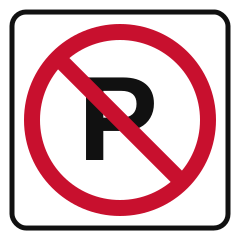
- Pick-up and drop-off only
- Do not park here
- No stopping at any time
- Parking for permit holders only
In good weather and road conditions, what is the minimum following distance?
- Three seconds
- Two seconds
- One second
- Four seconds
Who closely monitors a new B.C. driver's record?
- The vehicle's insurance broker
- The local police detachment
- The Superintendent of Motor Vehicles
- The new driver's own driving school
What does this sign mean?
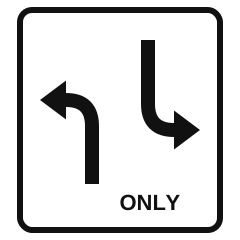
- Vehicles from both directions must turn left; no through traffic
- Traffic in this lane may go straight or turn left
- Buses from both directions may use this lane
- Left turns are not allowed here for traffic coming from either direction
The posted limit is 80 km/h, but it's foggy and the road is slick. What does that 80 km/h represent?
- A safe target speed in any weather
- The minimum speed you must keep
- The exact speed you're expected to drive
- The maximum for ideal conditions only
About how far ahead do your low beam headlights light the road?
- Up to 10 metres
- Up to 60 metres
- Up to 30 metres
- Up to 100 metres
Which sign must a Class 7 novice driver display?
- A 'New Driver' sticker
- No sign is required
- The L (Learner) sign
- The N (Novice) sign
Who uses a two-way left-turn lane in the middle of the road?
- Only buses and emergency vehicles
- Left-turning drivers from both directions
- Drivers who want to pass slow traffic in the right lane
- Only drivers going your direction
Where should you put on your tire chains?
- In a designated chain-up area
- On the hill where you begin to slip
- On any shoulder with a slight slope
- In the left lane of the highway
The advance green arrow has gone off, but the regular green light is still on. Can you still turn left?
- No, left turns end when the arrow does
- No, you must wait for the next arrow
- No, you must wait in the lane for the next green arrow
- Yes, after yielding to pedestrians and oncoming traffic
It is getting dark and your car has automatic daytime running lights. What should you do?
- Keep using the daytime running lights
- Turn on the hazard lights
- Switch on the parking lights
- Turn on your headlights
You are driving past a crash scene that police are already handling. What should you avoid?
- Watching for emergency crews
- Staying focused on the road
- Keeping a safe distance ahead
- Slowing more than necessary
You are leaving a parking lot onto a street. Where should you first stop?
- Before the sidewalk or walking area
- In the curb lane of the street
- Only if a car is coming
- At the edge of the traffic lane
In certain foggy conditions, what does the guide allow if it helps you see better?
- Fog lamps used instead of headlamps
- Parking lights instead of headlamps
- High beams with the fog lamps
- Hazard lights instead of headlamps
You spot a possible hazard ahead. What does it mean to 'cover the brake'?
- Press the brake firmly right away
- Keep your foot on the gas pedal
- Rest your foot on the brake without pressing
- Pump the brake pedal several times
On a city street, where is an HOV lane usually located?
- In the middle lane
- Beside the centre median
- Directly beside the curb
- On the left-hand shoulder
At a crash scene, the other driver wants to argue about who caused it. What does the guide suggest?
- Insist that they admit it was them
- Admit fault to calm things down
- Avoid discussing who is at fault
- Agree on fault before either leaves
Police stop you for driving 45 km/h over the posted limit. What can they do to the vehicle?
- Tow it only if you're under 19
- Nothing; only a fine applies
- Remove just the licence plates
- Impound it on the spot
You stop to help at a crash. What should you prevent anyone from doing near the scene?
- Calling emergency services
- Smoking or lighting matches
- Setting out warning triangles
- Staying with injured people
There are no speed signs on a street inside a B.C. city. What is the speed limit?
- 60 km/h
- 30 km/h
- 50 km/h
- 40 km/h
You are approaching a flashing green light. Why should you watch for pedestrians?
- They must cross only when the light is red
- They are not allowed to cross on flashing green
- They may change the light to yellow, then red
- They always have a walk signal on flashing green
You are driving slower than regular traffic on a road with two lanes in your direction. A sign tells slower drivers what to do. Where should you be?
- On the paved shoulder
- In the right lane
- In the left lane
- In whichever lane is emptier
You're turning right on a green light while a pedestrian is crossing the street you're turning onto. What must you do?
- Yield to the pedestrian
- Turn quickly before they reach you
- Honk, then turn if there's room
- Turn first; your light is green
Why should you avoid being on the right side of a large vehicle near an intersection?
- It will brake harder on that side
- Its doors open onto the right side of the road
- You can be squeezed if it turns right
- It may pull into a left-turn lane
Your headlights suddenly go out at night. What should you try first?
- Switch to parking lights and continue
- Use your fog lights and keep going
- Follow the tail lights of another car
- Flick the switch on and off quickly
Your friend rides sitting on the open tailgate of your pickup. What can police do?
- Fine only the passenger
- Only warn the passenger
- Impound the vehicle
- Nothing on private roads
Where does ice tend to form before other road surfaces?
- On uphill stretches of road
- On busy multi-lane highways
- On bridges and overpasses
- On freshly paved asphalt
Why should you avoid honking at a cyclist unless you need to warn them?
- Cyclists can't hear horns anyway
- It counts as a stunt driving offence
- It could startle them and cause a fall
- Horns are banned near bike lanes
It's raining hard on the freeway. Should you use cruise control?
- No, never in wet or slippery conditions
- Yes, but only on long, straight sections
- Yes, as long as you stay under the limit
- Yes, it keeps your speed nice and steady
Your steering wheel has an airbag. Which hand positions may be better than 10 and 2?
- 10 and 2, with hands inside the rim
- 9 and 3, or 8 and 4 o'clock
- Any position, using one hand
- 11 and 1, or 12 and 6 o'clock
The tab under a school zone sign shows only a speed, with no hours. When does that limit apply?
- Only when children can be seen
- From dawn to dusk on school days
- From 8 a.m. to 5 p.m. on school days
- At all times, every day of the year
Two cars are stopped at a two-way stop. You want to turn left; the other driver wants to go straight. Who goes first?
- You, because you were the first one to come to a stop
- The other driver, unless you have already started turning
- You, since left turns have priority
- Whoever signals first
You're stopped facing uphill right behind a large truck. Why should you leave extra space in front?
- It may roll back when the brake is released
- Its trailer may swing out to the side as it starts
- It needs room to make a U-turn
- Its exhaust is harmful at close range
Someone is waiting to cross mid-block, away from any intersection. Why shouldn't you stop and wave them across?
- Pedestrians are never allowed on roads
- It slows down traffic for too long
- Other drivers may not expect it or see them
- You would be blocking a fire lane
You shifted to neutral after the gas pedal stuck and have now stopped safely. What next?
- Rev the engine hard to free the stuck pedal
- Restart the engine to test the pedal
- Turn off the engine and call for help
- Shift back to drive and carry on
What does the white diamond symbol on this sign, also painted on the road, indicate?
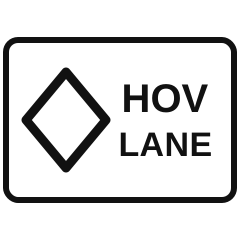
- A lane for left turns only
- A reserved lane for certain vehicles
- A lane closed for construction work ahead
- A lane that merges ahead
At an intersection with no painted crosswalk, a pedestrian is crossing close to your half of the road. Who has the right-of-way?
- The pedestrian
- You, if going straight
- Whoever arrived first
- You, since it's unmarked
You're following a bus. How can you tell you're probably not hidden in the driver's blind spot?
- You can see both of its side mirrors
- You can see its rear tires
- You are within one car length
- You can read its licence plate
Two lanes are marked for left turns. You turn from the far-left lane. Which lane should you turn into?
- The far-left lane of the cross street
- The curb lane of the cross street
- The lane next to the far-left lane
- Whichever lane has the most space
After a vehicle is impounded, who pays the towing and storage fees?
- ICBC
- The police department
- The towing company
- The vehicle's owner
All BC Class 7 practice tests
- BC Class 7 Mock Exam 1 – 50 QuestionsTimed practice · 45 minutes · answers explained
- BC Class 7 Mock Exam 2 – 50 QuestionsTimed practice · 45 minutes · answers explained
- BC Class 7 Mock Exam 3 – 50 QuestionsTimed practice · 45 minutes · answers explained
- BC Class 7 Mock Exam 4 – 50 QuestionsTimed practice · 45 minutes · answers explained
- BC Class 7 Mock Exam 5 – 50 QuestionsTimed practice · 45 minutes · answers explained
- Regulatory signsStop, yield and speed signs, school and playground zone signs, crosswalk signs, lane use and turn control signs, parking signs and reserved lane signs.
- Warning signs and object markersYellow diamond warning signs for curves, hills, merges, lane endings, crossings, wildlife and road hazards, plus object markers on obstructions.
- Construction, guide and railway signsOrange construction and work zone signs, information and destination signs, and railway crossing signs.
- Traffic lights and lane control signalsSteady and flashing lights, green and yellow arrows, transit priority signals and overhead lane control signals.
- Road markingsYellow and white lines, passing rules by line type, crosswalk and stop lines, reserved lane and bicycle lane markings, and painted islands.
About this practice test
How many questions are in BC Class 7 practice test 10?
50 original multiple-choice practice questions covering weather, visibility and night driving, large vehicles, buses, emergency vehicles and trains, regulatory signs, lanes, turns and passing, graduated licensing and penalties, pedestrians, cyclists and motorcycles, speed, space and communication, intersections and right-of-way, your vehicle and safety equipment, emergency driving strategies. Each answer includes an explanation. This mixed practice set does not reproduce the official exam format or predict an official score.
Are the questions the same every time?
Yes. Practice test 10 always has the same 50 questions, so you can repeat it until you get them all right. The other 10 sets use different questions.
Are these real test questions?
No. The official question bank is not published. These are original questions written from the official handbook, which is what the real BC Class 7 test is based on.