How is a two-point turn done?
BC Class 7 overview
BC Class 7 Practice Test 8
50 questions on lanes, turns and passing, graduated licensing and penalties, fitness to drive, distraction and attitude, emergency driving strategies, intersections and right-of-way and more.
- No sign-up
- Every answer explained
- Independent · not a government site
- Set 8 of 11
- 50 questions
- Instant feedback
0/50
All 50 questions in this test
Every question and its answer choices. The correct answers and explanations appear when you take the test above.
How is a two-point turn done?
- Back up the length of the block
- Turn left across the road in one sweep
- Back into a driveway, then pull out the other way
- Make a sharp left turn, then back up to your right side
An N driver is taking a lesson supervised by a licensed driving instructor. Does the one-passenger limit apply?
- Only on the highway
- No, it doesn't apply
- Only after midnight
- Yes, it always applies
About what share of the information you use while driving reaches you through your eyes?
- About 80 per cent
- About 95 per cent
- About 50 per cent
- About 60 per cent
More penalty points or more serious offences can lead to a GLP driver being prohibited for how long?
- Exactly 30 days and no more
- One month to a year or more
- Only for 24 hours
- Up to one week only
If you double your speed, what happens to the force of impact in a crash?
- It rises by half
- It doubles
- It quadruples
- It triples
An intersection has no stop line, no crosswalk and no sidewalk. Where should you stop?
- Three metres back from the corner
- Just before you enter the intersection
- Where you can see the cross street
- One car length into the intersection
Which of these instructions can appear on a B.C. warning sign?
- Remove sunglasses
- Turn off your headlights
- Lower your windows
- Sound your horn
A yellow sign mounted on an obstruction tells you to keep right of it. What kind of sign is this?
- A regulatory sign
- A lane use sign
- An object marker
- A turn control sign
You were following too closely and rear-ended a car that stopped suddenly. Who is held responsible?
- You, as the following driver
- Both drivers share it equally
- The driver who stopped suddenly
- No one, if nobody was hurt
Your hood suddenly flies up and blocks your view. What should you do?
- Stop in your lane immediately
- Brake as hard as you possibly can right away
- Reach out and push the hood down
- Look under the hood or out the side window
An aggressive driver is following you and you feel threatened. Where should you drive?
- Onto a quiet side road to lose them
- To an empty parking lot to stop
- To a police station or busy public place
- Straight home, then lock the doors
You're behind a cyclist on a narrow road marked with a single solid yellow centre line. May you cross the line to pass?
- No, never across a solid line
- Only if the limit is over 50 km/h
- Yes, if you can do it safely
- Only if the cyclist waves you by
You are setting your head restraint before a drive. Where should its top be?
- Level with your shoulders
- Level with the bottom of your neck, below the ears
- At least level with the top of your head
- Level with your chin
You and another car reach an uncontrolled intersection at the same time. The other car is on your right. What do you do?
- Go first because you are on the left
- Flash your lights and go first
- Yield to the car on your right
- Go first if you are going straight
You are wearing sunglasses on a bright day and are about to enter a tunnel. What should you do?
- Keep your sunglasses on and use high beams
- Slow down, take off sunglasses, lights on
- Turn on hazard lights and keep your speed
- Speed up to get through it quickly
A no-stopping sign shows a range of hours. When does the restriction apply?
- Only from 8 a.m. to 5 p.m.
- Only on weekends and holidays
- Only during the posted times
- At all hours, every day
A bicycle's front headlight for night riding in B.C. must be visible from at least what distance?
- 150 metres
- 50 metres
- 100 metres
- 300 metres
You corrected a skid, but now the rear of the car swings to the left. What most likely caused this?
- Overcorrecting the first skid
- Taking your foot off the gas
- Having ABS on the vehicle
- Not braking hard enough
You are stopped at an intersection and see this sign facing you across the cross street. What does it tell you?

- The road ahead is closed beyond the cross street
- Traffic on the cross street flows only in the arrow's direction
- Only right turns are allowed from the street you are on
- The cross street has two lanes going each way
When does an anti-lock braking system (ABS) come into action?
- Only when the car is in reverse
- Only when the parking brake is applied
- Every time you touch the brake pedal
- Only when you press hard on the brake pedal
You are driving beside a lane that ends ahead. How can you help merging drivers?
- Adjust your speed or change lanes
- Speed up to close the gap
- Sound your horn to warn them
- Stay beside them until the lane ends
When should fog lamps be used?
- In fog, in place of brake lights
- In fog, with or instead of headlamps
- Whenever you're driving at night
- Any time there's light rain
A crossing supervisor near a school signals you to stop. When are you required to obey them?
- Only if police are present
- Only during school hours
- At all times
- Only from 8 a.m. to 5 p.m.
Why should you watch for people in motorized wheelchairs or scooters along the edge of the road?
- Sidewalks may be missing or hard to use
- They are required by law to ride in traffic
- They always have the right-of-way
- They must use the centre of the lane
In a bicycle lane, which way must cyclists travel?
- Against traffic so they can see oncoming vehicles
- Opposite to traffic on one-way streets
- In the same direction as the traffic beside them
- In either direction they choose
You are caught driving while prohibited. What could happen?
- Your prohibition is shortened
- Impoundment, plus fines or jail
- Only penalty points are added to it
- Only a warning letter is sent
A driver behind you is tailgating and flashing their high beams. How should you respond?
- Give them room; avoid eye contact
- Brake suddenly to warn them off
- Speed up to get away from them
- Gesture at them to make them back off
Driving at night, you notice small, unusual spots of light on the road ahead. What might they be?
- Puddles reflecting the nearby street lights
- Reflectors in a construction zone
- An animal's eyes reflecting your lights
- Broken glass left from a crash
You're following another vehicle at night with your high beams on. Within what distance must you dim them?
- 150 metres
- 100 metres
- 300 metres
- 50 metres
You are leaving the freeway. When should you start slowing down?
- Before you signal
- After you are in the exit lane
- While still in the freeway lane
- As soon as you see the exit sign
Why should you increase your following distance behind a large truck?
- So the truck won't overheat
- To use the truck's slipstream
- So the driver can hear your horn
- To see more of the road ahead
What does this sign warn you about?
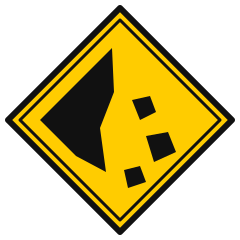
- Rocks on the road ahead
- Pavement ends ahead
- A steep hill ahead
- A soft or gravel shoulder ahead
What should you do when you see this sign?
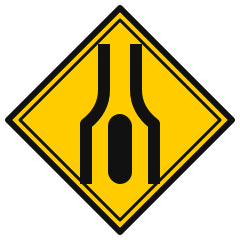
- Use either lane; the median continues
- Keep right; the divided highway ends ahead
- Stop; there is a closed lane ahead
- Keep left; a divided highway is starting just ahead
You're on a four-lane road behind a school bus that's flashing its red lights. Which lanes must stop?
- Vehicles in all lanes
- Only lanes going your way
- Only the curb lane
- Only the bus's own lane
On a multi-lane road, which lane is often the safest one to choose?
- The centre lane
- The right lane
- The fastest lane
- The left lane
You are first in line at a red light. A sign says no right turn on red. You want to turn right. What must you do?
- Turn after a full stop if the way is clear
- Turn only if no pedestrians are present
- Wait for a green light before turning
- Turn after yielding to oncoming traffic
Which of these is correct when using a roundabout?
- Change lanes to reach your exit
- Signal right before you exit
- Drive beside large trucks
- Signal left before you exit
The number on this sign is the maximum legal speed under which conditions?

- Only when no pedestrians are on the sidewalk
- When the road is bare and dry and visibility is good
- Only during daylight hours on weekdays
- At all times, whatever the weather or road condition
To avoid angering other drivers, the guide says to keep your headlights on low beam except when?
- When you're on a busy freeway
- When you're behind a big truck
- When you're in an unlit area
- When it is raining heavily
The traffic light is red at an intersection just past a railway crossing. Where should you stop?
- Anywhere, as long as gates are up
- Before the crossing unless there's room past it
- On the tracks, close to the light
- Just past the first rail
You've just passed a large truck. When can you safely move back into its lane?
- After you've gone one car length past
- When the truck flashes its high beams
- As soon as you've cleared its front bumper
- When you see its headlights in your rear-view mirror
When are you allowed to pass a vehicle on the right?
- When the driver ahead is turning left
- When you are late for an appointment
- When the shoulder is wide and paved
- When the driver ahead is slower than the limit
At a four-way stop, which vehicle goes first?
- The vehicle that is going straight through the intersection
- The vehicle on the left
- The largest vehicle
- The first to arrive and come to a full stop
In B.C. in 2014, speed was a factor in about what share of reported fatal collisions?
- About 60 per cent
- About 27 per cent
- About 10 per cent
- About 45 per cent
How far over the posted limit counts as excessive speeding that can lead to impoundment?
- 20 km/h or more
- 40 km/h or more
- 60 km/h or more
- 30 km/h or more
How can you spot possible black ice?
- A dull, very dry-looking road surface
- Shiny black asphalt instead of gray-white
- Small puddles along the road shoulder
- A white, powdery layer on the road
Where must you never place a rear-facing infant seat?
- Behind the driver's seat
- Directly behind the driver's seat on the left side
- In a seat with an active frontal airbag
- In the centre of the back seat
Where must you display your L sign?
- At the back, visible to drivers behind
- On the driver's door, visible from the side
- Inside, on the dashboard facing you
- At the front, visible to oncoming drivers
The brake warning light comes on while you are pressing the foot brake. What does this mean?
- The parking brake is fully released
- The brake pads are new and are still settling in
- The anti-lock brakes are switched off
- The brake system is not working properly
You are heading down an icy hill. Which gear does the guide recommend?
- A high gear
- A low gear
- Neutral
- Overdrive
All BC Class 7 practice tests
- BC Class 7 Mock Exam 1 – 50 QuestionsTimed practice · 45 minutes · answers explained
- BC Class 7 Mock Exam 2 – 50 QuestionsTimed practice · 45 minutes · answers explained
- BC Class 7 Mock Exam 3 – 50 QuestionsTimed practice · 45 minutes · answers explained
- BC Class 7 Mock Exam 4 – 50 QuestionsTimed practice · 45 minutes · answers explained
- BC Class 7 Mock Exam 5 – 50 QuestionsTimed practice · 45 minutes · answers explained
- Regulatory signsStop, yield and speed signs, school and playground zone signs, crosswalk signs, lane use and turn control signs, parking signs and reserved lane signs.
- Warning signs and object markersYellow diamond warning signs for curves, hills, merges, lane endings, crossings, wildlife and road hazards, plus object markers on obstructions.
- Construction, guide and railway signsOrange construction and work zone signs, information and destination signs, and railway crossing signs.
- Traffic lights and lane control signalsSteady and flashing lights, green and yellow arrows, transit priority signals and overhead lane control signals.
- Road markingsYellow and white lines, passing rules by line type, crosswalk and stop lines, reserved lane and bicycle lane markings, and painted islands.
About this practice test
How many questions are in BC Class 7 practice test 8?
50 original multiple-choice practice questions covering lanes, turns and passing, graduated licensing and penalties, fitness to drive, distraction and attitude, emergency driving strategies, intersections and right-of-way, warning signs and object markers, speed, space and communication, pedestrians, cyclists and motorcycles, your vehicle and safety equipment, weather, visibility and night driving, regulatory signs, road markings, large vehicles, buses, emergency vehicles and trains. Each answer includes an explanation. This mixed practice set does not reproduce the official exam format or predict an official score.
Are the questions the same every time?
Yes. Practice test 8 always has the same 50 questions, so you can repeat it until you get them all right. The other 10 sets use different questions.
Are these real test questions?
No. The official question bank is not published. These are original questions written from the official handbook, which is what the real BC Class 7 test is based on.