ICBC knowledge test PDF: 50 printable practice questions with answers
50 original BC Class 7 practice questions on one printable sheet, with a separate answer key, an explanation and the handbook chapter for every answer. Print it or save it as a PDF. Free; not the official test.
- No sign-up
- Every answer explained
- Independent · not a government site
- 50 questions
- Answer key included
- Free, no sign-up
This page puts 50 original practice questions for the ICBC Class 7 Knowledge Test on one sheet you can print or save as a PDF. They are drawn evenly from our 18 topics (regulatory signs, warning signs and object markers, construction, guide and railway signs, traffic lights and lane control signals, road markings, your vehicle and safety equipment, intersections and right-of-way and lanes, turns and passing, among others), so one sitting covers the whole test, not just the easy chapters.
The answer key starts on a new page after the last question. Each answer has a short explanation and the chapter of the Learn to Drive Smart it comes from, so you can check the rule in the official source instead of memorising our wording. These are not the official test questions: the Insurance Corporation of British Columbia (ICBC) does not publish its question bank. When the sheet feels easy, sit a timed mock exam of 50 questions (you need 40 correct to pass our mock).
ICBC knowledge test PDF: 50 printable practice questions with answers
1.What does this sign warn you about?

- A railway crossing ahead
- A yield sign ahead
- A traffic signal ahead
- A stop sign ahead
2.There are no speed signs on a street inside a B.C. city. What is the speed limit?
- 60 km/h
- 30 km/h
- 50 km/h
- 40 km/h
3.Another driver is passing you. What should you do?
- Move onto the left shoulder
- Slow down and make room
- Keep the same speed and flash lights
- Speed up to stay ahead
4.A cyclist ahead holds their right arm straight out to the side. What are they signalling?
- A left turn
- A lane drift
- A stop
- A right turn
5.How does mixing drugs with even a small amount of alcohol affect a driver?
- The effects tend to cancel each other
- It can greatly increase impairment
- It has no extra effect on driving
- It lowers your BAC more quickly
6.What does the warning 'don't overdrive your ability to see' mean?
- Be able to stop within the distance you can see
- Keep your eyes fixed on the road just ahead
- Use your high beams whenever it is dark out
- Never drive faster than the vehicle ahead of you
7.After a crash, which of these must you give the other driver?
- The registered owner's name and address
- Your date of birth and age
- Your employer's name and phone number
- Your driving school's details
8.When do posted construction zone speed limits apply?
- Only when workers are present
- 24 hours a day
- Only during daylight hours
- Only from 7 a.m. to 7 p.m.
9.Which of these is a legal place to park?
- On a boulevard
- At a curb 10 m from a fire hydrant
- In a bicycle lane
- On a bridge
10.A lane is marked on both sides with double broken yellow lines. What is it?
- A bus-only lane during rush hours
- A reversible lane; signals show if you may use it
- A two-way left-turn lane shared by both directions
- A painted island you must not drive on
11.During which hours may a learner drive?
- Between 6 a.m. and 11 p.m.
- Between 5 a.m. and midnight
- Between 5 a.m. and 9 p.m.
- At any hour with a supervisor
12.How often does the guide suggest doing a thorough periodic check of your vehicle?
- Once a year
- Every trip
- Every few weeks
- Every two years
13.You have a steady green light, but traffic is backed up into the intersection. What should you do?
- Go; green gives you the right-of-way
- Sound your horn and move forward
- Wait until the intersection is clear
- Enter and wait inside the intersection
14.A train has passed and the crossing gate is starting to rise. When may you go?
- When the last car clears the crossing
- Only once the gate is fully raised
- When the bells stop ringing
- As soon as the gate starts to rise
15.A school zone sign has a tab showing 30 km/h. In the standard B.C. example, when does that 30 km/h limit apply?
- Dawn to dusk every day
- 8 a.m. to 4 p.m. on school days
- 7 a.m. to 6 p.m. every day
- 8 a.m. to 5 p.m. on school days
16.On wet roads, how much braking distance should you allow?
- At least twice the normal distance
- The same as on dry pavement
- At least ten times the normal distance
- About one and a half times normal
17.You are in the intersection waiting to turn left when the light turns yellow. What can you do?
- Back out of the intersection
- Wait where you are for the next green light to come on
- Stop where you are until it turns red
- Complete your turn, watching for red-light runners
18.Which action does the guide suggest to help prevent highway hypnosis?
- Turn off the cruise control
- Use high beams all the time
- Drive in the far-left lane
- Turn the stereo up loud
19.What does this sign warn you about?

- A road surface under repair ahead
- The road may be slippery ahead
- A soft shoulder ahead
- A winding road ahead
20.Halfway through a curve, you feel your tires start to lose their grip. What should you do?
- Ease off the gas, then re-apply it gently
- Shift into neutral and coast through
- Steer sharply toward the inside edge
- Brake hard until the car slows down
21.On a freeway entrance, what separates the acceleration lane from the rest of the roadway?
- A broken white line
- A solid yellow line
- A solid white line
- A double yellow line
22.When you're about to turn left, why do oncoming motorcycles need extra attention?
- They must always yield to turning cars
- They're hard to see and their speed is hard to judge
- They can't brake as well as cars
- Their riders can't see turn signals
23.Alcohol makes drivers more impulsive. How does this usually show up on the road?
- Signalling much too early before turns
- Taking bigger risks, such as speeding
- Driving well below the speed limit
- Stopping at every green light
24.On the highway, looking at least 12 seconds ahead means watching roughly how far down the road?
- About 100 metres
- Half a kilometre
- About 50 metres
- About two kilometres
25.You hit black ice and the rear of your car slides to the right. What should you do?
- Brake firmly and hold the wheel straight
- Brake hard and steer left
- Ease off the gas and steer right
- Accelerate and steer left
26.You're in the left lane of a one-way street when a fire truck approaches with lights and siren. Which way should you pull over?
- To the left
- Nowhere; just slow down
- Into the intersection
- To the right
27.You want to park near a crosswalk. What is the minimum distance?
- 3 m
- 6 m
- 5 m
- 15 m
28.Is it legal in B.C. to drive over freshly painted, wet pavement markings?
- Yes, if you slow down
- Only when changing lanes
- No, it is illegal
- Yes, if no paint crew is present
29.Where must you display your L sign?
- At the back, visible to drivers behind
- On the driver's door, visible from the side
- Inside, on the dashboard facing you
- At the front, visible to oncoming drivers
30.You are setting your head restraint before a drive. Where should its top be?
- Level with your shoulders
- Level with the bottom of your neck, below the ears
- At least level with the top of your head
- Level with your chin
31.You approach a flashing green light. What does it mean in B.C.?
- It is a signal fault; treat it as a four-way stop
- It is an advance left turn; oncoming traffic has a red
- It is pedestrian-controlled; go only if the intersection is clear
- It is about to turn yellow, so speed up to clear the intersection
32.How may public railway crossings be marked?
- With signs or pavement markings, and sometimes warning devices
- Only with a stop sign at every crossing
- Only with a flag person during the day
- Only with gates, bells and flashing lights at every public crossing
33.It is 2 p.m. on a Saturday and you pass a playground zone sign. Does the 30 km/h limit apply?
- No, it applies only from 8 a.m. to 5 p.m.
- Only if children are on the roadway
- No, it applies only on school days
- Yes, it applies every day from dawn to dusk
34.Why are temperatures near freezing more dangerous than colder temperatures?
- Ice can form unseen and unexpectedly
- Tires lose air pressure much faster
- Fog is always thicker near freezing
- Snow is much deeper near freezing
35.The green left-turn arrow on a separate signal turns yellow before you can turn. What should you do?
- Move into the through lane instead
- Stop and wait for the next green arrow
- Turn quickly before it goes red
- Turn after yielding to oncoming traffic
36.Your friend is speeding badly and you've already tried humour and asking politely. What is the guide's last-resort option?
- Grab the steering wheel
- Pull the parking brake
- Reach over and turn off the key
- Ask to be let out of the car
37.What does this sign warn you about?
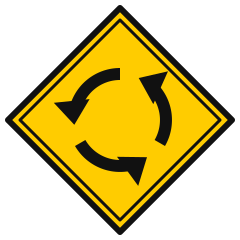
- A detour ahead
- A roundabout ahead
- Two-way traffic ahead
- U-turns are allowed ahead
38.Is it legal to coast down a hill in neutral or with the clutch pushed in?
- No, you must stay in gear
- Yes, to save fuel on long hills
- Only with an automatic transmission
- Yes, if the hill isn't steep
39.Where should you avoid changing lanes?
- In a passing lane
- On a wide highway
- On a straight road
- In an intersection
40.You're about to pass a slow truck on a two-lane road. Besides oncoming cars, what should you check for?
- Pedestrians on the far sidewalk
- Cyclists ahead of the truck or oncoming
- Parked cars on the other side
- Bus stops along the right edge
41.After drinking, your eyes lose some of their reflex abilities. Which problem does this cause?
- Braking much too early
- Seeing double images
- Feeling suddenly sleepy
- Being blinded by glare
42.When doing a shoulder check, how far should you look over your shoulder?
- Only as far as the side mirror
- At least 15 degrees
- At least 45 degrees
- At least 90 degrees
43.The guide compares hitting a solid object at 60 km/h to a vehicle falling from what height?
- The roof of a one-storey building
- The roof of a four-storey building
- The roof of a two-storey building
- The roof of a twelve-storey building
44.You're stopped facing uphill right behind a large truck. Why should you leave extra space in front?
- It may roll back when the brake is released
- Its trailer may swing out to the side as it starts
- It needs room to make a U-turn
- Its exhaust is harmful at close range
45.Your car is pointed down a steep street, curb on your right. How should the front wheels be set?
- Straight ahead
- Away from the curb
- To the left
- To the right
46.What does a broken white line between two lanes going your way allow?
- Passing on the shoulder
- Making a U-turn whenever it is clear
- Changing lanes when it is safe
- No lane changes at all
47.More penalty points or more serious offences can lead to a GLP driver being prohibited for how long?
- Exactly 30 days and no more
- One month to a year or more
- Only for 24 hours
- Up to one week only
48.You are driving on a space-saver spare tire. What is the maximum speed?
- 60 km/h
- 100 km/h
- 90 km/h
- 80 km/h
49.A flashing green arrow pointing left appears with a steady red light. What does it mean?
- Only buses may turn left now
- All traffic may proceed with caution
- Left turns must stop; through traffic may go
- Left turns may go; through traffic must stop
50.What should you do when you see this sign?
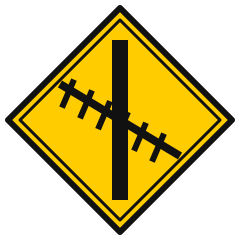
- Be prepared to stop; a railway crossing is ahead
- Turn off; the road ends at the tracks
- Speed up to cross before any train
- Stop at once; a train is crossing the road right now
Answer key with explanations
1. D — A stop sign ahead
The red octagon symbol above the arrow warns of a stop sign ahead; be ready to stop.
Warning signs and object markers · Based on: Learn to Drive Smart (ICBC, March 2026 edition), Ch. 3 Signs, signals and road markings, p. 33
2. C — 50 km/h
Unless a sign says otherwise, the B.C. limit within cities and towns is 50 km/h.
Speed, space and communication · Based on: Learn to Drive Smart (ICBC, March 2026 edition), Ch. 5 See-think-do, p. 69
3. B — Slow down and make room
It is illegal to speed up while being passed; slowing down helps the other driver get back into your lane.
Lanes, turns and passing · Based on: Learn to Drive Smart (ICBC, March 2026 edition), Ch. 4 Rules of the road, p. 54
4. D — A right turn
Cyclists may signal a right turn by holding the right arm straight out, so learn to recognize cyclist hand signals.
Pedestrians, cyclists and motorcycles · Based on: Learn to Drive Smart (ICBC, March 2026 edition), Ch. 6 Sharing the road, p. 87
5. B — It can greatly increase impairment
Many drugs greatly increase impairment when combined with even small amounts of alcohol.
Alcohol, drugs and impairment · Based on: Learn to Drive Smart (ICBC, March 2026 edition), Ch. 7 Personal strategies, p. 106
6. A — Be able to stop within the distance you can see
If something appears at the edge of what you can see, you need to be able to stop before reaching it, so match your speed to your sight distance.
Observation and hazard perception · Based on: Learn to Drive Smart (ICBC, March 2026 edition), Ch. 5 See-think-do, p. 60
7. A — The registered owner's name and address
You must exchange your name and address, the registered owner's name and address, the plate number and insurance information.
Emergency driving strategies · Based on: Learn to Drive Smart (ICBC, March 2026 edition), Ch. 8 Emergency strategies, p. 133
8. B — 24 hours a day
Posted construction zone speed limits are in force around the clock, whether or not you see workers.
Large vehicles, buses, emergency vehicles and trains · Based on: Learn to Drive Smart (ICBC, March 2026 edition), Ch. 6 Sharing the road, p. 95
9. B — At a curb 10 m from a fire hydrant
Bicycle lanes, bridges, highway tunnels, sidewalks and boulevards are all illegal places to park; 10 m from a hydrant exceeds the 5 m limit.
Parking rules · Based on: Learn to Drive Smart (ICBC, March 2026 edition), Ch. 4 Rules of the road, p. 58
10. B — A reversible lane; signals show if you may use it
Double broken yellow lines mark a reversible lane; a lane control signal shows whether you may use it.
Road markings · Based on: Learn to Drive Smart (ICBC, March 2026 edition), Ch. 3 Signs, signals and road markings, p. 38
11. B — Between 5 a.m. and midnight
Learners are restricted to driving between 5 a.m. and midnight, even with a supervisor.
Graduated licensing and penalties · Based on: Learn to Drive Smart (ICBC, March 2026 edition), Ch. 9 Your licence, p. 138
12. C — Every few weeks
A quick pre-trip check is done every time, but the more thorough periodic check is done every few weeks depending on how much you drive.
Your vehicle and safety equipment · Based on: Learn to Drive Smart (ICBC, March 2026 edition), Ch. 2 You and your vehicle, p. 24
13. C — Wait until the intersection is clear
A steady green means continue only if the intersection is clear, so do not enter and block it.
Traffic lights and lane control signals · Based on: Learn to Drive Smart (ICBC, March 2026 edition), Ch. 3 Signs, signals and road markings, p. 37
14. B — Only once the gate is fully raised
At a gated crossing you must stay stopped until the gate is all the way up, not just starting to rise.
Construction, guide and railway signs · Based on: Learn to Drive Smart (ICBC, March 2026 edition), Ch. 3 Signs, signals and road markings, p. 36
15. D — 8 a.m. to 5 p.m. on school days
The tab gives the limit and hours; the B.C. example is 30 km/h from 8 a.m. to 5 p.m. on school days.
Regulatory signs · Based on: Learn to Drive Smart (ICBC, March 2026 edition), Ch. 3 Signs, signals and road markings, p. 31
16. A — At least twice the normal distance
Wet roads reduce traction, so the guide says to allow at least double the normal braking distance and brake gently.
Weather, visibility and night driving · Based on: Learn to Drive Smart (ICBC, March 2026 edition), Ch. 8 Emergency strategies, p. 120
17. D — Complete your turn, watching for red-light runners
If you are already in the intersection to turn left, you may legally finish the turn, but watch for oncoming drivers trying to beat the red.
Intersections and right-of-way · Based on: Learn to Drive Smart (ICBC, March 2026 edition), Ch. 4 Rules of the road, p. 44
18. A — Turn off the cruise control
Turning off cruise control, scanning systematically and using stay-awake strategies keep you engaged on long, monotonous highways.
Fitness to drive, distraction and attitude · Based on: Learn to Drive Smart (ICBC, March 2026 edition), Ch. 7 Personal strategies, p. 100
19. B — The road may be slippery ahead
The skidding car and wavy tracks warn that the road surface ahead may be slippery, so drive with extra care.
Warning signs and object markers · Based on: Learn to Drive Smart (ICBC, March 2026 edition), Ch. 3 Signs, signals and road markings, p. 33
20. A — Ease off the gas, then re-apply it gently
Don't brake when traction is slipping in a curve; lift off the accelerator and apply it gently again once grip returns.
Speed, space and communication · Based on: Learn to Drive Smart (ICBC, March 2026 edition), Ch. 5 See-think-do, p. 71
21. C — A solid white line
The acceleration lane, where you match freeway speed, is set off by a solid white line; the merging area by a broken white line.
Lanes, turns and passing · Based on: Learn to Drive Smart (ICBC, March 2026 edition), Ch. 4 Rules of the road, p. 55
22. B — They're hard to see and their speed is hard to judge
Motorcycles are hard to spot, especially at night, at dusk or in heavy traffic, and it's difficult to judge how fast they're approaching.
Pedestrians, cyclists and motorcycles · Based on: Learn to Drive Smart (ICBC, March 2026 edition), Ch. 6 Sharing the road, p. 89
23. B — Taking bigger risks, such as speeding
Increased impulsiveness leads impaired drivers to take greater risks, such as speeding or taking chances.
Alcohol, drugs and impairment · Based on: Learn to Drive Smart (ICBC, March 2026 edition), Ch. 7 Personal strategies, p. 104
24. B — Half a kilometre
At highway speeds, 12 seconds of travel covers about half a kilometre, giving you time to prepare for hazards.
Observation and hazard perception · Based on: Learn to Drive Smart (ICBC, March 2026 edition), Ch. 5 See-think-do, p. 60
25. C — Ease off the gas and steer right
Ease off the accelerator, don't brake, and steer smoothly where you want to go, which here is to the right.
Emergency driving strategies · Based on: Learn to Drive Smart (ICBC, March 2026 edition), Ch. 8 Emergency strategies, p. 117
26. A — To the left
Normally you pull right, but in the left lane of a one-way street or divided highway, pull to the left and stop.
Large vehicles, buses, emergency vehicles and trains · Based on: Learn to Drive Smart (ICBC, March 2026 edition), Ch. 6 Sharing the road, p. 93
27. B — 6 m
Parking within six metres of a crosswalk or an intersection is illegal.
Parking rules · Based on: Learn to Drive Smart (ICBC, March 2026 edition), Ch. 4 Rules of the road, p. 58
28. C — No, it is illegal
Driving over wet, freshly painted markings is against the law, so steer around them.
Road markings · Based on: Learn to Drive Smart (ICBC, March 2026 edition), Ch. 3 Signs, signals and road markings, p. 38
29. A — At the back, visible to drivers behind
The official L sign goes in the back windshield or on the rear of the vehicle so drivers behind you can see it.
Graduated licensing and penalties · Based on: Learn to Drive Smart (ICBC, March 2026 edition), Ch. 9 Your licence, p. 138
30. C — At least level with the top of your head
The restraint should reach at least the top of your head and sit as close to the back of your head as possible to help prevent whiplash.
Your vehicle and safety equipment · Based on: Learn to Drive Smart (ICBC, March 2026 edition), Ch. 2 You and your vehicle, p. 13
31. C — It is pedestrian-controlled; go only if the intersection is clear
In B.C., a flashing green is a pedestrian-controlled light; proceed only if the intersection is clear.
Traffic lights and lane control signals · Based on: Learn to Drive Smart (ICBC, March 2026 edition), Ch. 3 Signs, signals and road markings, p. 37
32. A — With signs or pavement markings, and sometimes warning devices
Crossings are shown by signs or pavement markings and may also have mechanical or electrical warning devices.
Construction, guide and railway signs · Based on: Learn to Drive Smart (ICBC, March 2026 edition), Ch. 3 Signs, signals and road markings, p. 36
33. D — Yes, it applies every day from dawn to dusk
Unlike school zones, playground zones are in effect every day of the week from dawn to dusk.
Regulatory signs · Based on: Learn to Drive Smart (ICBC, March 2026 edition), Ch. 3 Signs, signals and road markings, p. 31
34. A — Ice can form unseen and unexpectedly
Near freezing, ice can form without warning and may not be visible even though the road looks the same.
Weather, visibility and night driving · Based on: Learn to Drive Smart (ICBC, March 2026 edition), Ch. 8 Emergency strategies, p. 121
35. B — Stop and wait for the next green arrow
Once the separate green arrow turns yellow, you must stop and wait for the next green arrow before turning.
Intersections and right-of-way · Based on: Learn to Drive Smart (ICBC, March 2026 edition), Ch. 4 Rules of the road, p. 45
36. D — Ask to be let out of the car
If nothing else works with an unsafe driver, the guide's final suggestion is to ask to be let out of the car.
Fitness to drive, distraction and attitude · Based on: Learn to Drive Smart (ICBC, March 2026 edition), Ch. 7 Personal strategies, p. 110
37. B — A roundabout ahead
The circular arrows warn that a roundabout is ahead, so be ready to adjust your speed for it.
Warning signs and object markers · Based on: Learn to Drive Smart (ICBC, March 2026 edition), Ch. 3 Signs, signals and road markings, p. 33
38. A — No, you must stay in gear
Coasting this way is illegal in B.C. because you need to be in gear to safely control the vehicle.
Speed, space and communication · Based on: Learn to Drive Smart (ICBC, March 2026 edition), Ch. 5 See-think-do, p. 71
39. D — In an intersection
Changing lanes in an intersection can confuse other drivers and cause a crash.
Lanes, turns and passing · Based on: Learn to Drive Smart (ICBC, March 2026 edition), Ch. 4 Rules of the road, p. 53
40. B — Cyclists ahead of the truck or oncoming
Before passing another vehicle, look for oncoming cyclists and any cyclist in front of the vehicle you're passing.
Pedestrians, cyclists and motorcycles · Based on: Learn to Drive Smart (ICBC, March 2026 edition), Ch. 6 Sharing the road, p. 86
41. D — Being blinded by glare
When the eyes lose their reflexes, a drinking driver is more easily blinded by glare from lights.
Alcohol, drugs and impairment · Based on: Learn to Drive Smart (ICBC, March 2026 edition), Ch. 7 Personal strategies, p. 104
42. C — At least 45 degrees
Turning at least 45 degrees toward the side you're moving to lets you see the blind spot the mirror misses.
Observation and hazard perception · Based on: Learn to Drive Smart (ICBC, March 2026 edition), Ch. 5 See-think-do, p. 62
43. B — The roof of a four-storey building
At 30 km/h a crash is like falling from one storey; at 60 km/h it's like falling from the roof of a four-storey building.
Emergency driving strategies · Based on: Learn to Drive Smart (ICBC, March 2026 edition), Ch. 8 Emergency strategies, p. 131
44. A — It may roll back when the brake is released
On an upgrade, a large vehicle can roll backward as the driver releases the brake, so give it extra room.
Large vehicles, buses, emergency vehicles and trains · Based on: Learn to Drive Smart (ICBC, March 2026 edition), Ch. 6 Sharing the road, p. 90
45. D — To the right
Downhill, with or without a curb, turn the wheels right so the car rolls toward the curb or edge, not into traffic.
Parking rules · Based on: Learn to Drive Smart (ICBC, March 2026 edition), Ch. 4 Rules of the road, p. 58
46. C — Changing lanes when it is safe
A broken white line means you may change lanes, but only when it is safe.
Road markings · Based on: Learn to Drive Smart (ICBC, March 2026 edition), Ch. 3 Signs, signals and road markings, p. 39
47. B — One month to a year or more
GLP drivers who rack up more points or serious offences can be prohibited from driving for one month to a year or longer.
Graduated licensing and penalties · Based on: Learn to Drive Smart (ICBC, March 2026 edition), Ch. 9 Your licence, p. 141
48. D — 80 km/h
The guide says never to drive faster than 80 km/h on a space-saver spare, and to keep it at the pressure marked on its side.
Your vehicle and safety equipment · Based on: Learn to Drive Smart (ICBC, March 2026 edition), Ch. 2 You and your vehicle, p. 25
49. D — Left turns may go; through traffic must stop
With a steady red, the flashing green arrow allows left turns while through traffic waits for the red.
Traffic lights and lane control signals · Based on: Learn to Drive Smart (ICBC, March 2026 edition), Ch. 3 Signs, signals and road markings, p. 37
50. A — Be prepared to stop; a railway crossing is ahead
This warning sign tells you a railway crossing is ahead, so slow down and be ready to stop.
Construction, guide and railway signs · Based on: Learn to Drive Smart (ICBC, March 2026 edition), Ch. 3 Signs, signals and road markings, p. 36
Original practice questions by Canada Exam Prep, written from the official handbook. Not official test questions. Free to print for personal study.
FAQ
BC Class 7 questions and answers (printable): common questions
Are these the real BC Class 7 test questions?
No. The Insurance Corporation of British Columbia (ICBC) keeps its question bank private. Every question here is original and written from the Learn to Drive Smart, the material the real test is based on. Understanding the rules, not memorising answers, is what helps on test day.
How do I save the BC Class 7 questions and answers as a PDF?
Press the print button and choose Save as PDF instead of a printer. Menus, buttons and ads are hidden when you print, and the answer key starts on a new page after question 50.
How many questions are on the printable sheet?
50, chosen from all 18 topics in our bank of 535 questions. For more, use the online practice tests, which show the correct answer and an explanation after every question.
Keep practising
- ICBC signs test50 B.C. road sign, traffic light and road marking questions for the ICBC knowledge test, each explained with the Learn to Drive Smart page behind it.
- B.C. road signs chartEvery road sign drawn in our ICBC practice bank on one page, from stop and yield to work-zone and railway signs, with what each one means and what to do.
- BC Class 7 study guide
- How to get a learner's licence in B.C.
- ICBC road test guide
- BC Class 7 Mock Exam 1 – 50 QuestionsTimed practice · 45 minutes · answers explained
- BC Class 7 Mock Exam 2 – 50 QuestionsTimed practice · 45 minutes · answers explained
- BC Class 7 Practice Test 150 questions with explanations
- BC Class 7 Practice Test 250 questions with explanations
- BC Class 7 Practice Test 350 questions with explanations
Practice by topic
- Regulatory signsStop, yield and speed signs, school and playground zone signs, crosswalk signs, lane use and turn control signs, parking signs and reserved lane signs.
- Warning signs and object markersYellow diamond warning signs for curves, hills, merges, lane endings, crossings, wildlife and road hazards, plus object markers on obstructions.
- Construction, guide and railway signsOrange construction and work zone signs, information and destination signs, and railway crossing signs.
- Traffic lights and lane control signalsSteady and flashing lights, green and yellow arrows, transit priority signals and overhead lane control signals.
- Road markingsYellow and white lines, passing rules by line type, crosswalk and stop lines, reserved lane and bicycle lane markings, and painted islands.
- Your vehicle and safety equipmentSeat and head restraint adjustment, seatbelts, child car seat stages, airbags, mirrors, controls, lights, anti-lock brakes, pre-trip checks, tires and winter preparation.
- Intersections and right-of-waySignalling, controlled and uncontrolled intersections, where to stop, right-of-way at lights, stop signs and yield signs, traffic circles, roundabouts and entering a roadway.
- Lanes, turns and passingChoosing a lane, turning right and left, multiple and two-way left-turn lanes, U-turns, HOV, bus and bicycle lanes, passing, merging, freeway entrances and exits, and turning around.
- Parking rulesWhere parking is illegal, required distances from hydrants, crosswalks, stop signs and railway crossings, curb distance and hill parking.
- Observation and hazard perceptionScanning ahead, behind and at intersections, mirror and shoulder checks, blind spots, hazard perception, assessing risk and choosing a solution.
- Speed, space and communicationSpeed limits and appropriate speeds, curves, steering, stopping distance, the two-second rule, space behind and beside, safe gaps, signals, lights and the horn.
- Pedestrians, cyclists and motorcyclesYielding to pedestrians, passing distance and rules for cyclists, and sharing the road with motorcycle riders and other passenger vehicles.
- Large vehicles, buses, emergency vehicles and trainsLarge vehicle blind spots, school buses, transit buses, emergency vehicles, stopped vehicles with flashing lights, construction zones, railway crossings and horses.
- Fitness to drive, distraction and attitudeVision, health and fatigue, cellphones and other devices, dangerous emotions, risk taking, peer pressure, unsafe passengers and aggression on the road.
- Alcohol, drugs and impairmentHow alcohol and drugs affect driving, blood alcohol facts, medications, illegal drugs, cannabis and combining drugs with alcohol.
- Emergency driving strategiesEmergency braking, anti-lock brakes, skid recovery, tire blowouts, brake failure and other breakdowns, animals on the road, collision avoidance and what to do at a crash.
- Weather, visibility and night drivingLoss of visibility, glare, rain, hydroplaning, deep water, ice and snow, being stranded, wind and turbulence, headlight use and overdriving your headlights.
- Graduated licensing and penaltiesLearner (L) and novice (N) stage restrictions, supervisor and passenger rules, GLP penalties, fines and penalty points, impaired driving penalties and vehicle impoundment.