You are in the learner stage and receive a driving prohibition. What happens to your learner stage?
BC Class 7 overview
BC Class 7 Mock Exam 1
Same format as the real test. Answers stay hidden until you submit.
- No sign-up
- Every answer explained
- Independent · not a government site
- 50 questions
- 45 min
- Pass mark 40/50
0/50
All 50 questions in this test
Every question and its answer choices. The correct answers and explanations appear when you take the test above.
You are in the learner stage and receive a driving prohibition. What happens to your learner stage?
- It's extended; no time counts while prohibited
- Nothing changes; the time keeps counting
- It's cancelled and you start over at the test
- You move up to the N stage early
An aggressive driver is following you and you feel threatened. Where should you drive?
- Onto a quiet side road to lose them
- To an empty parking lot to stop
- To a police station or busy public place
- Straight home, then lock the doors
At a public railway crossing, who must yield?
- Whoever reaches the crossing first
- You must always yield to trains
- Trains yield when gates are up
- Trains yield to vehicles on the tracks
You are turning left from a two-way street onto a one-way street. Which lane do you turn into?
- Any lane of the one-way street
- The centre lane of the one-way street
- The left lane of the one-way street
- The right lane of the one-way street
You want to turn left into a driveway mid-block across a solid double yellow line. Is this allowed?
- Yes, but only between 9 p.m. and 6 a.m.
- No, a double yellow line never allows it
- Only if there is a two-way left-turn lane
- Yes, if it is safe and no sign prohibits it
You're about to pass a horse and rider on a rural road. What should you avoid?
- Honking your horn
- Slowing down early
- Passing at a low speed
- Leaving lots of space
How far over the posted limit counts as excessive speeding that can lead to impoundment?
- 20 km/h or more
- 40 km/h or more
- 60 km/h or more
- 30 km/h or more
Which statement about anti-lock brakes (ABS) is true?
- It always stops you sooner
- It lets you drive faster safely
- On gravel, stopping may take longer
- It works only on dry, clean pavement
Why should you keep your car stereo at a moderate volume while driving?
- Loud music is a ticketable noise offence
- It can damage the dashboard speakers
- You might miss sirens or train whistles
- It drains the vehicle battery too quickly
The guide compares hitting a solid object at 60 km/h to a vehicle falling from what height?
- The roof of a one-storey building
- The roof of a four-storey building
- The roof of a two-storey building
- The roof of a twelve-storey building
A school bus ahead turns on alternating flashing amber lights. What does this usually mean?
- It's about to pull away
- It's preparing to stop
- You may pass at any speed
- Children are crossing now
On a freeway with three lanes in your direction, which lanes should you generally use?
- Only the far-left lane
- Only the far-right lane
- The centre or a right-hand lane
- Any lane you like
Until what age does ICBC recommend children ride in the back seat?
- 12 years
- 7 years
- 9 years
- 16 years
Which of these warns you that a large vehicle is about to back up?
- A beeper, four-way flashers or backup lights
- A flashing left turn signal
- Its engine noise getting quieter
- A puff of smoke from the exhaust
You are stopped at an intersection and see this sign facing you across the cross street. What does it tell you?

- The road ahead is closed beyond the cross street
- Traffic on the cross street flows only in the arrow's direction
- Only right turns are allowed from the street you are on
- The cross street has two lanes going each way
You are in a lane signed for left turns only and have already entered the intersection when you realize you meant to go straight. What must you do?
- Move into the through lane quickly
- Complete the left turn
- Go straight if no one is beside you
- Stop and wait for a gap to change lanes
The light ahead turns steady yellow as you approach. What must you do?
- Stop before the intersection unless you can't stop safely
- Speed up so you can clear the intersection before red
- Stop only if a pedestrian is waiting
- Continue at the same speed
Your car is stuck on the railway tracks. After getting everyone out, how far from the track should you go?
- At least 5 metres
- At least 30 metres
- At least 15 metres
- At least 100 metres
At an intersection with no painted crosswalk, a pedestrian is crossing close to your half of the road. Who has the right-of-way?
- The pedestrian
- You, if going straight
- Whoever arrived first
- You, since it's unmarked
Below what speed does ICBC suggest rolling down the windows instead of using air conditioning?
- 80 km/h
- 30 km/h
- 50 km/h
- 70 km/h
A learner had one small glass of wine with dinner. May they drive home?
- Yes, if the supervisor says it's okay
- Yes, if their BAC is under .05
- Yes, if their BAC is under .08
- No, L drivers must have zero alcohol
In good weather and road conditions, what is the minimum following distance?
- Three seconds
- Two seconds
- One second
- Four seconds
What unit are the distances on a green destination sign like this one?
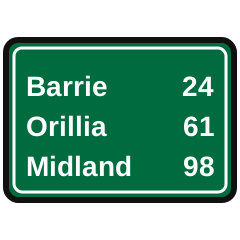
- Miles
- Metres
- Minutes of travel
- Kilometres
You are setting your head restraint before a drive. Where should its top be?
- Level with your shoulders
- Level with the bottom of your neck, below the ears
- At least level with the top of your head
- Level with your chin
A rider ahead is struggling to control their horse. What should you do?
- Pass quickly before it gets worse
- Steer around it on the shoulder
- Stop and wait until it's under control
- Honk to help calm the horse
According to the guide, what is the main cause of skidding?
- Worn-out tires
- Mechanical failures
- Rain and ice
- Poor driving skills
For one of these impoundment offences, police can immediately impound the vehicle for how long?
- Seven days
- 90 days
- 24 hours
- Three days
How often does the guide suggest doing a thorough periodic check of your vehicle?
- Once a year
- Every trip
- Every few weeks
- Every two years
Why should you never turn the ignition to the Lock position while the car is moving?
- The headlights and dashboard lights will turn off at once
- The steering may lock and you could lose control
- The headlights will turn off at once
- The brakes will stop working right away
You stop to help at a crash. What should you prevent anyone from doing near the scene?
- Calling emergency services
- Smoking or lighting matches
- Setting out warning triangles
- Staying with injured people
A lane control signal over your lane tells you to move out of it. Where should you go?
- Onto the right shoulder
- Into the lane with a red X
- Into a lane with a green arrow
- Stay in your lane until the signal changes
A strong crosswind gusts as a tractor-trailer passes you. What should you do?
- Brake hard and stop in your own lane
- Steer hard away from the side of the truck
- Speed up to get past the truck quickly
- Slow down; grip the wheel with both hands
Which of these is an 'I' statement you could use with an unsafe driver?
- Everyone says you're a terrible driver.
- Slow down or I'm never riding again.
- You're driving like a maniac!
- I'm nervous right now; could you slow down?
Your friend rides sitting on the open tailgate of your pickup. What can police do?
- Fine only the passenger
- Only warn the passenger
- Impound the vehicle
- Nothing on private roads
You're stopped at a red light and your car is blocking the path of an approaching fire truck. What may you have to do?
- Stay put; never move on a red
- Back up into the car behind you
- Turn the corner to get out of its way
- Drive into the middle of the intersection
When you change lanes, who has the right-of-way?
- Vehicles already in the lane you're entering
- You do, once you have signalled your intention to move
- Whoever is in the left lane
- The faster of the two vehicles
You're about to pull away from the right-hand curb into traffic. Which mirror shows whether cars are coming up from behind?
- The left side-view mirror
- Only the rear-view mirror
- The right side-view mirror
- Only the back-up camera
How should a seatbelt be worn?
- Snug over the chest and low over the hips
- Loose over the chest and across the stomach
- With the shoulder strap behind your back
- With the shoulder strap under your arm
A car is coming straight at you in your lane. Which way should you steer to avoid a head-on crash?
- Toward the centre
- To the right
- To the left
- Straight, braking
Why should you check the exhaust system before winter?
- Leaks can let carbon monoxide build up inside
- Exhaust leaks drain the battery
- Snow can freeze the tailpipe shut
- Cold air makes the muffler louder
On which two kinds of warning signs are you told to slow to the advisory speed shown?
- Steep hill signs and rough road signs
- Narrow bridge signs and tunnel signs
- School zone signs and playground signs
- Sharp curve signs and highway exit signs
You are driving at the speed limit in the left lane of a highway. Why should you move right?
- Drivers in the left lane must always go over the limit
- Staying there may push others to pass on your right
- The left lane is closed to cars at night
- The left lane is only for trucks
What should you do when you see this sign?

- Slow down; a steep hill is ahead
- Watch for heavy trucks entering the road ahead
- Speed up to keep your momentum
- Shift to neutral to save fuel
Your steering wheel has an airbag. Which hand positions may be better than 10 and 2?
- 10 and 2, with hands inside the rim
- 9 and 3, or 8 and 4 o'clock
- Any position, using one hand
- 11 and 1, or 12 and 6 o'clock
How much longer can it take to stop on ice compared with a normal stop?
- About 10 times as far
- About three times as far
- About five times as far
- About twice as far
What does this sign warn you about?
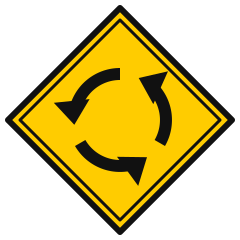
- A detour ahead
- A roundabout ahead
- Two-way traffic ahead
- U-turns are allowed ahead
You drive through a red light. What penalty does the guide's table show?
- $368 and 4 points
- $167 and 3 points
- $109 and 3 points
- $167 and 2 points
Your gas pedal sticks at highway speed. What should you never do?
- Apply the brakes firmly and steadily
- Shift the transmission into neutral
- Reach down and free it by hand
- Look for an escape path off the road
The tab under a school zone sign shows only a speed, with no hours. When does that limit apply?
- Only when children can be seen
- From dawn to dusk on school days
- From 8 a.m. to 5 p.m. on school days
- At all times, every day of the year
There is a solid yellow line on your side and a broken yellow line beside it on the far side. May you pass?
- Yes, whenever it is safe to do so
- Yes, as long as you can get back into your lane within 10 seconds
- No; pass only when the broken line is on your side
- Yes, but only to pass slow trucks
Keep practising
- BC Class 7 Mock Exam 2 – 50 QuestionsTimed practice · 45 minutes · answers explained
- BC Class 7 Mock Exam 3 – 50 QuestionsTimed practice · 45 minutes · answers explained
- BC Class 7 Mock Exam 4 – 50 QuestionsTimed practice · 45 minutes · answers explained
- BC Class 7 Mock Exam 5 – 50 QuestionsTimed practice · 45 minutes · answers explained
- BC Class 7 Practice Test 150 questions with explanations
- BC Class 7 Practice Test 250 questions with explanations
- BC Class 7 Practice Test 350 questions with explanations
- BC Class 7 Practice Test 450 questions with explanations