You spot a possible hazard ahead. What does it mean to 'cover the brake'?
BC Class 7 overview
BC Class 7 Mock Exam 3
Same format as the real test. Answers stay hidden until you submit.
- No sign-up
- Every answer explained
- Independent · not a government site
- 50 questions
- 45 min
- Pass mark 40/50
0/50
All 50 questions in this test
Every question and its answer choices. The correct answers and explanations appear when you take the test above.
You spot a possible hazard ahead. What does it mean to 'cover the brake'?
- Press the brake firmly right away
- Keep your foot on the gas pedal
- Rest your foot on the brake without pressing
- Pump the brake pedal several times
A pregnant passenger is buckling up. Where should the lap belt go?
- Across the middle of the belly
- Snug and below the baby
- Loose and over the baby
- Above the baby, under the ribs
Where should you avoid changing lanes?
- In a passing lane
- On a wide highway
- On a straight road
- In an intersection
You're on the second day of a long road trip. Why should you be especially careful today?
- Traffic is always heaviest on day two
- Your licence rules change after day one
- Fatigue is most likely to hit you today
- Tires wear fastest on the second day
Your headlights suddenly go out at night. What should you try first?
- Switch to parking lights and continue
- Use your fog lights and keep going
- Follow the tail lights of another car
- Flick the switch on and off quickly
You are turning right at an intersection. Which lane should you end up in?
- Any lane that is open
- The right lane of the cross street
- The centre lane of the cross street
- The left lane of the cross street
For the N-stage passenger limit, which of these counts as immediate family?
- An aunt
- A first cousin
- A step-brother
- A roommate
Your car starts to hydroplane. What should you do?
- Brake firmly right away to stop
- Steer sharply toward the shoulder
- Accelerate to regain your grip
- Ease off the gas and keep straight
What does this sign mean for the stretch of road it covers?
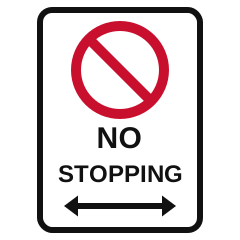
- No parking along here, but brief stops are allowed
- No stopping until the next no-stopping sign
- You may stop only to load passengers
- You may stop for up to 5 minutes
Heavy snow and freezing rain are forecast. What does the guide call the best option?
- Drive early before it gets worse
- Stay home or take the bus
- Drive with your hazard lights flashing
- Take the highway, not side streets
In B.C., what equipment must a bicycle have when ridden at night?
- Flashing red lights at the front and back
- White headlight, red rear light and red reflector
- A red rear reflector only, no front light
- White headlight and amber side reflectors
You notice you're gripping the wheel tightly because you're upset. Why does the guide suggest loosening your grip?
- It keeps the airbag from deploying
- It reduces wear on the steering wheel
- It eases your arm and neck muscles
- It lets you steer faster in a crisis
You're driving a manual-transmission car toward a railway crossing. When should you change to a lower gear?
- While you're on the tracks
- As the front wheels hit the rail
- Before you begin to cross
- Halfway across the crossing
You're driving on a city street. How far ahead should you be scanning?
- One to two blocks
- Half a block
- Just to the car in front
- Three to four blocks
You have a steady green light, but traffic is backed up into the intersection. What should you do?
- Go; green gives you the right-of-way
- Sound your horn and move forward
- Wait until the intersection is clear
- Enter and wait inside the intersection
You don't hear a train whistle as you approach a railway crossing. Does that mean no train is coming?
- Yes; trains always whistle first
- Yes, unless it is nighttime
- Only if there are no gates
- No; trains don't whistle at every crossing
You've stopped at a stop sign but bushes block your view of the cross street. What should you do next?
- Wait for a driver to wave you on
- Creep forward slowly until you can see
- Go quickly before any traffic arrives
- Honk, then drive straight through
Your car has been sitting in the driveway for several hours and you need to back out. What does the guide suggest first?
- Walk around the back to check the path
- Tap the horn twice, then reverse
- Rely on the back-up camera alone to back out
- Turn on your hazard lights first
For one of these impoundment offences, police can immediately impound the vehicle for how long?
- Seven days
- 90 days
- 24 hours
- Three days
You're turning left on a green light and an oncoming motorcycle is going straight through. By law, what must you do?
- Turn first; the rider must yield to you
- Turn quickly before the light changes
- Yield to the motorcycle before turning
- Flash your headlights, then turn
Why should you leave plenty of space when passing a motorcycle?
- Your car may throw dirt or water at the rider
- Your mirrors could catch their handlebars
- Riders are required to move right when passed
- Motorcycles always speed up when passed
A train has passed and the crossing gate is starting to rise. When may you go?
- When the last car clears the crossing
- Only once the gate is fully raised
- When the bells stop ringing
- As soon as the gate starts to rise
You see a steady white rectangular light at an intersection. Who may go on it?
- Only buses
- Pedestrians and cyclists
- Emergency vehicles only
- Traffic turning right
When does an anti-lock braking system (ABS) come into action?
- Only when the car is in reverse
- Only when the parking brake is applied
- Every time you touch the brake pedal
- Only when you press hard on the brake pedal
On a road with a 60 km/h limit, how much space must you leave when passing someone on a personal mobility device?
- At least 0.5 metre
- At least 2.5 metres
- At least 1.5 metres
- At least 1.0 metre
Why are temperatures near freezing more dangerous than colder temperatures?
- Ice can form unseen and unexpectedly
- Tires lose air pressure much faster
- Fog is always thicker near freezing
- Snow is much deeper near freezing
During what period must you use your headlights?
- From sunset until sunrise only
- From 1 hour after sunset to 1 hour before sunrise
- From 30 min after sunset to 30 min before sunrise
- Only when the street lights are on
Smoke and flames are coming from under your hood. What should you do?
- Open the hood to check the fire
- Get everyone out and move well away
- Keep driving to a service station
- Stay inside with all the windows rolled up
On a two-lane road, where in your lane should you generally position your vehicle?
- Fairly close to the centre line
- On the paved shoulder when possible
- Straddling the centre line slightly
- As close to the right edge as you can
On a dark rural road with your high beams on, roughly how much road can you see lit up?
- About 50 metres
- About 150 metres
- About 100 metres
- About 30 metres
What must you do at a flashing red light?
- Stop only if traffic is coming
- Wait until it turns green
- Slow down, then keep going if the way looks clear
- Stop completely, then go when safe
In the see-think-do strategy, what happens during the 'think' step?
- You pick the most dangerous hazard and a safe solution
- You steer, brake or signal to avoid trouble
- You scan the road around you for hazards
- You check your mirrors and blind spots
A school bus ahead turns on alternating flashing amber lights. What does this usually mean?
- It's about to pull away
- It's preparing to stop
- You may pass at any speed
- Children are crossing now
If you double your speed, what happens to the force of impact in a crash?
- It rises by half
- It doubles
- It quadruples
- It triples
How often does the guide suggest doing a thorough periodic check of your vehicle?
- Once a year
- Every trip
- Every few weeks
- Every two years
What colour are school zone signs in B.C.?
- White with red letters
- Orange with black symbols
- Yellow with a black border
- Fluorescent yellow-green
You hold an N licence. When may you use a hands-free phone while driving?
- Only for calls shorter than one minute
- Whenever the phone is mounted on the dash
- Only to call 9-1-1 to report an emergency
- Only while stopped in heavy traffic
You are in the right lane of a freeway and a driver is trying to merge in from an entrance. What can you do?
- Speed up so they merge behind
- Stop to let them in
- Move left if safe or adjust your speed
- Hold your lane and speed
When you set your seat position, what should your right foot be able to do?
- Reach only the edge of the gas pedal
- Rest flat on the gas pedal with the leg fully straight out
- Reach the floor behind the brake with a slight bend in the leg
- Press the brake to the floor with the leg locked
A curve ahead sign has no speed tab under it. What should you do?
- Move into the left lane early
- Brake hard once you are in the curve
- Keep your speed; no tab means no advice
- Slow down before the curve
You're stranded in snow and want to run the engine for heat. How often should it run?
- About 15 minutes every hour
- About five minutes every hour
- About five minutes in every 10
- All the time with the windows shut
What colour is the school crosswalk ahead sign?
- Fluorescent yellow-green
- Orange with black symbols
- White with black lettering
- Yellow with black symbols
You are waiting at the roadside with the engine running. After how long should you turn it off?
- More than 10 seconds
- More than 3 minutes
- More than 60 seconds
- More than 5 minutes
When you see this sign, what should you do?

- Stop and wait for a crossing guard
- Keep your speed; the sign is only advice, not law
- Sound your horn to warn the children
- Reduce speed when children are present
After drinking, your eyes lose some of their reflex abilities. Which problem does this cause?
- Braking much too early
- Seeing double images
- Feeling suddenly sleepy
- Being blinded by glare
Why isn't driving far below the speed of surrounding traffic always the safest choice?
- Frustrated drivers may try to pass you
- Low speeds can overheat your engine
- Brakes work poorly at low speeds
- Police ticket anyone driving under the posted limit
You shifted to neutral after the gas pedal stuck and have now stopped safely. What next?
- Rev the engine hard to free the stuck pedal
- Restart the engine to test the pedal
- Turn off the engine and call for help
- Shift back to drive and carry on
At a school crosswalk, a crossing guard is on duty. What must you do?
- Stop only when the light is red
- Sound your horn and continue slowly
- Follow the crossing guard's directions
- Go if no children are in your lane
What do white lines between lanes separate?
- Traffic moving in opposite directions
- Turning traffic from parked cars
- Traffic moving in the same direction
- Bicycles from motor vehicles
A railway crossing gate is down, but you can't see a train. What must you do?
- Wait 30 seconds, then go
- Drive around the gate carefully
- Cross if you hear no whistle
- Stop and wait for the gate to go up
Keep practising
- BC Class 7 Mock Exam 1 – 50 QuestionsTimed practice · 45 minutes · answers explained
- BC Class 7 Mock Exam 2 – 50 QuestionsTimed practice · 45 minutes · answers explained
- BC Class 7 Mock Exam 4 – 50 QuestionsTimed practice · 45 minutes · answers explained
- BC Class 7 Mock Exam 5 – 50 QuestionsTimed practice · 45 minutes · answers explained
- BC Class 7 Practice Test 150 questions with explanations
- BC Class 7 Practice Test 250 questions with explanations
- BC Class 7 Practice Test 350 questions with explanations
- BC Class 7 Practice Test 450 questions with explanations