What does a marker like this one indicate?
Nunavut Class 7: Warning signs
Yellow warning signs for curves, merges, narrow roads, divided highways, intersections, signals, hills, slippery roads, railway crossings, deer, lane endings, fallen rock, soft shoulders, and hazard markers.
- No sign-up
- Every answer explained
- Independent · not a government site
- 31 questions
- Topic drill
Study reference: Nunavut Driver's Manual (2022 posting), Ch. 5 Rules of the Road — Warning signs, Hazard markers, pp. 21–23
All 31 questions in this test
Every question and its answer choices. The correct answers and explanations appear when you take the test above.
What does a marker like this one indicate?
- The end of the road is just ahead
- A school crossing
- An obstacle on or beside the road
- A parking area
What does this yellow sign mean?
- One-way street begins
- Two-way traffic is ahead
- Divided highway ends here
- Passing lane ahead
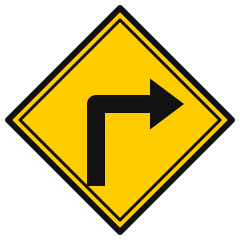
What does this sign warn you of?
- A sharp right turn ahead
- A side road on the right
- A right lane that ends
- A gentle curve to the right
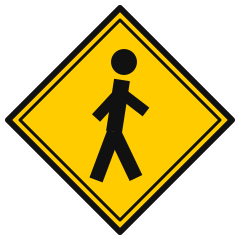
What does this sign warn you of?
- A school bus stop ahead
- Pedestrian activity ahead
- A playground on the left
- A hiking trail entrance
Why does the manual say to use extra caution on a road marked with a winding road sign?
- Trucks are not allowed
- Passing is restricted
- The speed limit is higher
- The surface is always gravel
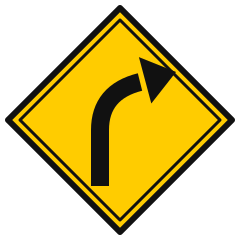
What does this sign mean?
- A sharp right turn at a corner
- A merge from the right
- Keep right of an island
- A curve to the right ahead
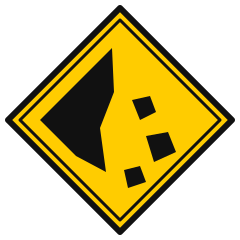
What hazard does this sign warn of?
- Rocks or landslides may block the road
- A quarry entrance ahead
- A steep drop-off along the edge of the road
- A rough gravel surface ahead
You are on a divided highway and see this sign. What should you expect?
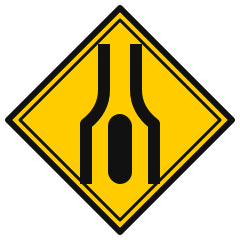
- A wider median ahead
- Oncoming traffic with no median between you
- A one-way road ahead
- An exit lane leaving on the right side ahead
What does this sign warn you of?
- A sharp curve ahead
- A truck entrance ahead
- A runaway lane ahead
- A steep hill ahead
An underpass warning sign shows a measurement. What does it tell you?
- The distance to the underpass
- How much height clearance there is
- The speed limit under the bridge
- How long the underpass is
What does this sign warn you of?
- A steep hill ahead
- Two-way traffic ahead
- A divided highway is starting ahead
- A narrow structure such as a bridge
What does a dead end warning sign tell you?
- The road ends at a gravel road
- The road ends; you must exit right or left
- The road is closed ahead for summer repairs
- Parking is not allowed ahead
What does this sign warn you of?
- A one-way road ahead
- A red light camera ahead
- A school crossing ahead
- A stop sign ahead
What do markers like this warn you of?
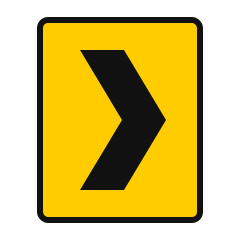
- A lane that is closed ahead
- The edge of a one-way street
- A change in road direction on a curve or turn
- A safe place to pull over and stop on the shoulder
What does this sign warn you about?
- A winding road ahead
- A car wash entrance ahead
- Loose gravel on the shoulder
- The road is slippery when wet
A warning sign shows a hidden intersection ahead. What should you watch for?
- Pedestrians on the shoulder
- Vehicles approaching from both directions
- Only vehicles coming from the right
- Trucks entering from a quarry
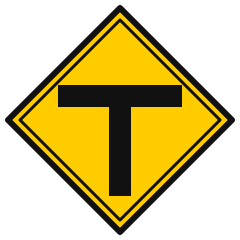
What does this sign warn you of?
- A railway crossing ahead
- The road ends at a T-intersection
- A sharp turn to the right
- A side road joins from the left
This sign with a speed tab is posted before a curve. What does the number on the tab tell you?

- The maximum comfortable speed for the curve
- The speed that trucks must keep to
- The minimum speed for the curve
- The new speed limit for the highway
A warning sign says the pavement ends ahead. What should you expect?
- The road continues with a gravel surface
- A toll booth is ahead
- A bridge deck is ahead
- The road ends at a barrier with no way through
What does this sign warn you about?
- A detour around road work
- A slippery road when wet
- A road that narrows to one lane
- A winding road ahead
You are in the right lane and see this sign. What is about to happen?

- A new lane opens on your right
- A side road joins the highway from the right ahead
- Your lane ends and the road narrows to one lane
- The road curves sharply to the left
What does this sign mean?
- Fallen rock on the road
- The pavement ends ahead
- A steep hill ahead
- A bump or rough road ahead
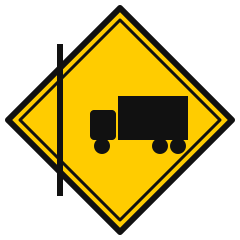
What does this sign warn you of?
- A truck route begins here
- A weigh scale is ahead
- Trucks may enter the road ahead
- Trucks are not allowed on this road
What does this sign tell you?
- Two lanes merge into one
- A divided highway ends
- Keep right of the island
- A divided highway begins
On this railway advance warning sign, the track is drawn on a slant. What does the slant show?
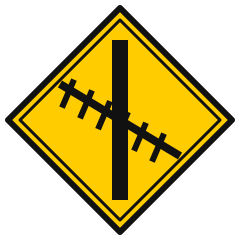
- How many tracks there are
- Which direction the next train will be travelling
- Where you must stop for a train
- The angle at which the tracks cross the road
What is ahead when you see this sign?

- Traffic lights
- A construction zone
- A police check stop
- A railway crossing
A sign warns of soft shoulders. What is the hazard?
- The road surface is newly paved
- The road has no shoulders at all
- The shoulder is used as a bike lane in summer
- The road edges are soft and may be dangerous
What does this sign tell you?
- Animals are kept behind a fence
- Hunting is allowed in this area during the season
- Deer often cross this part of the highway
- A wildlife park is nearby
What should you generally do when you see a yellow warning sign?
- Slow down and proceed with caution
- Sound your horn as you pass
- Stop and wait for a signal
- Keep your speed and move left
What does this sign warn you of?
- Two lanes merge ahead
- A divided highway begins
- A side road joins from the right
- The road ends ahead
You see this sign. What is ahead?
- A bridge with one lane
- The pavement becomes narrower
- A lane for turning traffic
- The pavement ends and gravel begins
Warning signs: key rules to remember
Our summary of what the official handbook says on this topic, in our own words. Read it before or after the practice questions above, then check the original chapter. Read the official chapter ↗
Warning signs (general)
- Warning signs alert you to possible hazards on or near the road that you cannot see yet.
- Response: slow down and proceed with caution.
- Yellow = general warning, danger (colour code, p. 18).
Examples of warning signs
- Sharp right turn ahead.
- Sharp right curve with a speed tab: the tab gives the maximum comfortable speed for the curve (example in the manual: 40 km/h).
- Right curve ahead; reverse curve ahead.
- Winding road ahead: use extra caution, passing is restricted.
- Two lanes merge ahead.
- Narrow structure ahead (for example a bridge).
- Pavement narrows ahead.
- Divided highway begins; divided highway ends.
- Hidden intersection ahead: watch for vehicles coming from both directions.
- T-intersection: use caution.
- Stop sign ahead. Traffic lights ahead.
- Bump or rough road ahead.
Examples of warning signs (continued)
- Steep hill ahead.
- Dead end: exit to the right or left.
- Road slippery when wet: caution.
- Playground or playground crosswalk ahead. Pedestrian activity ahead.
- Chevrons: warn of changes in road alignment on curves or sharp turns.
- Railway crossing advance warning: the position of the track drawn on the sign shows the angle at which the tracks cross the road.
- Deer regularly cross this section of highway.
- Road narrows to one lane: right lane ends.
- Underpass ahead: shows the overhead clearance.
- Pavement ends: road continues with a gravel surface.
- Fallen rock or landslides may block the road.
- Two-way traffic ahead. Truck entrance.
- Soft shoulders: road shoulders right beside the travelled lanes are soft and may be dangerous.
Hazard markers
- Mark obstacles on the roadway or shoulder.
- Different markers tell you to pass on either side, pass on the right, or pass on the left of the obstacle.
Other topics
- Regulatory signsSign shapes and the Nunavut colour code, stop and yield, speed signs, no U-turn, do not enter, one-way and two-way, keep right, passing signs, turn-control and overhead lane signs, and parking signs.
- School, construction and service signsThe pedestrian-school advance sign and its speed tab, school and pedestrian crosswalk signs, construction and maintenance signs, the slow moving vehicle sign, and service and information signs.
- Traffic lights and signalsLight colours and order, the fourth red light, red, amber and green lights, right turn on red, flashing red, amber and green, green arrows, lane use signals, pedestrian signals and police or flagman directions.
- Pavement markingsYellow and white lines, broken and solid lines, solid-and-broken pairs, double solid lines, stop lines and crosswalks, cross-hatching and directional arrows.
- Licence classes and the driver examinationNunavut's seven licence classes, what a Class 7 learner may drive, minimum ages, the two-part written test, vision and road tests, test refusals and licence conditions.
- Your licence, registration and insuranceLicence renewal and expiry, new residents, lost licences, name and address changes, licence offences, vehicle registration, the $200,000 insurance minimum, plate-to-owner plates and transfers.
- Your vehicle, equipment and seat beltsPre-drive checks, seating and steering position, warning lights, attitude and distraction, required equipment and light distances, mirrors, equipment inspection, seat belts and winter preparation.
- Right-of-way, emergency vehicles and railway crossingsUncontrolled intersections, entering from driveways and lanes, left turns, emergency vehicles and the 150 m fire engine rule, funeral processions, traffic circles and railway crossing stopping distances.
- Pedestrians, school buses and cyclistsCrosswalks, school and playground zones, pedestrian and driver responsibilities, blind pedestrians, stopping for school buses, and sharing the road with cyclists.
- Signalling, turning and turnaboutsWhen and how far ahead to signal, hand signals, right and left turns, turns between one-way and two-way streets, U-turns, two-point and three-point turns, prohibited turnabouts and approaching intersections.
- Highways, following distance and passingFreeway and controlled access highway driving, the two-second rule and following distances, avoiding rear-end collisions, passing in towns and on highways, meeting other vehicles and changing lanes.
- Stopping distances, parking and speed limitsReaction and braking distance, where you may not stop or park, parallel, angle and hill parking, opening doors, Nunavut's 90, 80 and 50 km/h limits, safe speed and the slow driver.
- Gravel roads, dust and winter drivingDust clouds and the 60 km/h meeting rule, flying stones, loose gravel and washboard, winter equipment, carbon monoxide, blizzards, icy roads, black ice and starting on ice.
- Fog, night driving, fatigue, curves and hillsFog, headlight reach and dimming distances, glare, night speed, drowsiness, curves and hills, coasting, hydroplaning, the first rain, and snowplows with flashing blue lights.
- Driving emergencies and accidentsRunning off the pavement, blowouts, skids, wet brakes, disabled vehicles, head-on threats, fires, sinking vehicles, stuck accelerators, and your legal duties after an accident including the $1,000 reporting rule.
- Alcohol, drugs and drivingHow alcohol affects driving, the 0.08 limit and impairment at any level, the blood-alcohol chart, prescription and over-the-counter drugs, illicit drugs and sobering-up myths.
- Motorcycles, trailers and larger vehiclesMotorcycle equipment and learner rules, sharing the road with motorcycles, towing a trailer, and rules for commercial vehicles such as clearance lights, load flags and trailer brakes.