You are parking downhill next to a curb. Which way should you turn your front wheels?
Nunavut Class 7 overview
Nunavut Class 7 Practice Test 5
30 questions on stopping distances, parking and speed limits, your vehicle, equipment and seat belts, motorcycles, trailers and larger vehicles, warning signs, pedestrians, school buses and cyclists and more.
- No sign-up
- Every answer explained
- Independent · not a government site
- Set 5 of 13
- 30 questions
- Instant feedback
0/30
All 30 questions in this test
Every question and its answer choices. The correct answers and explanations appear when you take the test above.
You are parking downhill next to a curb. Which way should you turn your front wheels?
- It does not matter
- Straight ahead
- Toward the curb
- Away from the curb
How far ahead must your headlights clearly light up objects in normal conditions?
- At least 60 m
- At least 30 m
- At least 300 m
- At least 110 m
Which licence class do you need to ride a moped?
- Class 6
- Class 5
- Class 4
- Class 7
A warning sign shows a hidden intersection ahead. What should you watch for?
- Pedestrians on the shoulder
- Vehicles approaching from both directions
- Only vehicles coming from the right
- Trucks entering from a quarry
Why should you give a young cyclist extra room when a truck passes?
- Cyclists cannot hear trucks
- Large trucks have the right-of-way over bicycles
- The truck's wind can knock them off balance
- Cyclists must stop for trucks
What do white lane lines separate?
- Traffic moving in the same direction
- Truck lanes from car lanes
- Traffic moving in opposite directions
- The road from the shoulder only
What does this sign mean?
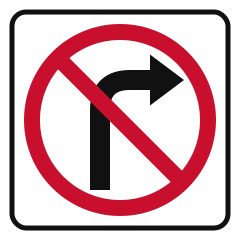
- Right turns are not permitted
- Right turns allowed on red only
- Right lane ends ahead
- Keep right of the island ahead
A railway crossing signal is flashing on a road outside a municipality. How far from the nearest rail must you stop?
- Not less than 5 m
- Not less than 30 m
- Not less than 1 m
- Not less than 15 m
You drive a manual transmission car over railway tracks. What must you avoid?
- Crossing at a slow, steady speed
- Shifting gears on the crossing
- Crossing in a low gear
- Looking both ways first
Which of these affects how far your car travels once the brakes are applied?
- The age of the driver's licence
- The colour of your car
- The time of day you drive
- The condition of your tires
You have a blowout at highway speed. What should you do first?
- Brake hard immediately
- Steer onto the shoulder at once and brake hard
- Hold the wheel firmly and ease off the gas
- Shift into reverse
Traffic on the freeway is slow on the left. May you pass on the shoulder?
- Yes, at low speed
- Yes, if you signal
- Only in an emergency lane
- No, never pass on the shoulder
How is alcohol removed from your body?
- Mainly by the liver, which takes time
- By eating a large meal
- By exercising for a few minutes
- By drinking lots of water quickly
You see a vehicle coming toward you on a dusty gravel road. When should you have your headlights on?
- Only if the other driver flashes theirs
- Only after sunset
- Well before you meet it
- Only once you are in the dust
The fog becomes so thick that you can barely see. What does the manual say to do?
- Creep along at 10 to 15 km/h
- Follow the tail lights ahead closely
- Switch to high beams and continue
- Pull carefully off the pavement and wait
In normal sunlight, from how far away must your brake lights be visible?
- At least 150 m
- At least 30 m
- At least 110 m
- At least 10 m
When is a learner not allowed to ride a motorcycle?
- Before 10 a.m. or in any zone over 50 km/h
- On weekends or on holidays
- After sunset or in 70 km/h or higher zones
- In any zone over 30 km/h
What does this sign mean?
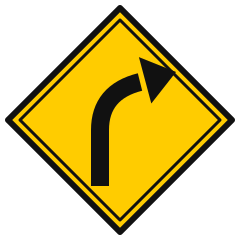
- A sharp right turn at a corner
- A merge from the right
- Keep right of an island
- A curve to the right ahead
Your licence expired eight months ago. Can you still renew it without being re-examined?
- No, you must reapply as a new driver
- Yes, it has expired less than a year
- No, you must retake all tests
- Only with a doctor's note
How should you use the brakes during a skid?
- Don't use them at all, ever
- Pump them, with no hard braking
- Press and hold them hard
- Use the parking brake
You come up behind a snowplow working on the highway. What should you do?
- Give it the right-of-way and pass only with caution
- Honk so the driver pulls over
- Pass it quickly to get ahead
- Follow it closely so you can drive in its cleared path
Your light has just turned green. What should you do before going?
- Go right away to keep traffic moving
- Check left, right and ahead for late runners
- Wait for the car beside you to go
- Sound your horn to warn others
Which licence must you already hold before you can be tested for a Class 5 licence?
- A school bus endorsement
- No licence is needed
- A Class 4 licence
- A valid learner's licence
How does the manual describe alcohol's effect on the body?
- It has no effect at low levels
- It is a depressant that slows reflexes
- It is a stimulant that sharpens you
- It improves night vision
How do you book a driver's examination in Nunavut?
- Online only, through the territorial website
- In person at a driver examination office
- No booking; tests are walk-in
- By mail with a cheque
A flashing amber light stands by itself, away from any other signal. Which of these might it be warning you about?
- A toll booth ahead
- A police check stop on the road ahead
- A free parking area ahead
- A railway or school crossing ahead
Which lane use signals allow you to drive in the lane below them?
- A red arrow or a green circle
- A red X or an amber arrow
- A green arrow or a green X
- Only a flashing amber X
A pedestrian-school advance sign has a tab under it reading "km/h During School Days" with a number. What does that mean?
- It applies only to school buses
- It applies only when children are visible
- It is a suggested speed only
- You must keep to that speed on school days
A blizzard is coming but you absolutely must travel. What does the manual advise?
- Tell no one, to avoid worry
- Drive faster to beat the storm
- Start with a full tank and a call-back plan
- Leave with half a tank to save weight
You see this sign at the entrance to a street. What does it mean?

- Parking is not allowed on this street
- The street is closed to trucks only
- Stop, then enter when clear
- You must not enter this street
All Nunavut Class 7 practice tests
- Nunavut Class 7 Mock Exam 1 – 30 QuestionsUntimed practice · answers explained
- Nunavut Class 7 Mock Exam 2 – 30 QuestionsUntimed practice · answers explained
- Nunavut Class 7 Mock Exam 3 – 30 QuestionsUntimed practice · answers explained
- Nunavut Class 7 Mock Exam 4 – 30 QuestionsUntimed practice · answers explained
- Nunavut Class 7 Mock Exam 5 – 30 QuestionsUntimed practice · answers explained
- Regulatory signsSign shapes and the Nunavut colour code, stop and yield, speed signs, no U-turn, do not enter, one-way and two-way, keep right, passing signs, turn-control and overhead lane signs, and parking signs.
- Warning signsYellow warning signs for curves, merges, narrow roads, divided highways, intersections, signals, hills, slippery roads, railway crossings, deer, lane endings, fallen rock, soft shoulders, and hazard markers.
- School, construction and service signsThe pedestrian-school advance sign and its speed tab, school and pedestrian crosswalk signs, construction and maintenance signs, the slow moving vehicle sign, and service and information signs.
- Traffic lights and signalsLight colours and order, the fourth red light, red, amber and green lights, right turn on red, flashing red, amber and green, green arrows, lane use signals, pedestrian signals and police or flagman directions.
- Pavement markingsYellow and white lines, broken and solid lines, solid-and-broken pairs, double solid lines, stop lines and crosswalks, cross-hatching and directional arrows.
About this practice test
How many questions are in Nunavut Class 7 practice test 5?
30 original multiple-choice practice questions covering stopping distances, parking and speed limits, your vehicle, equipment and seat belts, motorcycles, trailers and larger vehicles, warning signs, pedestrians, school buses and cyclists, pavement markings, regulatory signs, right-of-way, emergency vehicles and railway crossings, driving emergencies and accidents, highways, following distance and passing, alcohol, drugs and driving, gravel roads, dust and winter driving, fog, night driving, fatigue, curves and hills, your licence, registration and insurance, signalling, turning and turnabouts, licence classes and the driver examination, traffic lights and signals, school, construction and service signs. Each answer includes an explanation. This mixed practice set does not reproduce the official exam format or predict an official score.
Are the questions the same every time?
Yes. Practice test 5 always has the same 30 questions, so you can repeat it until you get them all right. The other 12 sets use different questions.
Are these real test questions?
No. The official question bank is not published. These are original questions written from the official handbook, which is what the real Nunavut Class 7 test is based on.