Your car has broken down and you can't move it off the road. How can you warn other drivers?
Nunavut Class 7 overview
Nunavut Class 7 Practice Test 4
30 questions on driving emergencies and accidents, highways, following distance and passing, warning signs, regulatory signs, school, construction and service signs and more.
- No sign-up
- Every answer explained
- Independent · not a government site
- Set 4 of 13
- 30 questions
- Instant feedback
0/30
All 30 questions in this test
Every question and its answer choices. The correct answers and explanations appear when you take the test above.
Your car has broken down and you can't move it off the road. How can you warn other drivers?
- Leave your high beams on, aimed at oncoming traffic
- Stand in the lane and wave
- Leave the doors open
- Raise the hood or tie a cloth to the door handle
You are entering a freeway from an on-ramp. Where should you build up your speed?
- In the acceleration lane
- On the shoulder
- After merging into traffic
- In the right freeway lane
What does this yellow sign mean?

- One-way street begins
- Two-way traffic is ahead
- Divided highway ends here
- Passing lane ahead
You are approaching a yield sign and a pedestrian is crossing the intersection ahead. Who goes first?
- You, if you sound your horn
- The pedestrian
- Whoever reaches the crosswalk first
- You, because you are already moving
What does this sign on the back of a vehicle tell you?

- The vehicle travels much slower than traffic
- The vehicle is towing a trailer
- The vehicle is carrying dangerous goods or fuel
- The vehicle is a school bus
Traffic on the road is moving fast and you need to turn soon. When should you move into the turning lane?
- Sooner than you would in slow traffic
- Only once you reach the corner
- Once you have slowed to a stop
- At the last moment
An oncoming car's bright headlights are blinding you. Where should you look?
- At the centre line
- Straight into the headlights
- Toward the right edge of the road
- At your speedometer
You meet an oncoming vehicle on a road with room for only one lane each way. What should you do?
- Flash your lights and keep going
- Give it as close to half the road as possible
- Drive in the centre of the road until it passes
- Stop and wait every time
A person with a white cane at the curb raises the cane toward the street. What does this mean for you?
- Sound your horn to warn them
- Drive past slowly and carefully
- Wave them across and keep moving
- Stop and give them the right-of-way
Who must wear a helmet on a motorcycle in Nunavut?
- Only on highways
- Only the driver
- Only riders under 18
- All riders
A person drives a borrowed car without a licence. Who can be held liable?
- Only the vehicle owner's insurance company
- Only the driver
- Both the driver and the vehicle owner
- Only the vehicle owner
The light changes to amber just as your vehicle enters the intersection. What should you do?
- Stop in the middle of the intersection
- Speed up as much as possible
- Continue through with extreme caution
- Back up behind the stop line
Inside a municipality, a crossing gate is down. How far from the nearest rail must you stop?
- Not less than 50 m
- Not less than 3 m
- Not less than 15 m
- Not less than 5 m
An underpass warning sign shows a measurement. What does it tell you?
- The distance to the underpass
- How much height clearance there is
- The speed limit under the bridge
- How long the underpass is
When you park at a curb, how close must your right wheels be to it?
- Touching the curb
- Within 30 cm
- Within 60 cm
- Within 1 m
You need glasses to meet the vision standard. What does that mean for your driving?
- You must wear them whenever you drive
- Wear them only at night
- Wear them only for the vision test itself
- Wear them only on highways
Why are yellow and black markings painted on fixed objects such as concrete islands?
- To show a snow route
- To show where parking is allowed
- To give advance warning of the hazard
- To mark the start of a school zone
Signs of this colour are used for what purpose?
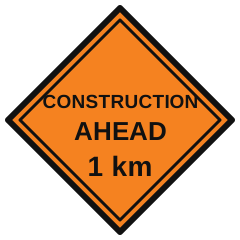
- School zones
- Services available in a community
- Road construction and maintenance
- Off-road facilities
In a car with an automatic transmission, how can you check that your seat is close enough?
- Reach the radio without leaning
- Press the gas pedal to the floor
- Rest your right foot flat on the floor under the brake
- Touch the windshield with your hand while sitting upright
What happens at a road test if your vehicle's signal lights don't work properly?
- The road test is refused
- The examiner fixes them first
- You use hand signals during the test
- You lose a few marks only
Inside a multi-lane traffic circle, which vehicle must yield?
- The vehicle in the outer lane never yields
- The vehicle on the right yields to the vehicle on the left
- The slower vehicle yields
- The vehicle on the left yields to the vehicle on the right
At a red light, a white stop line is painted before the crosswalk. Where do you stop?
- Before the stop line
- On top of the stop line
- At the edge of the crosswalk
- Just inside the intersection
Your car is facing up a slope, stopped beside a curb. How should the front wheels be set before you leave it?
- Left, away from the curb
- Halfway toward the curb
- Straight ahead
- Right, toward the curb
You are driving near a playground and see a child near the road. How fast should you go?
- The posted limit, since driving at it is legal
- Any speed if the child sees you
- A reasonable and prudent speed, ready to stop
- Fast enough to pass quickly
A police officer inspects your vehicle and finds defective equipment. What may the officer do?
- Take away your driver's licence for one full year
- Order the vehicle off the road until it is safe
- Only give you a verbal warning
- Make you pay for a new vehicle
At night, what must mark the end of a load that extends more than 1.5 m beyond the rear of a vehicle?
- A red flag only
- An amber reflector
- A red light
- A white light
What kind of weight does the manual recommend for winter traction?
- Frozen sand
- Cement blocks
- Bags of salt or dry sand
- Iron bars or cut firewood
On what date does your Nunavut driver's licence expire?
- On your birthday
- On January 1
- On the date you first passed
- On June 30
On a vertical traffic signal with four lights, where is the extra light?
- Beside the green light
- At the very top
- At the very bottom
- Between red and amber
Which abilities does alcohol affect first?
- Muscle strength
- Hearing and sense of smell
- Judgment and self-control
- Eyesight in daylight
All Nunavut Class 7 practice tests
- Nunavut Class 7 Mock Exam 1 – 30 QuestionsUntimed practice · answers explained
- Nunavut Class 7 Mock Exam 2 – 30 QuestionsUntimed practice · answers explained
- Nunavut Class 7 Mock Exam 3 – 30 QuestionsUntimed practice · answers explained
- Nunavut Class 7 Mock Exam 4 – 30 QuestionsUntimed practice · answers explained
- Nunavut Class 7 Mock Exam 5 – 30 QuestionsUntimed practice · answers explained
- Regulatory signsSign shapes and the Nunavut colour code, stop and yield, speed signs, no U-turn, do not enter, one-way and two-way, keep right, passing signs, turn-control and overhead lane signs, and parking signs.
- Warning signsYellow warning signs for curves, merges, narrow roads, divided highways, intersections, signals, hills, slippery roads, railway crossings, deer, lane endings, fallen rock, soft shoulders, and hazard markers.
- School, construction and service signsThe pedestrian-school advance sign and its speed tab, school and pedestrian crosswalk signs, construction and maintenance signs, the slow moving vehicle sign, and service and information signs.
- Traffic lights and signalsLight colours and order, the fourth red light, red, amber and green lights, right turn on red, flashing red, amber and green, green arrows, lane use signals, pedestrian signals and police or flagman directions.
- Pavement markingsYellow and white lines, broken and solid lines, solid-and-broken pairs, double solid lines, stop lines and crosswalks, cross-hatching and directional arrows.
About this practice test
How many questions are in Nunavut Class 7 practice test 4?
30 original multiple-choice practice questions covering driving emergencies and accidents, highways, following distance and passing, warning signs, regulatory signs, school, construction and service signs, signalling, turning and turnabouts, fog, night driving, fatigue, curves and hills, pedestrians, school buses and cyclists, motorcycles, trailers and larger vehicles, your licence, registration and insurance, traffic lights and signals, right-of-way, emergency vehicles and railway crossings, stopping distances, parking and speed limits, licence classes and the driver examination, pavement markings, your vehicle, equipment and seat belts, gravel roads, dust and winter driving, alcohol, drugs and driving. Each answer includes an explanation. This mixed practice set does not reproduce the official exam format or predict an official score.
Are the questions the same every time?
Yes. Practice test 4 always has the same 30 questions, so you can repeat it until you get them all right. The other 12 sets use different questions.
Are these real test questions?
No. The official question bank is not published. These are original questions written from the official handbook, which is what the real Nunavut Class 7 test is based on.