You are driving in town and plan to turn at the next corner. About how far ahead should you signal?
Nunavut Class 7 overview
Nunavut Class 7 Practice Test 2
30 questions on signalling, turning and turnabouts, your vehicle, equipment and seat belts, licence classes and the driver examination, pavement markings, motorcycles, trailers and larger vehicles and more.
- No sign-up
- Every answer explained
- Independent · not a government site
- Set 2 of 13
- 30 questions
- Instant feedback
0/30
All 30 questions in this test
Every question and its answer choices. The correct answers and explanations appear when you take the test above.
You are driving in town and plan to turn at the next corner. About how far ahead should you signal?
- 100 m
- 30 m
- 5 m
- 300 m
Where does the manual say most accidents happen?
- Close to home
- On gravel roads only
- On long highway trips
- In parking lots
You cannot make your test appointment and you do not tell the office in advance. What may happen?
- Your learner's licence is cancelled
- You may lose the test fee
- You are banned from testing
- Nothing; you can rebook free
There is no stop line, and a pedestrian is about to step into the crosswalk ahead. Where should you stop?
- In the crosswalk
- At the far side of the intersection
- Before the crosswalk
- Only if the light is red
You hold a Class 7 licence and want to learn to ride a motorcycle. What condition applies?
- A Class 6 holder must accompany you and keep you in view
- You may ride alone during daylight
- You need a written permit from the local RCMP before riding
- A Class 5 holder must ride as your passenger
On a controlled access highway, what may you do on the median?
- Nothing; never drive on it
- Pass slow vehicles on it
- Use it to turn around
- Stop there to rest
What does this sign require you to do?

- Give way only to large trucks
- Speed up to merge ahead of traffic
- Give way to cross traffic and pedestrians
- Stop fully every time, then go
You are pulling out from a parked position. Who has the right-of-way?
- You, once you signal
- Whoever is moving slower
- You, if you were there first
- Traffic already on the road
A rear tire blows out. What will you most likely feel?
- The car pulls hard to one side
- The rear end sways or fishtails
- The brakes stop working
- The steering wheel locks
A vehicle is coming toward you at night and you have your high beams on. When should you dim them?
- Only if the other driver dims first
- Within 300 m of the vehicle
- Within 30 m of the vehicle
- Only when the vehicle has passed
How should you load a trailer?
- With the heaviest weight at the hitch
- With the heaviest weight at the back
- With the heaviest weight over the axles
- Spread evenly toward the rear
Your car starts to hydroplane on a wet road. What should you do?
- Steer sharply to the shoulder
- Brake hard right away
- Take your foot off the accelerator
- Speed up to push through
How can you keep dust out of your car on a gravel road?
- Turn off the fan, close all the vents and open a window
- Close windows, run the heater fan and open front vents
- Use the air recirculation only
- Open all windows to clear the air
What hazard does this sign warn of?
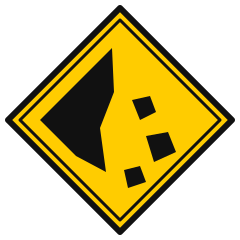
- Rocks or landslides may block the road
- A quarry entrance ahead
- A steep drop-off along the edge of the road
- A rough gravel surface ahead
A service sign shows an aeroplane. What does it point to?
- An air ambulance base
- A flight school
- The airport
- A weather station
A pedestrian is in the crosswalk ahead of you. What must you do?
- Stop and yield to the pedestrian
- Steer around the pedestrian
- Slow down and sound your horn
- Continue if they are not in your lane
You have just moved to Nunavut with a car registered in Manitoba. How long do you have to switch it to Nunavut registration?
- 90 days
- Until the old registration expires
- 30 days
- 14 days
A speed sign warns of a change in the speed limit ahead. What is it telling you?
- Speed is checked by radar ahead
- The speed limit ends here
- You may now drive faster
- A lower speed zone is coming up
In one study, how did the crash rate of amphetamine users compare with non-users?
- It was ten times higher
- It was the same
- It was half as high
- It was twice as high
You are driving through deep snow. How should you handle the vehicle?
- Keep the wheels straight and keep momentum
- Spin the wheels to dig through
- Turn sharply left and right to find firmer snow
- Stop often to check the tires
You are towing a trailer that blocks the view through your inside mirror. What mirrors must your vehicle have?
- Outside mirrors on both the left and right
- A mirror on the left side only, extended out
- A larger inside mirror
- No extra mirrors are needed
Your accelerator pedal sticks while you are driving. What should you do?
- Pump the gas pedal hard
- Turn the engine off at speed
- Shift to neutral and stop when safe
- Steer onto the shoulder at speed
You are taking an allergy or cold medicine with an antihistamine. What does the manual advise?
- It is safe at any dose
- Don't use it when you will be driving
- Drive only short distances
- Take it with coffee to stay alert
At a red light there is no stop line and no crosswalk. Where must you stop?
- Halfway into the intersection
- Beside the traffic light
- Five metres past the corner
- Before you enter the intersection
May you park your vehicle on a bridge?
- Only on a two-lane bridge
- Yes, if your hazard lights are on
- Yes, for up to 10 minutes
- No, it is not permitted
When do emergency vehicles have the right-of-way over other traffic?
- Only on highways outside of towns
- Only between sunset and sunrise
- While using flashing red lights and a siren
- At all times, even when they are parked
What does this sign warn you of?

- Two lanes merge ahead
- A divided highway begins
- A side road joins from the right
- The road ends ahead
You are about to enter a traffic circle. Who has the right-of-way?
- Traffic waiting to enter on your right
- Traffic already in the circle
- Whichever vehicle is larger
- You, because you are entering
What are the two parts of the basic written knowledge test?
- Vehicle repair and first aid
- Highway routes and city maps
- Rules of the road and sign identification
- Parallel parking and backing up procedures
You are approaching a green light that has been green for some time. What should you be ready for?
- It will stay green for a minute
- Pedestrians must wait for you
- Cross traffic will get a flashing green
- It may turn amber before you get there
All Nunavut Class 7 practice tests
- Nunavut Class 7 Mock Exam 1 – 30 QuestionsUntimed practice · answers explained
- Nunavut Class 7 Mock Exam 2 – 30 QuestionsUntimed practice · answers explained
- Nunavut Class 7 Mock Exam 3 – 30 QuestionsUntimed practice · answers explained
- Nunavut Class 7 Mock Exam 4 – 30 QuestionsUntimed practice · answers explained
- Nunavut Class 7 Mock Exam 5 – 30 QuestionsUntimed practice · answers explained
- Regulatory signsSign shapes and the Nunavut colour code, stop and yield, speed signs, no U-turn, do not enter, one-way and two-way, keep right, passing signs, turn-control and overhead lane signs, and parking signs.
- Warning signsYellow warning signs for curves, merges, narrow roads, divided highways, intersections, signals, hills, slippery roads, railway crossings, deer, lane endings, fallen rock, soft shoulders, and hazard markers.
- School, construction and service signsThe pedestrian-school advance sign and its speed tab, school and pedestrian crosswalk signs, construction and maintenance signs, the slow moving vehicle sign, and service and information signs.
- Traffic lights and signalsLight colours and order, the fourth red light, red, amber and green lights, right turn on red, flashing red, amber and green, green arrows, lane use signals, pedestrian signals and police or flagman directions.
- Pavement markingsYellow and white lines, broken and solid lines, solid-and-broken pairs, double solid lines, stop lines and crosswalks, cross-hatching and directional arrows.
About this practice test
How many questions are in Nunavut Class 7 practice test 2?
30 original multiple-choice practice questions covering signalling, turning and turnabouts, your vehicle, equipment and seat belts, licence classes and the driver examination, pavement markings, motorcycles, trailers and larger vehicles, highways, following distance and passing, regulatory signs, stopping distances, parking and speed limits, driving emergencies and accidents, fog, night driving, fatigue, curves and hills, gravel roads, dust and winter driving, warning signs, school, construction and service signs, pedestrians, school buses and cyclists, your licence, registration and insurance, alcohol, drugs and driving, traffic lights and signals, right-of-way, emergency vehicles and railway crossings. Each answer includes an explanation. This mixed practice set does not reproduce the official exam format or predict an official score.
Are the questions the same every time?
Yes. Practice test 2 always has the same 30 questions, so you can repeat it until you get them all right. The other 12 sets use different questions.
Are these real test questions?
No. The official question bank is not published. These are original questions written from the official handbook, which is what the real Nunavut Class 7 test is based on.