An overhead sign above your lane shows a straight arrow with a branch to the left. What may you do from this lane?
Nunavut Class 7 overview
Nunavut Class 7: Regulatory signs
Sign shapes and the Nunavut colour code, stop and yield, speed signs, no U-turn, do not enter, one-way and two-way, keep right, passing signs, turn-control and overhead lane signs, and parking signs.
- No sign-up
- Every answer explained
- Independent · not a government site
- 26 questions
- Topic drill
0/26
Study reference: Nunavut Driver's Manual (2022 posting), Ch. 5 Rules of the Road — Sign shapes, Standard sign colours, Regulatory signs, Overhead designation signs, pp. 18–21
All 26 questions in this test
Every question and its answer choices. The correct answers and explanations appear when you take the test above.
An overhead sign above your lane shows a straight arrow with a branch to the left. What may you do from this lane?
- Go straight only
- Turn left only
- Go straight or turn left
- Turn right or go straight
In the Nunavut sign colour code, what does red mean?
- Stop or prohibition
- Directional guidance
- General warning
- Construction ahead
What does this sign tell you about the street?

- Traffic may move in one direction only
- The road is a dead end
- Turn right at the next intersection
- Two-way traffic is ahead
These signs hang over three lanes approaching an intersection. What must a driver in the right-hand lane do?
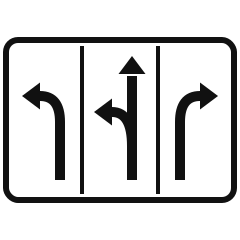
- Make any movement
- Go straight or turn right
- Turn right
- Turn left
A speed sign warns of a change in the speed limit ahead. What is it telling you?
- Speed is checked by radar ahead
- The speed limit ends here
- You may now drive faster
- A lower speed zone is coming up
What is the result of disobeying a regulatory sign?
- Your vehicle is inspected
- You receive a warning only
- Nothing, they are advice only
- You commit an offence
You see this sign at the entrance to a street. What does it mean?

- Parking is not allowed on this street
- The street is closed to trucks only
- Stop, then enter when clear
- You must not enter this street
What does brown on a road sign indicate?
- Off-road facilities
- A general warning
- A school zone
- A regulation you must obey
What does an orange sign tell you?
- Construction or maintenance is ahead
- An off-road facility is near this road
- A service is nearby
- A school zone is ahead
What does this sign require you to do?

- Give way only to large trucks
- Speed up to merge ahead of traffic
- Give way to cross traffic and pedestrians
- Stop fully every time, then go
You are approaching a yield sign and a pedestrian is crossing the intersection ahead. Who goes first?
- You, if you sound your horn
- The pedestrian
- Whoever reaches the crosswalk first
- You, because you are already moving
Some signs in the manual are not used anywhere in Nunavut. Why must you still learn them?
- They appear on the road test only
- Your licence may be valid in other places
- They will be installed next year
- They apply to off-road vehicles
Some roads post a separate maximum speed for night-time. When does that number apply?
- Only during the winter months
- At night, in any weather
- At night, when conditions are ideal
- Only to commercial trucks
You drive past this sign. What has changed?
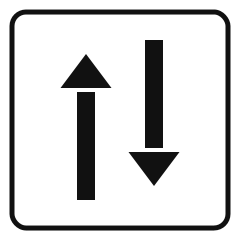
- You are no longer on a one-way road
- Passing is now allowed in both lanes
- You are entering a one-way road
- A divided highway begins here
You want to turn left at an intersection where this sign is posted. What should you do?
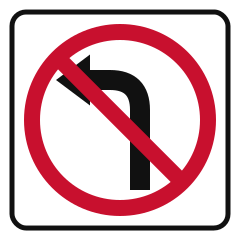
- Turn left after a full stop
- Do not turn left here
- Turn left only on a green arrow
- Turn left if there are no pedestrians
You are in a lane at an intersection where this sign applies. What must you do?
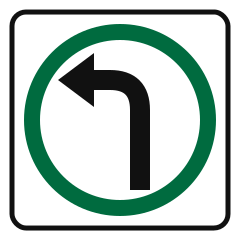
- Go straight or turn left
- Turn left only after stopping
- Turn left
- Make any turn you choose
What does this sign mean?

- Sharp curve ahead, slow down
- Two-way traffic resumes ahead
- You may not turn around to go the other way
- You may make a U-turn only when clear
Where are overhead lane designation signs placed?
- On the right shoulder, before the lane
- Above the road, centred over each lane
- Painted on the pavement in each lane
- On the traffic light pole only
According to the Nunavut manual, what is the colour blue used for on signs?
- Off-road facilities
- Construction warnings
- Directional guidance and route numbers
- School signs and service information
What does this sign mean?

- Two lanes merge ahead
- Passing is permitted when clear
- Passing is not permitted
- Keep to the right lane only
What does this sign tell you?

- The lowest speed you may drive
- The highest speed allowed in ideal conditions
- A speed that is recommended only for heavy trucks
- A speed that applies only at night
Why does the manual say you should know signs by their shape?
- Because shapes change with the season
- So you can read them when the words are hidden
- Because colours are not used in Nunavut
- So you can tell how far away they are
What does this sign mean?
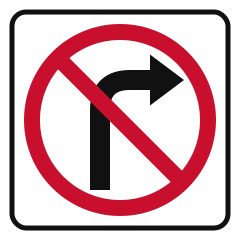
- Right turns are not permitted
- Right turns allowed on red only
- Right lane ends ahead
- Keep right of the island ahead
This sign is on a traffic island ahead of you. What must you do?

- Stop before reaching the island
- Pass to the left of the island
- Pass on either side of the island
- Pass to the right of the island
You come to this sign at an intersection. What must you do?

- Sound your horn and go through slowly
- Slow down and go if no one is coming
- Stop only if cross traffic is present
- Stop, and go only when it is absolutely safe
Which colour on a sign indicates a general warning or danger?
- Green
- Brown
- Yellow
- White
Regulatory signs: key rules to remember
Our summary of what the official handbook says on this topic, in our own words. Read it before or after the practice questions above, then check the original chapter. Read the official chapter ↗
Signs: sign shapes
- Sign shapes carry meaning, so you can still tell a sign's intent when darkness, fading light, fog, rain, snow or dust hides its lettering or symbol.
- The manual says traffic signs have six basic shapes (shown as pictures only; shapes are not named in the text).
- The manual includes signs you will not see in Nunavut; a licence not restricted to Nunavut lets you drive elsewhere, so you must know them.
Regulatory and warning signs
- Regulatory signs tell drivers about laws and regulations; disobeying one is an offence.
- They tell you where to stop or yield, about speed zones, parking rules and situations that need special care.
Standard sign colours (Nunavut colour code)
- Red: stop or prohibition.
- Green: movement permitted, directional guidance.
- White: regulation.
- Orange: construction and maintenance warning.
- Blue: school signs and service information.
- Yellow: general warning, danger.
- Brown: off-road facilities.
Regulatory signs
- Stop: come to a stop; do not go until it is absolutely safe.
- Yield: give the right-of-way to traffic not facing the sign and to all pedestrians in the intersection or crosswalk.
- Maximum speed sign: highest speed allowed under ideal conditions.
- Advance speed sign: warns that a lower maximum speed zone is ahead.
- Night speed sign: maximum speed at night under ideal conditions.
- No U-turn: you must not turn around on the roadway to go the opposite way.
- Do not enter: you must not enter the street.
- Two-way traffic: you are no longer on a one-way road; drive in the right-hand lane.
- Keep right: placed on traffic islands or obstructions; pass on the right.
- Truck route: trucks may use the road. No trucks: heavy trucks not allowed.
- Passing permitted sign: pass if the way is clear. No passing sign: passing not permitted.
Turn-control and one-way signs
- One-way signs: traffic allowed in one direction only.
- Signs for: no turns, turn right only, no right turn, no left turn, turn left only, turn right or left only.
- A sign shows where you may park. Another sign prohibits motorized snow vehicles on that road.
Overhead designation signs
- Mounted above the road on the approach to an intersection, each centred over the lane it controls.
- In a lane under one of these signs you may only make the movement shown.
- Example: lane 1 must turn left; lane 2 may turn left or go straight; lane 3 must turn right.
- Other lane signs: right or through; all movements; right or left; through only.
Other topics
- Warning signsYellow warning signs for curves, merges, narrow roads, divided highways, intersections, signals, hills, slippery roads, railway crossings, deer, lane endings, fallen rock, soft shoulders, and hazard markers.
- School, construction and service signsThe pedestrian-school advance sign and its speed tab, school and pedestrian crosswalk signs, construction and maintenance signs, the slow moving vehicle sign, and service and information signs.
- Traffic lights and signalsLight colours and order, the fourth red light, red, amber and green lights, right turn on red, flashing red, amber and green, green arrows, lane use signals, pedestrian signals and police or flagman directions.
- Pavement markingsYellow and white lines, broken and solid lines, solid-and-broken pairs, double solid lines, stop lines and crosswalks, cross-hatching and directional arrows.
- Licence classes and the driver examinationNunavut's seven licence classes, what a Class 7 learner may drive, minimum ages, the two-part written test, vision and road tests, test refusals and licence conditions.
- Your licence, registration and insuranceLicence renewal and expiry, new residents, lost licences, name and address changes, licence offences, vehicle registration, the $200,000 insurance minimum, plate-to-owner plates and transfers.
- Your vehicle, equipment and seat beltsPre-drive checks, seating and steering position, warning lights, attitude and distraction, required equipment and light distances, mirrors, equipment inspection, seat belts and winter preparation.
- Right-of-way, emergency vehicles and railway crossingsUncontrolled intersections, entering from driveways and lanes, left turns, emergency vehicles and the 150 m fire engine rule, funeral processions, traffic circles and railway crossing stopping distances.
- Pedestrians, school buses and cyclistsCrosswalks, school and playground zones, pedestrian and driver responsibilities, blind pedestrians, stopping for school buses, and sharing the road with cyclists.
- Signalling, turning and turnaboutsWhen and how far ahead to signal, hand signals, right and left turns, turns between one-way and two-way streets, U-turns, two-point and three-point turns, prohibited turnabouts and approaching intersections.
- Highways, following distance and passingFreeway and controlled access highway driving, the two-second rule and following distances, avoiding rear-end collisions, passing in towns and on highways, meeting other vehicles and changing lanes.
- Stopping distances, parking and speed limitsReaction and braking distance, where you may not stop or park, parallel, angle and hill parking, opening doors, Nunavut's 90, 80 and 50 km/h limits, safe speed and the slow driver.
- Gravel roads, dust and winter drivingDust clouds and the 60 km/h meeting rule, flying stones, loose gravel and washboard, winter equipment, carbon monoxide, blizzards, icy roads, black ice and starting on ice.
- Fog, night driving, fatigue, curves and hillsFog, headlight reach and dimming distances, glare, night speed, drowsiness, curves and hills, coasting, hydroplaning, the first rain, and snowplows with flashing blue lights.
- Driving emergencies and accidentsRunning off the pavement, blowouts, skids, wet brakes, disabled vehicles, head-on threats, fires, sinking vehicles, stuck accelerators, and your legal duties after an accident including the $1,000 reporting rule.
- Alcohol, drugs and drivingHow alcohol affects driving, the 0.08 limit and impairment at any level, the blood-alcohol chart, prescription and over-the-counter drugs, illicit drugs and sobering-up myths.
- Motorcycles, trailers and larger vehiclesMotorcycle equipment and learner rules, sharing the road with motorcycles, towing a trailer, and rules for commercial vehicles such as clearance lights, load flags and trailer brakes.