Above what maximum gross weight must a trailer have its own brakes?
Nunavut Class 7 overview
Nunavut Class 7 Mock Exam 2
Same format as the real test. Answers stay hidden until you submit. The official time limit is not published; the timer is a practice setting.
- No sign-up
- Every answer explained
- Independent · not a government site
- 30 questions
- untimed
- Pass mark 12/15 per section
0/30
All 30 questions in this test
Every question and its answer choices. The correct answers and explanations appear when you take the test above.
Above what maximum gross weight must a trailer have its own brakes?
- 680 kg
- 300 kg
- 1,500 kg
- 4,500 kg
You are approaching a green light that has been green for some time. What should you be ready for?
- It will stay green for a minute
- Pedestrians must wait for you
- Cross traffic will get a flashing green
- It may turn amber before you get there
A sign warns of soft shoulders. What is the hazard?
- The road surface is newly paved
- The road has no shoulders at all
- The shoulder is used as a bike lane in summer
- The road edges are soft and may be dangerous
A vehicle is coming toward you at night and you have your high beams on. When should you dim them?
- Only if the other driver dims first
- Within 300 m of the vehicle
- Within 30 m of the vehicle
- Only when the vehicle has passed
What is the speed limit for trucks outside cities and towns?
- 70 km/h at night only
- 60 km/h at all times
- 80 km/h, day or night
- 90 km/h, day or night
With a trailer in tow, how far behind you must your mirrors give you a clear view?
- At least 15 m
- At least 30 m
- At least 60 m
- At least 150 m
What should you generally do when you see a yellow warning sign?
- Slow down and proceed with caution
- Sound your horn as you pass
- Stop and wait for a signal
- Keep your speed and move left
How does the manual describe alcohol's effect on the body?
- It has no effect at low levels
- It is a depressant that slows reflexes
- It is a stimulant that sharpens you
- It improves night vision
You feel loose gravel pulling at your wheels. What should you do?
- Brake hard and steer to firm ground
- Speed up to get through
- Jerk the wheel back to the centre
- Slow down without braking and hold steady
Why can you not always rely on pavement markings during a Nunavut winter?
- They are removed every fall
- They change colour in the cold
- They are not used outside towns
- Snow and ice can cover them
When are roads especially slippery in the rain?
- Once the road has dried
- Just after it starts to rain
- After several hours of rain
- Only during heavy downpours
You meet an oncoming vehicle on a road with room for only one lane each way. What should you do?
- Flash your lights and keep going
- Give it as close to half the road as possible
- Drive in the centre of the road until it passes
- Stop and wait every time
A driver has just started taking high blood pressure pills. What side effect does the manual warn about?
- Faster reflexes
- Light-headedness
- Better concentration
- Sharper vision
This sign with a speed tab is posted before a curve. What does the number on the tab tell you?

- The maximum comfortable speed for the curve
- The speed that trucks must keep to
- The minimum speed for the curve
- The new speed limit for the highway
You come to this sign at an intersection. What must you do?

- Sound your horn and go through slowly
- Slow down and go if no one is coming
- Stop only if cross traffic is present
- Stop, and go only when it is absolutely safe
You meet a school bus stopped with its flashing lights on, coming toward you on the other side of the road. What must you do?
- Continue, since it is not in your lane
- Stop before reaching the bus
- Stop only if children are visible
- Slow down and pass carefully
When may you leave the scene of an accident you were involved in?
- When formalities are done or police allow it
- Whenever no one seems hurt
- As soon as you swap phone numbers with the other driver
- After 15 minutes
You come up behind a vehicle showing a slow moving vehicle sign. What should you expect?
- It is about to turn left
- It will pull over to let you pass
- It is an emergency vehicle
- It is going well below the posted speed
What does this yellow sign mean?

- One-way street begins
- Two-way traffic is ahead
- Divided highway ends here
- Passing lane ahead
At night, what must mark the end of a load that extends more than 1.5 m beyond the rear of a vehicle?
- A red flag only
- An amber reflector
- A red light
- A white light
Your right wheels drift off the pavement onto the shoulder. What should you do first?
- Swerve sharply back onto the road
- Steer straight, ease off the gas and brake gently
- Brake hard and come to a full stop on the shoulder
- Speed up and steer back quickly
A sign warns of a barricade across the highway. What does that tell you?
- A weigh scale is ahead
- A police check stop is set up on the road ahead
- The speed limit is rising
- The road is closed or traffic is diverted
Which abilities does alcohol affect first?
- Muscle strength
- Hearing and sense of smell
- Judgment and self-control
- Eyesight in daylight
What is the standard order in which traffic lights change?
- Green, amber, red, then green again
- Red, amber, green, then red
- Green, red, amber, then green
- Amber, green, red, then amber
When may a cyclist carry a passenger?
- Only on quiet side streets
- Only if the bike has a fixed seat for one
- Whenever the passenger is a child
- Only during daylight hours
You see this sign. What is ahead?

- A bridge with one lane
- The pavement becomes narrower
- A lane for turning traffic
- The pavement ends and gravel begins
What does this sign tell you?

- Two lanes merge into one
- A divided highway ends
- Keep right of the island
- A divided highway begins
You want to turn left at an intersection where this sign is posted. What should you do?
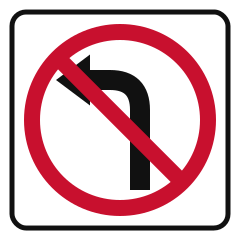
- Turn left after a full stop
- Do not turn left here
- Turn left only on a green arrow
- Turn left if there are no pedestrians
You are turning right on a green light and a pedestrian is crossing with the green. Who has the right-of-way?
- Whoever entered first
- The pedestrian
- You, if you signalled early
- You, because your light is green
What does a solid white line between lanes mean?
- The lane is for buses only
- Lane changing is allowed when clear
- Lane changing is not permitted
- Passing is allowed on the right
Keep practising
- Nunavut Class 7 Mock Exam 1 – 30 QuestionsUntimed practice · answers explained
- Nunavut Class 7 Mock Exam 3 – 30 QuestionsUntimed practice · answers explained
- Nunavut Class 7 Mock Exam 4 – 30 QuestionsUntimed practice · answers explained
- Nunavut Class 7 Mock Exam 5 – 30 QuestionsUntimed practice · answers explained
- Nunavut Class 7 Practice Test 130 questions with explanations
- Nunavut Class 7 Practice Test 230 questions with explanations
- Nunavut Class 7 Practice Test 330 questions with explanations
- Nunavut Class 7 Practice Test 430 questions with explanations