After an accident, what information must you give the other driver?
Nunavut Class 7 overview
Nunavut Class 7 Mock Exam 1
Same format as the real test. Answers stay hidden until you submit. The official time limit is not published; the timer is a practice setting.
- No sign-up
- Every answer explained
- Independent · not a government site
- 30 questions
- untimed
- Pass mark 12/15 per section
0/30
All 30 questions in this test
Every question and its answer choices. The correct answers and explanations appear when you take the test above.
After an accident, what information must you give the other driver?
- Your name, address, licence number and vehicle ownership
- Only your insurance company's name and your policy number
- Only your phone number
- Nothing until the police arrive
You are taking an allergy or cold medicine with an antihistamine. What does the manual advise?
- It is safe at any dose
- Don't use it when you will be driving
- Drive only short distances
- Take it with coffee to stay alert
You see this sign at the entrance to a street. What does it mean?

- Parking is not allowed on this street
- The street is closed to trucks only
- Stop, then enter when clear
- You must not enter this street
What does this sign warn you of?
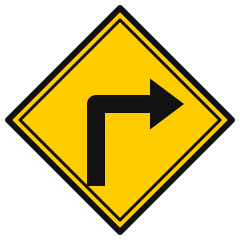
- A sharp right turn ahead
- A side road on the right
- A right lane that ends
- A gentle curve to the right
You see diagonal stripes enclosed by two solid lines on the approach to a bridge pier. What are they for?
- To show a passing zone before the bridge
- To mark a bus stop
- To guide you away from the fixed object
- To mark a place to stop
You meet a school bus stopped with its flashing lights on, coming toward you on the other side of the road. What must you do?
- Continue, since it is not in your lane
- Stop before reaching the bus
- Stop only if children are visible
- Slow down and pass carefully
Why should you never coast down a hill in neutral?
- It makes the horn stop working
- It uses more fuel
- All the slowing is left to the brakes
- It is only a problem in winter
You have just passed this sign. How should you drive?

- At the normal limit, watching ahead
- Faster, to clear the zone quickly
- Slowly, ready to stop at any moment
- Normally, unless a bus is stopped
What does a marker like this one indicate?

- The end of the road is just ahead
- A school crossing
- An obstacle on or beside the road
- A parking area
How should you change your following distance when towing a trailer?
- Keep it the same
- Reduce it slightly
- Double it
- Add one car length
You face a flashing green light. What may you do?
- Turn right only after stopping
- Wait for oncoming traffic to clear
- Go straight only
- Turn left, turn right or go straight
Your licence expired eight months ago. Can you still renew it without being re-examined?
- No, you must reapply as a new driver
- Yes, it has expired less than a year
- No, you must retake all tests
- Only with a doctor's note
In a car with an automatic transmission, how can you check that your seat is close enough?
- Reach the radio without leaning
- Press the gas pedal to the floor
- Rest your right foot flat on the floor under the brake
- Touch the windshield with your hand while sitting upright
What does this sign warn you about?

- A winding road ahead
- A car wash entrance ahead
- Loose gravel on the shoulder
- The road is slippery when wet
Inside a multi-lane traffic circle, which vehicle must yield?
- The vehicle in the outer lane never yields
- The vehicle on the right yields to the vehicle on the left
- The slower vehicle yields
- The vehicle on the left yields to the vehicle on the right
What must you show before you can register a vehicle?
- A safety inspection report
- A Class 5 licence
- Proof of insurance
- A road test receipt
Before changing lanes, what must you do besides checking your mirrors?
- Sound your horn
- Turn on your hazard lights for a few seconds
- Look over your shoulder at the blind spot
- Flash your headlights
You are approaching a yield sign and a pedestrian is crossing the intersection ahead. Who goes first?
- You, if you sound your horn
- The pedestrian
- Whoever reaches the crosswalk first
- You, because you are already moving
At 90 km/h in ideal conditions, about how far do you need to stop your vehicle?
- About 150 m
- About 45 m
- About 30 m
- About 75 m
What does this sign warn you of?

- A steep hill ahead
- Two-way traffic ahead
- A divided highway is starting ahead
- A narrow structure such as a bridge
Where should your hands be on the steering wheel?
- One hand at twelve o'clock
- On the inside spokes
- At the bottom of the wheel, close together
- On the top half, at about ten and two
What does this sign mean?

- Snow removal is finished
- A park with hiking trails is just ahead
- A gravel pit is ahead
- Workers are on or near the road ahead
You are approaching a school crosswalk sign and the car ahead is moving slowly. What must you never do here?
- Pass the vehicle at the crosswalk
- Cover your brake pedal
- Slow down behind the vehicle
- Prepare to stop for children
These signs hang over three lanes approaching an intersection. What must a driver in the right-hand lane do?
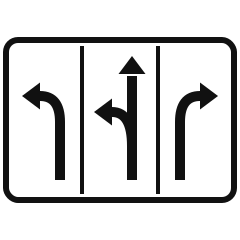
- Make any movement
- Go straight or turn right
- Turn right
- Turn left
Inside a municipality, a crossing gate is down. How far from the nearest rail must you stop?
- Not less than 50 m
- Not less than 3 m
- Not less than 15 m
- Not less than 5 m
How can you keep dust out of your car on a gravel road?
- Turn off the fan, close all the vents and open a window
- Close windows, run the heater fan and open front vents
- Use the air recirculation only
- Open all windows to clear the air
Why does the manual say you should know signs by their shape?
- Because shapes change with the season
- So you can read them when the words are hidden
- Because colours are not used in Nunavut
- So you can tell how far away they are
A lane use signal over your lane shows a red X. What does it mean?
- The lane ends ahead
- You must not drive in that lane
- Slow down in that lane
- The lane is for buses only
A pedestrian-school advance sign has a tab under it reading "km/h During School Days" with a number. What does that mean?
- It applies only to school buses
- It applies only when children are visible
- It is a suggested speed only
- You must keep to that speed on school days
What does the manual advise you not to do at the scene of an accident?
- Exchange insurance details
- Get witnesses' names
- Draw a sketch of the scene
- Discuss who may be at fault
Keep practising
- Nunavut Class 7 Mock Exam 2 – 30 QuestionsUntimed practice · answers explained
- Nunavut Class 7 Mock Exam 3 – 30 QuestionsUntimed practice · answers explained
- Nunavut Class 7 Mock Exam 4 – 30 QuestionsUntimed practice · answers explained
- Nunavut Class 7 Mock Exam 5 – 30 QuestionsUntimed practice · answers explained
- Nunavut Class 7 Practice Test 130 questions with explanations
- Nunavut Class 7 Practice Test 230 questions with explanations
- Nunavut Class 7 Practice Test 330 questions with explanations
- Nunavut Class 7 Practice Test 430 questions with explanations