Your car is stopped on ice. How should you start moving?
Nunavut Class 7 overview
Nunavut Class 7 Practice Test 3
30 questions on gravel roads, dust and winter driving, fog, night driving, fatigue, curves and hills, licence classes and the driver examination, driving emergencies and accidents, your vehicle, equipment and seat belts and more.
- No sign-up
- Every answer explained
- Independent · not a government site
- Set 3 of 13
- 30 questions
- Instant feedback
0/30
All 30 questions in this test
Every question and its answer choices. The correct answers and explanations appear when you take the test above.
Your car is stopped on ice. How should you start moving?
- In reverse, then forward
- By spinning the wheels quickly
- In a high gear, pressing hard on the accelerator
- In first or second gear, with gentle power
When are roads especially slippery in the rain?
- Once the road has dried
- Just after it starts to rain
- After several hours of rain
- Only during heavy downpours
What is the minimum age to apply for a Class 7 learner's licence in Nunavut?
- 14
- 18
- 15
- 16
What does the manual advise you not to do at the scene of an accident?
- Exchange insurance details
- Get witnesses' names
- Draw a sketch of the scene
- Discuss who may be at fault
Where should your hands be on the steering wheel?
- One hand at twelve o'clock
- On the inside spokes
- At the bottom of the wheel, close together
- On the top half, at about ten and two
You want to make a U-turn but traffic is heavy. What does the manual suggest?
- Make it quickly in a gap
- Use your hazard lights and turn
- Drive around the block instead
- Turn from the right lane
You see a vehicle with flashing blue lights on the highway. What is it?
- A police car
- An ambulance
- A tow truck
- A snowplow
You have stopped for a school bus with flashing lights. When may you go?
- After all the children have reached the sidewalk
- When the lights stop or the driver waves you on
- After waiting about 30 seconds
- When the bus door closes
A lane use signal over your lane shows a red X. What does it mean?
- The lane ends ahead
- You must not drive in that lane
- Slow down in that lane
- The lane is for buses only
Between what times must commercial vehicles use their clearance lights, headlights and tail lights?
- Only when it is snowing
- From sunset until midnight
- One hour after sunset to one hour before sunrise
- Half an hour after sunset to half an hour before dawn
Your blood alcohol is below 0.08%, but your driving is clearly affected. Can you be charged with impaired driving?
- Yes, at any level if your ability is impaired
- No, because you are under the legal 0.08% limit
- Only if you are a new driver
- Only if you cause a crash
A car suddenly comes at you in your lane. What should you do?
- Stop and wait in your lane
- Brake hard and head for the right shoulder
- Speed up to get past it
- Swerve left into the other lane to avoid it
You sell your car. What should you do with the licence plates?
- Remove them and keep them for your next vehicle
- Mail them to the RCMP
- Leave them on the car so the buyer can use them
- Throw them away
An advance community sign has small tabs underneath it. What do the tabs show?
- The local speed limits
- The services available in the community
- The distance to the next town or village
- The community's population
Where are overhead lane designation signs placed?
- On the right shoulder, before the lane
- Above the road, centred over each lane
- Painted on the pavement in each lane
- On the traffic light pole only
What does this sign warn you about?

- A park entrance is ahead
- Children may not cross here
- You are approaching a school zone
- A playground is closed ahead
You are involved in an accident. Who, besides a police officer, must you show your licence to?
- Every witness at the scene
- No one but the police
- The tow truck driver
- The other driver involved
Before changing lanes, what must you do besides checking your mirrors?
- Sound your horn
- Turn on your hazard lights for a few seconds
- Look over your shoulder at the blind spot
- Flash your headlights
You see diagonal stripes enclosed by two solid lines on the approach to a bridge pier. What are they for?
- To show a passing zone before the bridge
- To mark a bus stop
- To guide you away from the fixed object
- To mark a place to stop
Two vehicles reach an uncontrolled intersection at about the same time. Which one must yield?
- The vehicle going slower
- The vehicle on the right
- The smaller vehicle
- The vehicle on the left
What does a broken yellow centre line mean?
- The road is one-way
- Passing is never permitted
- Passing is permitted when traffic allows
- A lane is ending ahead and traffic must merge
You want to drive a taxi or a bus someday. How old must you be before testing for Class 1 to 4?
- 16
- 18
- 17
- 21
You must drive well below the normal speed of traffic. What should you do?
- Move right or pull off to let traffic pass
- Turn on your high beams
- Keep going in your lane; other drivers can wait
- Drive in the left lane
About what share of all traffic deaths are pedestrians?
- Nearly 75%
- About 5%
- Nearly 20%
- About 50%
Why should you avoid turning the steering wheel while the vehicle is standing still?
- It strains the steering and wears the tires
- It drains the battery quickly
- It is against the law in every province and territory
- It turns off the power brakes
Using the time-interval method, when is your following distance too short?
- When the car ahead brakes
- When you can see the car's tires
- When you reach the checkpoint in over two seconds
- When you pass the checkpoint in under two seconds
A friend has had too much to drink and drinks black coffee before driving. What effect does the coffee have?
- It makes them safe to drive in an hour
- It cuts the alcohol level in half
- It may wake them up, but won't sober them
- It removes alcohol from the blood
What does a marker like this one indicate?

- The end of the road is just ahead
- A school crossing
- An obstacle on or beside the road
- A parking area
You want to turn left at an intersection where this sign is posted. What should you do?
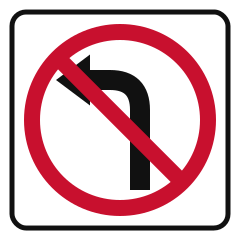
- Turn left after a full stop
- Do not turn left here
- Turn left only on a green arrow
- Turn left if there are no pedestrians
Another vehicle wants to pass you on a dusty gravel road. What should you do?
- Move right and slow to under 60 km/h
- Stop on the road
- Keep your speed and lane
- Speed up to keep out of its dust
All Nunavut Class 7 practice tests
- Nunavut Class 7 Mock Exam 1 – 30 QuestionsUntimed practice · answers explained
- Nunavut Class 7 Mock Exam 2 – 30 QuestionsUntimed practice · answers explained
- Nunavut Class 7 Mock Exam 3 – 30 QuestionsUntimed practice · answers explained
- Nunavut Class 7 Mock Exam 4 – 30 QuestionsUntimed practice · answers explained
- Nunavut Class 7 Mock Exam 5 – 30 QuestionsUntimed practice · answers explained
- Regulatory signsSign shapes and the Nunavut colour code, stop and yield, speed signs, no U-turn, do not enter, one-way and two-way, keep right, passing signs, turn-control and overhead lane signs, and parking signs.
- Warning signsYellow warning signs for curves, merges, narrow roads, divided highways, intersections, signals, hills, slippery roads, railway crossings, deer, lane endings, fallen rock, soft shoulders, and hazard markers.
- School, construction and service signsThe pedestrian-school advance sign and its speed tab, school and pedestrian crosswalk signs, construction and maintenance signs, the slow moving vehicle sign, and service and information signs.
- Traffic lights and signalsLight colours and order, the fourth red light, red, amber and green lights, right turn on red, flashing red, amber and green, green arrows, lane use signals, pedestrian signals and police or flagman directions.
- Pavement markingsYellow and white lines, broken and solid lines, solid-and-broken pairs, double solid lines, stop lines and crosswalks, cross-hatching and directional arrows.
About this practice test
How many questions are in Nunavut Class 7 practice test 3?
30 original multiple-choice practice questions covering gravel roads, dust and winter driving, fog, night driving, fatigue, curves and hills, licence classes and the driver examination, driving emergencies and accidents, your vehicle, equipment and seat belts, signalling, turning and turnabouts, pedestrians, school buses and cyclists, traffic lights and signals, motorcycles, trailers and larger vehicles, alcohol, drugs and driving, your licence, registration and insurance, school, construction and service signs, regulatory signs, highways, following distance and passing, pavement markings, right-of-way, emergency vehicles and railway crossings, stopping distances, parking and speed limits, warning signs. Each answer includes an explanation. This mixed practice set does not reproduce the official exam format or predict an official score.
Are the questions the same every time?
Yes. Practice test 3 always has the same 30 questions, so you can repeat it until you get them all right. The other 12 sets use different questions.
Are these real test questions?
No. The official question bank is not published. These are original questions written from the official handbook, which is what the real Nunavut Class 7 test is based on.