You realize you have just missed your freeway exit. What should you do?
Nunavut Class 7 overview
Nunavut Class 7 Practice Test 7
30 questions on highways, following distance and passing, motorcycles, trailers and larger vehicles, stopping distances, parking and speed limits, pedestrians, school buses and cyclists, your vehicle, equipment and seat belts and more.
- No sign-up
- Every answer explained
- Independent · not a government site
- Set 7 of 13
- 30 questions
- Instant feedback
0/30
All 30 questions in this test
Every question and its answer choices. The correct answers and explanations appear when you take the test above.
You realize you have just missed your freeway exit. What should you do?
- Keep going and take the next exit
- Stop and back up to the exit
- Stop on the shoulder and wait
- Make a U-turn across the median
Where in the lane does the manual suggest motorcyclists ride in traffic?
- Exactly on the centre line
- Between two lanes of cars
- Left of the centre of the lane
- On the right edge of the lane
You want to park near a corner with a stop sign. How far from the sign must you be?
- At least 10 m
- At least 1 m
- At least 20 m
- At least 5 m
The car in the lane beside you has stopped at a crosswalk. You cannot see why. What should you do?
- Stop as well, because a pedestrian may be crossing
- Pass it carefully on the left
- Pass it, since your own lane is clear of traffic ahead
- Sound your horn and continue
Who must wear a seat belt in Nunavut?
- Only front-seat passengers
- All drivers and passengers
- Only the driver
- Only on highways
On a vertical traffic light, where is the red light?
- On the left side
- At the bottom
- At the top
- In the middle
You have pulled over and stopped for a police car with lights and siren. When may you move again?
- When the siren is turned off
- After 10 seconds
- After it has passed
- As soon as you see it
A new resident has only a temporary driver's permit from another province. Will Nunavut accept it?
- No, temporary permits are not accepted
- Only with a letter from that province
- Yes, for up to 30 days
- Yes, if it is under a year old
You are approaching a school crosswalk sign and the car ahead is moving slowly. What must you never do here?
- Pass the vehicle at the crosswalk
- Cover your brake pedal
- Slow down behind the vehicle
- Prepare to stop for children
What does this sign tell you about the street?

- Traffic may move in one direction only
- The road is a dead end
- Turn right at the next intersection
- Two-way traffic is ahead
What does this sign warn you of?
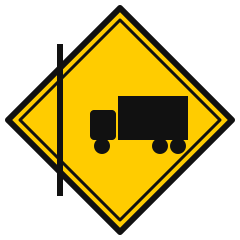
- A truck route begins here
- A weigh scale is ahead
- Trucks may enter the road ahead
- Trucks are not allowed on this road
You drive a truck and trailer that is 48 feet long. What following count does the manual's method give you?
- 4 seconds
- 5 seconds
- 2 seconds
- 8 seconds
You put your plates on another vehicle after insuring it. Within how many days must you get a new certificate of registration?
- 30 days
- 14 days
- 7 days
- 60 days
How should you position your vehicle in a left-hand curve?
- Close to the right shoulder
- Toward, but not over, the centre
- Over the centre line
- Straddling the right edge line
How close to a fire hydrant may you park?
- No closer than 3 m
- No closer than 6 m
- No closer than 1 m
- No closer than 15 m
How must cyclists ride when they travel in a group?
- In single file
- Two side by side
- In a tight cluster
- In the centre of the lane
How are conditions on your licence, such as a need for glasses, shown?
- In a separate letter you carry
- They are not shown anywhere
- By code letters on the licence
- By a coloured sticker on the car
Your trailer starts to sway from side to side. What should you do?
- Brake hard right away
- Slow down gradually and steer straight
- Steer sharply against each sway of the trailer
- Speed up to pull it straight
How close may you follow a fire engine?
- No closer than 30 m
- No closer than 300 m
- No closer than 60 m
- No closer than 150 m
How should you brake to slow down on an icy road?
- Use the parking brake
- Shift into neutral and coast
- Press the brake hard and hold it down until stopped
- Apply and release the brakes quickly but gently
A solid yellow line and a broken yellow line run side by side, with the broken line nearest you. What does that tell you?
- You may never pass here
- You must change lanes now
- You may pass when it is safe
- Only oncoming traffic may pass
According to the manual, in which kind of skid are more people hurt or killed?
- Dry-surface skids
- Skids on gravel
- Skids on wet leaves
- Skids on ice
Before turning left from a one-way street onto a two-way street, where should your vehicle be?
- On the shoulder
- On the left side of the one-way street
- On the right side of the one-way street
- In the middle of the one-way street
When should you use your horn?
- At every intersection
- Only when it is reasonably necessary
- Whenever someone ahead is driving slowly
- To greet other drivers
What advantage do pavement markings have over roadside signs?
- They are easier to see when wet
- They are never covered by snow
- They inform you without taking your eyes off the road
- They last much longer than signs, even in heavy traffic
Which of these does the law require you to signal?
- Slowing down or stopping
- Going over a hill
- Driving straight through a green light
- Turning on your headlights
A driver who uses insulin skips a meal. What could happen?
- The insulin stops working
- Low blood sugar could cause weakness or fainting
- Blood pressure rises sharply and causes a headache
- Nothing, if the dose was right
What does this sign warn you of?
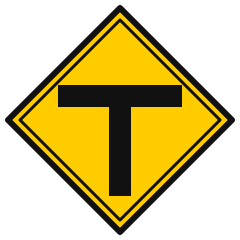
- A railway crossing ahead
- The road ends at a T-intersection
- A sharp turn to the right
- A side road joins from the left
Some traffic signals have four lights instead of three. What is the fourth light?
- A white light for transit buses
- A green arrow for left turns
- A flashing amber light for pedestrians crossing
- A second red light that works with the first
A construction sign warns of a diversion ahead. What does that mean?
- The road is closed for good past this point
- The road's path changes temporarily
- The road becomes one-way
- Traffic must stop and wait
All Nunavut Class 7 practice tests
- Nunavut Class 7 Mock Exam 1 – 30 QuestionsUntimed practice · answers explained
- Nunavut Class 7 Mock Exam 2 – 30 QuestionsUntimed practice · answers explained
- Nunavut Class 7 Mock Exam 3 – 30 QuestionsUntimed practice · answers explained
- Nunavut Class 7 Mock Exam 4 – 30 QuestionsUntimed practice · answers explained
- Nunavut Class 7 Mock Exam 5 – 30 QuestionsUntimed practice · answers explained
- Regulatory signsSign shapes and the Nunavut colour code, stop and yield, speed signs, no U-turn, do not enter, one-way and two-way, keep right, passing signs, turn-control and overhead lane signs, and parking signs.
- Warning signsYellow warning signs for curves, merges, narrow roads, divided highways, intersections, signals, hills, slippery roads, railway crossings, deer, lane endings, fallen rock, soft shoulders, and hazard markers.
- School, construction and service signsThe pedestrian-school advance sign and its speed tab, school and pedestrian crosswalk signs, construction and maintenance signs, the slow moving vehicle sign, and service and information signs.
- Traffic lights and signalsLight colours and order, the fourth red light, red, amber and green lights, right turn on red, flashing red, amber and green, green arrows, lane use signals, pedestrian signals and police or flagman directions.
- Pavement markingsYellow and white lines, broken and solid lines, solid-and-broken pairs, double solid lines, stop lines and crosswalks, cross-hatching and directional arrows.
About this practice test
How many questions are in Nunavut Class 7 practice test 7?
30 original multiple-choice practice questions covering highways, following distance and passing, motorcycles, trailers and larger vehicles, stopping distances, parking and speed limits, pedestrians, school buses and cyclists, your vehicle, equipment and seat belts, traffic lights and signals, right-of-way, emergency vehicles and railway crossings, your licence, registration and insurance, school, construction and service signs, regulatory signs, warning signs, fog, night driving, fatigue, curves and hills, licence classes and the driver examination, gravel roads, dust and winter driving, pavement markings, driving emergencies and accidents, signalling, turning and turnabouts, alcohol, drugs and driving. Each answer includes an explanation. This mixed practice set does not reproduce the official exam format or predict an official score.
Are the questions the same every time?
Yes. Practice test 7 always has the same 30 questions, so you can repeat it until you get them all right. The other 12 sets use different questions.
Are these real test questions?
No. The official question bank is not published. These are original questions written from the official handbook, which is what the real Nunavut Class 7 test is based on.