A car is parked at the curb and you stop beside it in the traffic lane to wait. What is this called, and is it allowed?
Nunavut Class 7 overview
Nunavut Class 7 Practice Test 1
30 questions on stopping distances, parking and speed limits, fog, night driving, fatigue, curves and hills, motorcycles, trailers and larger vehicles, driving emergencies and accidents, school, construction and service signs and more.
- No sign-up
- Every answer explained
- Independent · not a government site
- Set 1 of 13
- 30 questions
- Instant feedback
0/30
All 30 questions in this test
Every question and its answer choices. The correct answers and explanations appear when you take the test above.
A car is parked at the curb and you stop beside it in the traffic lane to wait. What is this called, and is it allowed?
- Double parking; it is not allowed
- Angle parking; it is allowed
- Standing; it is allowed briefly
- Loading; it is always allowed
What is highway hypnosis?
- A drowsy state from long, monotonous driving
- A reaction to medication
- Being dazzled by staring at oncoming headlights
- A fear of driving on highways
A load sticks out more than 1.5 m past the back of a vehicle during the day. What must be attached to its end?
- Nothing during daylight
- A white reflector strip
- An orange triangle at least 30 cm wide
- A red flag at least 30 cm square
What is a common cause of tire blowouts?
- Driving with snow tires
- Washing the car often
- Using cruise control
- Under-inflated tires
Why do construction and maintenance signs ask you to slow down?
- To protect you and the workers from hazards
- So workers can read your licence plate
- To save fuel in work zones
- Because police patrol every work zone
From what distance must your red tail lights be visible?
- At least 150 m
- At least 500 m
- At least 60 m
- At least 30 m
You are following a truck that is raising a heavy dust cloud on a gravel highway. What should you do?
- Pass it on the shoulder
- Stay back out of the dust until passing is safe
- Speed up and pass it quickly
- Follow close behind so you can see its taillights
You are using a hand signal for a turn. When should you stop signalling with your arm?
- After the turn is complete
- Only once you stop
- Before you start turning
- Halfway through the turn
When may a cyclist carry a passenger?
- Only on quiet side streets
- Only if the bike has a fixed seat for one
- Whenever the passenger is a child
- Only during daylight hours
Who has the right to use a school crosswalk?
- Only children and their parents
- Only school children
- Only children with a crossing guard
- Every pedestrian, of any age
You move to a new address. How soon must you tell the nearest issuing office?
- At your next renewal
- Within 60 days
- Within 30 days
- Within 15 days
May you turn right on a red light in Nunavut?
- Yes, without stopping first, if the way looks clear
- Yes, after a full stop, unless a sign forbids it
- No, never on a red light
- Only when a police officer allows it
What does this sign mean?

- Sharp curve ahead, slow down
- Two-way traffic resumes ahead
- You may not turn around to go the other way
- You may make a U-turn only when clear
You meet a school bus stopped with its flashing lights on, coming toward you on the other side of the road. What must you do?
- Continue, since it is not in your lane
- Stop before reaching the bus
- Stop only if children are visible
- Slow down and pass carefully
You see this sign. What is ahead?

- A bridge with one lane
- The pavement becomes narrower
- A lane for turning traffic
- The pavement ends and gravel begins
What must you do with the yearly registration sticker?
- Carry it with your licence
- Stick it on the windshield
- Stick it on the licence plate
- Keep it in the glove box
Does the first vehicle to enter an uncontrolled intersection automatically have the right-of-way?
- No, entering first does not give it
- Only if it is a larger vehicle
- Yes, always
- Yes, if it is going straight
Another driver is passing you. What should you do?
- Speed up to stay ahead
- Reduce speed slightly and keep right
- Brake hard to let them in
- Move toward the centre line so they see you
What do arrows painted in a traffic lane tell you?
- How far away the next highway exit is located
- Which direction you may move from that lane
- Which way the wind is blowing
- Which lane is fastest
The white line between your lane and the next is broken. What does that allow?
- Parking along the line
- Changing lanes when traffic allows
- Making a U-turn
- Passing by using the oncoming lane
About how much road does it take at 90 km/h to pass a car going 80 km/h?
- About half a kilometre
- About 2 kilometres
- About 150 metres
- About 50 metres
With a trailer in tow, how far behind you must your mirrors give you a clear view?
- At least 15 m
- At least 30 m
- At least 60 m
- At least 150 m
Which vehicle does a Class 4 licence allow you to drive?
- A bus of any size
- A motorcycle
- A taxicab
- A tractor-trailer
Outside a community at night, does the basic speed limit drop below the daytime limit?
- Yes, it drops to 80 km/h
- No, it stays at 90 km/h
- Yes, to 60 km/h
- Yes, to 70 km/h
On this railway advance warning sign, the track is drawn on a slant. What does the slant show?
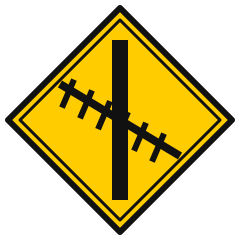
- How many tracks there are
- Which direction the next train will be travelling
- Where you must stop for a train
- The angle at which the tracks cross the road
The light is red and there is no stop line. Where do you stop?
- In line with the traffic light pole
- At the nearest crosswalk
- Wherever you can see cross traffic
- Past the crosswalk, at the corner
Above what maximum gross weight must a trailer have its own brakes?
- 680 kg
- 300 kg
- 1,500 kg
- 4,500 kg
At a crossing with signal lights, the train has passed but the lights are still flashing. What do you do?
- Drive around the signal post
- Wait until the signal stops
- Cross slowly with hazards on
- Cross, since the train is gone
Why should you not swing left before making a right turn?
- It wears out your tires
- It makes the turn too slow
- It is only a problem at night
- A driver behind may be passing you
According to studies in the manual, in what share of fatal accidents had at least one driver been drinking?
- About 5%
- About 90%
- About 50%
- About 20%
All Nunavut Class 7 practice tests
- Nunavut Class 7 Mock Exam 1 – 30 QuestionsUntimed practice · answers explained
- Nunavut Class 7 Mock Exam 2 – 30 QuestionsUntimed practice · answers explained
- Nunavut Class 7 Mock Exam 3 – 30 QuestionsUntimed practice · answers explained
- Nunavut Class 7 Mock Exam 4 – 30 QuestionsUntimed practice · answers explained
- Nunavut Class 7 Mock Exam 5 – 30 QuestionsUntimed practice · answers explained
- Regulatory signsSign shapes and the Nunavut colour code, stop and yield, speed signs, no U-turn, do not enter, one-way and two-way, keep right, passing signs, turn-control and overhead lane signs, and parking signs.
- Warning signsYellow warning signs for curves, merges, narrow roads, divided highways, intersections, signals, hills, slippery roads, railway crossings, deer, lane endings, fallen rock, soft shoulders, and hazard markers.
- School, construction and service signsThe pedestrian-school advance sign and its speed tab, school and pedestrian crosswalk signs, construction and maintenance signs, the slow moving vehicle sign, and service and information signs.
- Traffic lights and signalsLight colours and order, the fourth red light, red, amber and green lights, right turn on red, flashing red, amber and green, green arrows, lane use signals, pedestrian signals and police or flagman directions.
- Pavement markingsYellow and white lines, broken and solid lines, solid-and-broken pairs, double solid lines, stop lines and crosswalks, cross-hatching and directional arrows.
About this practice test
How many questions are in Nunavut Class 7 practice test 1?
30 original multiple-choice practice questions covering stopping distances, parking and speed limits, fog, night driving, fatigue, curves and hills, motorcycles, trailers and larger vehicles, driving emergencies and accidents, school, construction and service signs, your vehicle, equipment and seat belts, gravel roads, dust and winter driving, signalling, turning and turnabouts, pedestrians, school buses and cyclists, your licence, registration and insurance, traffic lights and signals, regulatory signs, warning signs, right-of-way, emergency vehicles and railway crossings, highways, following distance and passing, pavement markings, licence classes and the driver examination, alcohol, drugs and driving. Each answer includes an explanation. This mixed practice set does not reproduce the official exam format or predict an official score.
Are the questions the same every time?
Yes. Practice test 1 always has the same 30 questions, so you can repeat it until you get them all right. The other 12 sets use different questions.
Are these real test questions?
No. The official question bank is not published. These are original questions written from the official handbook, which is what the real Nunavut Class 7 test is based on.