You are the first to arrive at a crash scene. What should you do?
Nunavut Class 7 overview
Nunavut Class 7 Practice Test 9
30 questions on driving emergencies and accidents, signalling, turning and turnabouts, licence classes and the driver examination, regulatory signs, highways, following distance and passing and more.
- No sign-up
- Every answer explained
- Independent · not a government site
- Set 9 of 13
- 30 questions
- Instant feedback
0/30
All 30 questions in this test
Every question and its answer choices. The correct answers and explanations appear when you take the test above.
You are the first to arrive at a crash scene. What should you do?
- Drive past to avoid blocking traffic
- Move injured people into your car
- Stop in the lane beside the crash
- Pull off, turn on flashers and offer help
You are near the top of a hill. When is turning around there prohibited?
- When drivers can't see you within 150 m
- Only in winter conditions
- When you are within 30 m of the top
- When the speed limit is over 50 km/h
Besides how sharply you see, what else does the vision test check?
- Colour perception and field of vision
- Eye pressure and your blood sugar level
- Reaction time and hearing
- Night vision and depth only
You are in a lane at an intersection where this sign applies. What must you do?
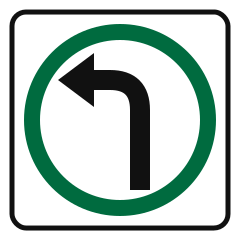
- Go straight or turn left
- Turn left only after stopping
- Turn left
- Make any turn you choose
What does a Class 7 licence allow you to do?
- Drive any vehicle with a supervisor
- Drive Class 5 or 6 vehicles while learning
- Drive a taxi while supervised
- Drive a car alone after six months
Driving conditions are poor. How should you change the two-second following interval?
- Increase it to three seconds or more
- Reduce it to one second
- Keep it at two seconds
- Use one car length per 10 km/h instead
You are buying a registered used vehicle. What should the seller give you?
- The previous registration, signed over to you
- Their insurance card
- Their licence plates
- Their driver's licence number and nothing else
What is the blood-alcohol chart in the manual used for?
- Estimating BAC from body weight and drinks
- Listing which drinks are legal
- Setting fines for impaired drivers
- Showing how fast alcohol leaves
How does the fatal accident rate at night compare with daytime?
- It is three times higher
- It is half as high
- It is ten times higher
- It is about the same
What does it mean to overdrive your headlights?
- Drive too fast to stop within the lit distance
- Leave your headlights on after you have parked
- Aim your headlights too high
- Use high beams in town
What does this sign warn you of?

- A sharp curve ahead
- A truck entrance ahead
- A runaway lane ahead
- A steep hill ahead
If your vehicle goes into water with the windows closed, about how long may it float?
- It sinks right away
- About one hour
- From three to ten minutes
- Less than 30 seconds at most
A solid yellow line and a broken yellow line run side by side. The solid line is on your side. May you pass?
- No, passing is not permitted
- Yes, if the road ahead is clear
- Yes, but only during daylight
- Only to pass a slow truck
What is the speed limit for trucks outside cities and towns?
- 70 km/h at night only
- 60 km/h at all times
- 80 km/h, day or night
- 90 km/h, day or night
You are turning left at an intersection with no advance signal. An oncoming car is close to the intersection. What do you do?
- Flash your lights and turn
- Turn, since you signalled first
- Turn quickly in front of it
- Let the oncoming car go first
You have just passed this sign. How should you drive?

- At the normal limit, watching ahead
- Faster, to clear the zone quickly
- Slowly, ready to stop at any moment
- Normally, unless a bus is stopped
You took a prescribed tranquillizer and then had one small drink. What does the manual warn?
- Only the drug affects you
- One drink with a drug is safe
- The combined effect is even stronger
- The drink cancels the drug
You come up behind a vehicle showing a slow moving vehicle sign. What should you expect?
- It is about to turn left
- It will pull over to let you pass
- It is an emergency vehicle
- It is going well below the posted speed
A pedestrian with a guide dog is waiting to cross. What should you avoid doing?
- Turning off your radio
- Stopping well back from the curb
- Waiting for them to cross
- Revving the engine or honking
What does this sign mean?

- Two lanes merge ahead
- Passing is permitted when clear
- Passing is not permitted
- Keep to the right lane only
Where is turning your vehicle around absolutely prohibited?
- On a straight, level road
- In a wide private driveway
- On a quiet residential street
- On a curve
May you park in a marked pedestrian crosswalk?
- Yes, at night only
- Yes, if nobody is crossing
- No, never
- Yes, for up to five minutes
May two motorcycles ride side by side in the same traffic lane?
- No, they must not ride two abreast
- Yes, in towns only
- Yes, always
- Yes, if both riders are licensed
You are parked with the engine running and start to feel dizzy and sick. What should you do?
- Turn up the heater
- Lie down in the back seat until it passes
- Close all the windows
- Turn off the engine and get fresh air
You start the engine and the brake warning light stays on. What should you do?
- Not drive; it may mean a serious brake problem
- Drive slowly until the light goes off on its own
- Pump the brakes and drive on
- Ignore it in cold weather
Where should you never run your vehicle's engine?
- In a closed garage
- At a fuel station after paying
- On a quiet gravel road
- In an open parking lot
Your licence is lost. What must you do before an issuing office can give you a duplicate?
- Retake the written test
- Wait 30 days for it to turn up
- Report the loss to the RCMP
- Get a letter from your employer
Why should you avoid changing lanes in an intersection?
- It damages the pavement markings
- It is allowed only on green
- Others can't tell if you are turning
- Intersections are always one lane
You face a flashing green light. What may you do?
- Turn right only after stopping
- Wait for oncoming traffic to clear
- Go straight only
- Turn left, turn right or go straight
What do yellow pavement lines separate?
- Bicycle lanes from car lanes
- Traffic moving in the same direction
- Parking lanes from travel lanes
- Traffic moving in opposite directions
All Nunavut Class 7 practice tests
- Nunavut Class 7 Mock Exam 1 – 30 QuestionsUntimed practice · answers explained
- Nunavut Class 7 Mock Exam 2 – 30 QuestionsUntimed practice · answers explained
- Nunavut Class 7 Mock Exam 3 – 30 QuestionsUntimed practice · answers explained
- Nunavut Class 7 Mock Exam 4 – 30 QuestionsUntimed practice · answers explained
- Nunavut Class 7 Mock Exam 5 – 30 QuestionsUntimed practice · answers explained
- Regulatory signsSign shapes and the Nunavut colour code, stop and yield, speed signs, no U-turn, do not enter, one-way and two-way, keep right, passing signs, turn-control and overhead lane signs, and parking signs.
- Warning signsYellow warning signs for curves, merges, narrow roads, divided highways, intersections, signals, hills, slippery roads, railway crossings, deer, lane endings, fallen rock, soft shoulders, and hazard markers.
- School, construction and service signsThe pedestrian-school advance sign and its speed tab, school and pedestrian crosswalk signs, construction and maintenance signs, the slow moving vehicle sign, and service and information signs.
- Traffic lights and signalsLight colours and order, the fourth red light, red, amber and green lights, right turn on red, flashing red, amber and green, green arrows, lane use signals, pedestrian signals and police or flagman directions.
- Pavement markingsYellow and white lines, broken and solid lines, solid-and-broken pairs, double solid lines, stop lines and crosswalks, cross-hatching and directional arrows.
About this practice test
How many questions are in Nunavut Class 7 practice test 9?
30 original multiple-choice practice questions covering driving emergencies and accidents, signalling, turning and turnabouts, licence classes and the driver examination, regulatory signs, highways, following distance and passing, your licence, registration and insurance, alcohol, drugs and driving, fog, night driving, fatigue, curves and hills, warning signs, pavement markings, stopping distances, parking and speed limits, right-of-way, emergency vehicles and railway crossings, school, construction and service signs, pedestrians, school buses and cyclists, motorcycles, trailers and larger vehicles, gravel roads, dust and winter driving, your vehicle, equipment and seat belts, traffic lights and signals. Each answer includes an explanation. This mixed practice set does not reproduce the official exam format or predict an official score.
Are the questions the same every time?
Yes. Practice test 9 always has the same 30 questions, so you can repeat it until you get them all right. The other 12 sets use different questions.
Are these real test questions?
No. The official question bank is not published. These are original questions written from the official handbook, which is what the real Nunavut Class 7 test is based on.