You are approaching a green light that has been green for some time. What should you be ready for?
Nunavut Class 7 overview
Nunavut Class 7 Mock Exam 3
Same format as the real test. Answers stay hidden until you submit. The official time limit is not published; the timer is a practice setting.
- No sign-up
- Every answer explained
- Independent · not a government site
- 30 questions
- untimed
- Pass mark 12/15 per section
0/30
All 30 questions in this test
Every question and its answer choices. The correct answers and explanations appear when you take the test above.
You are approaching a green light that has been green for some time. What should you be ready for?
- It will stay green for a minute
- Pedestrians must wait for you
- Cross traffic will get a flashing green
- It may turn amber before you get there
You see a vehicle coming toward you on a dusty gravel road. When should you have your headlights on?
- Only if the other driver flashes theirs
- Only after sunset
- Well before you meet it
- Only once you are in the dust
You come up behind a snowplow working on the highway. What should you do?
- Give it the right-of-way and pass only with caution
- Honk so the driver pulls over
- Pass it quickly to get ahead
- Follow it closely so you can drive in its cleared path
You have pulled over and stopped for a police car with lights and siren. When may you move again?
- When the siren is turned off
- After 10 seconds
- After it has passed
- As soon as you see it
What does this sign mean?

- Sharp curve ahead, slow down
- Two-way traffic resumes ahead
- You may not turn around to go the other way
- You may make a U-turn only when clear
A warning sign shows a hidden intersection ahead. What should you watch for?
- Pedestrians on the shoulder
- Vehicles approaching from both directions
- Only vehicles coming from the right
- Trucks entering from a quarry
Which of these is a typical sign of a driver who has been drinking?
- Keeping a steady speed
- Stopping fully at stop signs
- Signalling every single lane change well in advance
- Failing to dim headlights for oncoming traffic
What does a broken yellow centre line mean?
- The road is one-way
- Passing is never permitted
- Passing is permitted when traffic allows
- A lane is ending ahead and traffic must merge
Outside a community at night, does the basic speed limit drop below the daytime limit?
- Yes, it drops to 80 km/h
- No, it stays at 90 km/h
- Yes, to 60 km/h
- Yes, to 70 km/h
You have just driven through a deep puddle. What should you do?
- Test the brakes lightly as soon as you can
- Brake hard to check them
- Speed up so the wind dries the brakes faster
- Stop and wait an hour
What hazard does this sign warn of?
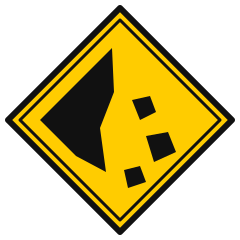
- Rocks or landslides may block the road
- A quarry entrance ahead
- A steep drop-off along the edge of the road
- A rough gravel surface ahead
A pedestrian-school advance sign has a tab under it reading "km/h During School Days" with a number. What does that mean?
- It applies only to school buses
- It applies only when children are visible
- It is a suggested speed only
- You must keep to that speed on school days
The light changes to amber just as your vehicle enters the intersection. What should you do?
- Stop in the middle of the intersection
- Speed up as much as possible
- Continue through with extreme caution
- Back up behind the stop line
On what date does your Nunavut driver's licence expire?
- On your birthday
- On January 1
- On the date you first passed
- On June 30
Why does the manual say you should know signs by their shape?
- Because shapes change with the season
- So you can read them when the words are hidden
- Because colours are not used in Nunavut
- So you can tell how far away they are
Why does the manual say to use extra caution on a road marked with a winding road sign?
- Trucks are not allowed
- Passing is restricted
- The speed limit is higher
- The surface is always gravel
How should you position your vehicle in a left-hand curve?
- Close to the right shoulder
- Toward, but not over, the centre
- Over the centre line
- Straddling the right edge line
A railway crossing signal is flashing on a road outside a municipality. How far from the nearest rail must you stop?
- Not less than 5 m
- Not less than 30 m
- Not less than 1 m
- Not less than 15 m
This sign with a speed tab is posted before a curve. What does the number on the tab tell you?

- The maximum comfortable speed for the curve
- The speed that trucks must keep to
- The minimum speed for the curve
- The new speed limit for the highway
How far must you stay from the driveway of a fire station when parking?
- At least 15 m
- At least 3 m
- At least 6 m
- At least 30 m
What is the result of disobeying a regulatory sign?
- Your vehicle is inspected
- You receive a warning only
- Nothing, they are advice only
- You commit an offence
What does this sign require you to do?

- Give way only to large trucks
- Speed up to merge ahead of traffic
- Give way to cross traffic and pedestrians
- Stop fully every time, then go
Your car is facing up a slope, stopped beside a curb. How should the front wheels be set before you leave it?
- Left, away from the curb
- Halfway toward the curb
- Straight ahead
- Right, toward the curb
May you park in a marked pedestrian crosswalk?
- Yes, at night only
- Yes, if nobody is crossing
- No, never
- Yes, for up to five minutes
You are parking downhill next to a curb. Which way should you turn your front wheels?
- It does not matter
- Straight ahead
- Toward the curb
- Away from the curb
You are turning right on a green light and a pedestrian is crossing with the green. Who has the right-of-way?
- Whoever entered first
- The pedestrian
- You, if you signalled early
- You, because your light is green
A warning sign says the pavement ends ahead. What should you expect?
- The road continues with a gravel surface
- A toll booth is ahead
- A bridge deck is ahead
- The road ends at a barrier with no way through
Why can you not always rely on pavement markings during a Nunavut winter?
- They are removed every fall
- They change colour in the cold
- They are not used outside towns
- Snow and ice can cover them
Your turn signal lights stop working. What must you do until they are fixed?
- Use your horn instead
- Use hand signals
- Flash your headlights
- Drive only in daylight
What is the manual's simple rule for a safe speed?
- Always match the car ahead of you
- Drive the limit in any weather
- Always drive 10 km/h under the posted limit just to be safe
- Never go faster than you can stop in the clear distance
Keep practising
- Nunavut Class 7 Mock Exam 1 – 30 QuestionsUntimed practice · answers explained
- Nunavut Class 7 Mock Exam 2 – 30 QuestionsUntimed practice · answers explained
- Nunavut Class 7 Mock Exam 4 – 30 QuestionsUntimed practice · answers explained
- Nunavut Class 7 Mock Exam 5 – 30 QuestionsUntimed practice · answers explained
- Nunavut Class 7 Practice Test 130 questions with explanations
- Nunavut Class 7 Practice Test 230 questions with explanations
- Nunavut Class 7 Practice Test 330 questions with explanations
- Nunavut Class 7 Practice Test 430 questions with explanations