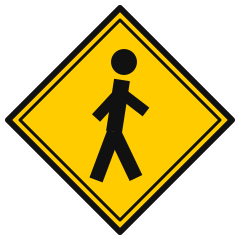
What does this sign mean?
Nunavut Class 7 Practice Test 12
30 questions on warning signs, regulatory signs, driving emergencies and accidents, your licence, registration and insurance, traffic lights and signals and more.
- No sign-up
- Every answer explained
- Independent · not a government site
- Set 12 of 13
- 30 questions
- Instant feedback
All 30 questions in this test
Every question and its answer choices. The correct answers and explanations appear when you take the test above.
What does this sign mean?
- Fallen rock on the road
- The pavement ends ahead
- A steep hill ahead
- A bump or rough road ahead
Some roads post a separate maximum speed for night-time. When does that number apply?
- Only during the winter months
- At night, in any weather
- At night, when conditions are ideal
- Only to commercial trucks
Your right wheels drift off the pavement onto the shoulder. What should you do first?
- Swerve sharply back onto the road
- Steer straight, ease off the gas and brake gently
- Brake hard and come to a full stop on the shoulder
- Speed up and steer back quickly
You move to Nunavut with a valid licence from Alberta. How long do you have to get a Nunavut licence?
- One year
- 90 days
- 30 days
- 60 days
What does an orange sign tell you?
- Construction or maintenance is ahead
- An off-road facility is near this road
- A service is nearby
- A school zone is ahead
On a horizontal traffic light, which position is the red light in?
- On the left
- On the right
- In the middle
- It varies by community
You are about to go down a very steep hill. What should you do?
- Shift to neutral at the top
- Speed up before the crest
- Shift to a lower gear before starting down
- Ride the brakes lightly all the way to the bottom
When may you leave the scene of an accident you were involved in?
- When formalities are done or police allow it
- Whenever no one seems hurt
- As soon as you swap phone numbers with the other driver
- After 15 minutes
What must you do before opening your car door on the street side?
- Nothing, parked cars have priority
- Make sure it won't endanger anyone
- Sound your horn
- Turn off your headlights
A collision cannot be avoided. What kind of impact does the manual say is better?
- A head-on hit at low speed
- Hitting the other car's side
- Hitting a solid wall straight on
- A glancing blow rather than head-on
On a two-lane highway, why should you not pull across the centre line just to see if it is clear to pass?
- It is allowed as long as you signal left first
- You should be able to see from your own lane
- It wastes fuel
- It only matters at night
You are following another vehicle at night. Within what distance does the law require you to dim your high beams?
- 60 m
- 150 m
- 15 m
- 300 m
About how far ahead do low-beam headlights light the road?
- About 30 m
- About 75 m
- About 10 m
- About 106 m
What is the youngest age at which you can be tested for a full Class 5 car licence?
- 17
- 16
- 15
- 18
What is the best way out of a vehicle that is sinking in water?
- Through the windows
- Through the sunroof only
- Through the doors at once
- Through the trunk
At what ages must a Class 5, 6 or 7 licence holder have a driver's medical?
- At 70, then every year
- At 65, then every five years
- At 75, at 80, then every two years
- At 80 only, then never again
What is the purpose of the amber light?
- To let pedestrians start crossing
- To show that left and right turns are now allowed
- To tell you to speed up
- To let traffic already in the intersection clear
A green arrow is shown together with a red light. What does the red light tell you?
- The arrow is about to turn red
- Pedestrians have the right-of-way at this corner
- You must stop before turning
- Other movements are given to other traffic
You drive past this sign. What has changed?
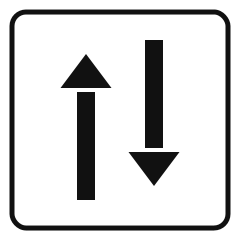
- You are no longer on a one-way road
- Passing is now allowed in both lanes
- You are entering a one-way road
- A divided highway begins here
You are in the right lane and see this sign. What is about to happen?

- A new lane opens on your right
- A side road joins the highway from the right ahead
- Your lane ends and the road narrows to one lane
- The road curves sharply to the left
What does this sign warn you of?
- A school bus stop ahead
- Pedestrian activity ahead
- A playground on the left
- A hiking trail entrance
What is the result of disobeying a regulatory sign?
- Your vehicle is inspected
- You receive a warning only
- Nothing, they are advice only
- You commit an offence
About how long does an average alert driver take to move their foot to the brake after seeing danger?
- About 3/4 of a second
- About 1/10 of a second
- About 3 seconds
- About 2 seconds
You are turning left from a two-way street onto a one-way street. Which lane should you finish in?
- Any lane that is clear
- The centre lane
- The lane closest to the right curb
- The lane closest to the left curb
At 90 km/h in ideal conditions, about how far do you need to stop your vehicle?
- About 150 m
- About 45 m
- About 30 m
- About 75 m
How close to a crosswalk may you stop or park?
- No closer than 3 m
- No closer than 1 m
- No closer than 15 m
- No closer than 6 m
What happens if you are convicted of driving while your licence is suspended?
- Only a small fine
- Only a written warning if it is your first offence
- Your car is registered to the RCMP
- A severe fine or jail, and a longer suspension
How far must you stay from the driveway of a fire station when parking?
- At least 15 m
- At least 3 m
- At least 6 m
- At least 30 m
A police officer is directing traffic at an intersection with working lights. Whose direction do you follow?
- The signs at the corner
- The police officer's
- The traffic lights'
- Whichever was there first
You are leaving a freeway. Where should you slow down?
- Before you signal
- In the left freeway lane
- In the deceleration lane
- On the main freeway lanes
All Nunavut Class 7 practice tests
- Nunavut Class 7 Mock Exam 1 – 30 QuestionsUntimed practice · answers explained
- Nunavut Class 7 Mock Exam 2 – 30 QuestionsUntimed practice · answers explained
- Nunavut Class 7 Mock Exam 3 – 30 QuestionsUntimed practice · answers explained
- Nunavut Class 7 Mock Exam 4 – 30 QuestionsUntimed practice · answers explained
- Nunavut Class 7 Mock Exam 5 – 30 QuestionsUntimed practice · answers explained
- Regulatory signsSign shapes and the Nunavut colour code, stop and yield, speed signs, no U-turn, do not enter, one-way and two-way, keep right, passing signs, turn-control and overhead lane signs, and parking signs.
- Warning signsYellow warning signs for curves, merges, narrow roads, divided highways, intersections, signals, hills, slippery roads, railway crossings, deer, lane endings, fallen rock, soft shoulders, and hazard markers.
- School, construction and service signsThe pedestrian-school advance sign and its speed tab, school and pedestrian crosswalk signs, construction and maintenance signs, the slow moving vehicle sign, and service and information signs.
- Traffic lights and signalsLight colours and order, the fourth red light, red, amber and green lights, right turn on red, flashing red, amber and green, green arrows, lane use signals, pedestrian signals and police or flagman directions.
- Pavement markingsYellow and white lines, broken and solid lines, solid-and-broken pairs, double solid lines, stop lines and crosswalks, cross-hatching and directional arrows.
About this practice test
How many questions are in Nunavut Class 7 practice test 12?
30 original multiple-choice practice questions covering warning signs, regulatory signs, driving emergencies and accidents, your licence, registration and insurance, traffic lights and signals, fog, night driving, fatigue, curves and hills, stopping distances, parking and speed limits, highways, following distance and passing, licence classes and the driver examination, signalling, turning and turnabouts. Each answer includes an explanation. This mixed practice set does not reproduce the official exam format or predict an official score.
Are the questions the same every time?
Yes. Practice test 12 always has the same 30 questions, so you can repeat it until you get them all right. The other 12 sets use different questions.
Are these real test questions?
No. The official question bank is not published. These are original questions written from the official handbook, which is what the real Nunavut Class 7 test is based on.